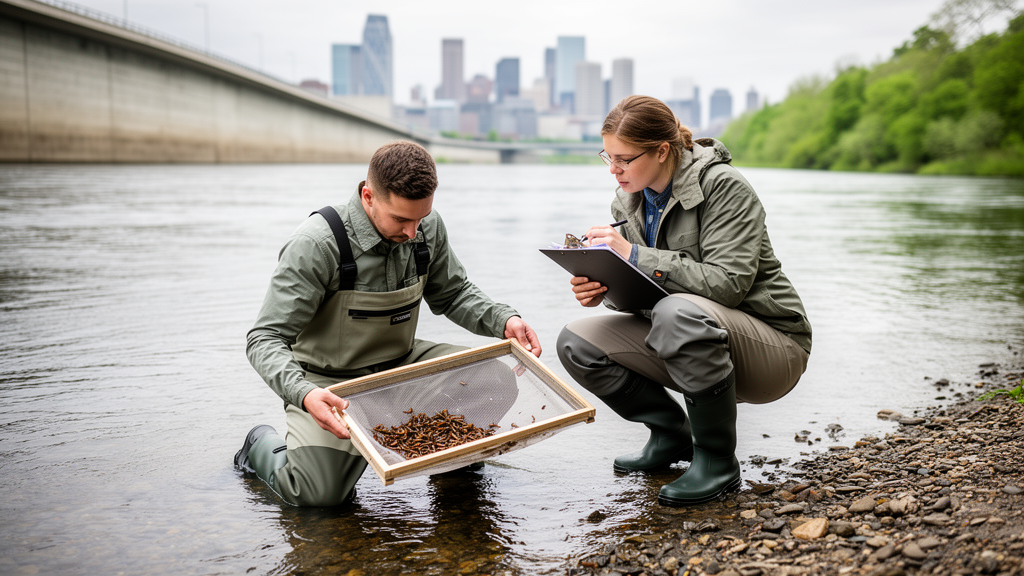
A sweeping survey of 385 river sites in Ningbo, a rapidly urbanizing coastal city in eastern China, has revealed how agricultural and urban land use reshapes the communities of freshwater macroinvertebrates living in the region’s rivers. The study, published in Ecology and Evolution, found that macroinvertebrate community composition differed significantly between sites classified as low- and high-disturbance, with disturbance level explaining 5.63 percent of the variation in community composition. The research also documented declines in functional diversity at heavily disturbed sites and traced the pathways through which land use appears to influence riverine biodiversity.
The survey covered 385 lotic river sites in Ningbo City, Zhejiang Province, on the southern edge of the Yangtze River Delta, and was carried out from May to June 2024. The region has undergone dramatic transformation over the past two decades, with its urbanization rate rising from 31.9 percent to 80.9 percent and its gross domestic product increasing roughly eightfold. The 385 sites spanned a wide range of land-use types, including forested, agricultural, and urban sites, representing a gradient of anthropogenic disturbance. Land-use data came from the GlobalLand30 dataset, which provides global land-cover information at a 30-meter spatial resolution; using ArcGIS, the researchers established a 1-kilometer circular buffer around each site and calculated the proportions of major land-use categories, including forest, urban, and agricultural land. The percentages of artificial surfaces and agricultural land were summed to represent anthropogenically influenced land use at each site; sites with a combined proportion below 50 percent were classified as low-disturbance and those at or above 50 percent as high-disturbance, an operational classification criterion rather than a universal ecological threshold.
At each site, macroinvertebrates were collected in triplicate using Surber nets at small-stream sites and hand-held nets at large-river sites, and the samples were combined into one composite sample per site. Samples were sieved through a 40-mesh screen and washed at the sampling site; specimens were sorted, fixed in 75 percent ethanol, and identified in the laboratory under a dissecting microscope to the lowest feasible taxonomic level, typically species. The census yielded organisms from 4 phyla, 8 classes, 24 orders, 91 families, and 211 species. Common orders included Mesogastropoda, Decapoda, Diptera, Ephemeroptera, Tubificida, and Odonata.
The environmental contrast between the two groups of sites was pronounced. High-disturbance reaches showed elevated nutrient and organic matter concentrations, with mean total nitrogen of 4.29 milligrams per liter, total phosphorus of 0.27 milligrams per liter, non-purgeable organic carbon of 18.31 milligrams per liter, and chemical oxygen demand of 4.55 milligrams per liter. Water temperature averaged 25.71 degrees Celsius and conductivity 450.86 microsiemens per centimeter at these sites. Low-disturbance reaches, by contrast, generally occurred at higher flow velocities of 0.24 meters per second and showed better water quality, with near-neutral pH of 7.34, higher dissolved oxygen of 9.72 milligrams per liter, and a markedly higher nitrogen-to-phosphorus ratio of 34.38. Forest cover peaked at low-disturbance sites, while agricultural land and impervious surfaces were higher in high-disturbance zones.
Community composition analysis using nonmetric multidimensional scaling showed a clear separation between low- and high-disturbance sites, with a stress value of 0.1895, within the generally acceptable range but close to its upper limit. Permutational multivariate analysis of variance confirmed the difference was statistically significant, with a p-value of 0.001. Species composition shifted in telling ways: low-disturbance sites were primarily composed of Mesogastropoda, Ephemeroptera, Decapoda, Diptera, and Odonata, whereas at high-disturbance sites Mesogastropoda dominated, followed by Decapoda, Diptera, and Tubificida. The proportion of pollution-sensitive taxa such as Ephemeroptera and Odonata decreased at high-disturbance sites, a pattern consistent with the replacement of disturbance-sensitive species by more tolerant ones described in the urban stream syndrome framework.
Functional feeding groups also shifted with disturbance. All five groups examined—filterers, gatherers, predators, scrapers, and shredders—differed significantly between the two site types. Filterers, gatherers, and predators were more abundant at low-disturbance sites, where stable hydrology, lower suspended sediment, continuous litterfall, and complex habitat structures such as rock piles and deadwood likely support their feeding strategies and prey resources. The authors suggest that nutrient enrichment from fertilization and sewage inputs may promote algal growth that favors scrapers, while crop debris and organic matter from sewage may provide resources for shredders.
Alpha diversity told a complementary story. Functional evenness was lower at high-disturbance sites, 0.409 versus 0.51, and functional richness was also lower, 4.108 versus 6.473, both differences significant at p below 0.001. The authors interpret the reduced functional richness as a contraction of functional niche space in highly disturbed reaches. Taxonomic richness also differed significantly between disturbance levels, although median values were similar between groups, indicating the difference was driven by the overall distribution of richness rather than a shift in its center. Taxonomic evenness showed a slightly higher median at high-disturbance sites, 0.796 versus 0.761, but the difference was not statistically significant, suggesting that intense environmental filtering may remove sensitive species and create gaps in functional space without necessarily making the remaining species uneven in abundance.
To probe potential pathways behind these patterns, the researchers used piecewise structural equation modeling linking agricultural and urban land-use proportions, three environmental variables retained after multicollinearity screening—pH, nitrate nitrogen, and non-purgeable organic carbon—and the four diversity metrics. The models showed that both urban and agricultural land use exerted significant negative direct effects on functional richness, functional evenness, and taxonomic richness, with urban land use having the strongest direct impact on taxonomic richness. Neither land-use type had a significant direct effect on taxonomic evenness. Indirect effects mediated by water quality were consistently weak across all models. Among the environmental variables, non-purgeable organic carbon showed a sustained and strong positive total effect on both functional and taxonomic richness, while nitrate nitrogen did not show significant direct associations with the diversity metrics within the environmental range observed. Taxonomic richness was the most responsive trait to land-use change, with an R-squared of 0.13, while taxonomic evenness was the least sensitive, at 0.03.
Because the study used observational data from a single seasonal survey, the authors caution that the structural equation model paths should be read as statistical associations and potential pathways rather than definitive causal effects. The dominance of direct over indirect pathways suggests that the measured physicochemical variables alone cannot fully explain the relationship between land use and biodiversity, pointing to unmeasured changes in habitat structure, channel morphology, riparian condition, and hydrological connectivity that commonly accompany agricultural and urban development. The positive association between organic carbon and richness, meanwhile, highlights the potential role of organic resource availability as a component of environmental filtering, since organic carbon fuels river food webs and supports detritivore and collector taxa. The authors also note that resistance and resilience were not directly measured in this spatial study, so interpretations about community recovery capacity remain potential implications rather than demonstrated outcomes.
The findings carry practical weight for river management and biomonitoring. The results suggest that taxonomic richness or evenness alone may not fully capture the ecological effects of intensified land use, because functional diversity and feeding-group composition reveal additional dimensions of community reorganization—particularly useful when changes in taxonomic richness are relatively limited. Combining taxonomic composition, functional diversity, and functional feeding groups within a multi-metric monitoring framework may therefore provide a more comprehensive assessment of ecological degradation and recovery. From a management perspective, the authors propose that maintaining riparian vegetation, organic-matter inputs, and habitat complexity from a watershed perspective may help sustain macroinvertebrate biodiversity in human-dominated river networks. They also call for future studies incorporating multi-seasonal, long-term, and multi-taxa monitoring to better capture how ecosystems respond to land-use-driven disturbance over time.
Subject of Research: Effects of urban and agricultural land use on macroinvertebrate community composition and diversity in a large Chinese river system
Article Title: Differential Impacts of Anthropogenic Disturbance on Community Composition and Alpha Diversity of Macroinvertebrates at a Large Urban River System
Article References: Bao, H., Lin, Z., Xia, Z., Zhang, M., Du, X., Oduro, C., Khan, S., & Wu, N. (2026). Differential Impacts of Anthropogenic Disturbance on Community Composition and Alpha Diversity of Macroinvertebrates at a Large Urban River System. Ecology and Evolution, 16(10), Article e74494. https://doi.org/10.1002/ece3.74494
Image Credits: AI Generated
DOI: 10.1002/ece3.74494
Keywords: macroinvertebrates, freshwater ecology, land use, urbanization, agriculture, functional diversity, taxonomic diversity, functional feeding groups, structural equation modeling, water quality, river ecosystems, Ningbo
News Source: Drew Townsend. (October 28, 2026). Differential Impacts of Anthropogenic Disturbance on Community Composition and Alpha Diversity of Macroinvertebrates at a Large Urban River System. Scienmag.