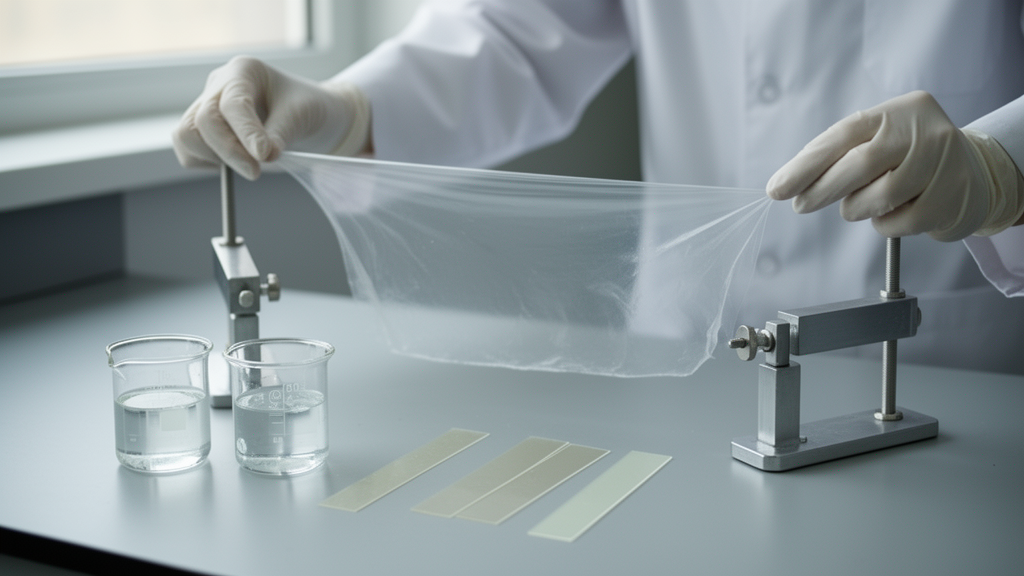
A careful sweep of glycerol concentrations has revealed a precise tipping point in chitosan-polyvinyl alcohol films, the biodegradable material candidates increasingly eyed for wound dressings, transdermal drug patches and sustainable packaging. Researchers prepared films with glycerol levels stepped from 1.0 to 3.0 millilitres while holding every other variable constant, and found that a modest 1.5 millilitre dose delivered the strongest, most stretchable and most moisture-resistant film of the entire series. Push beyond roughly 2.0 millilitres, however, and the plasticizer turns saboteur: tensile strength collapses, water uptake climbs steeply, and the film surface degrades into a patchwork of phase-separated domains.
The study, published in Discover Polymers, was designed to move beyond the qualitative treatment glycerol usually receives in the biopolymer literature. Only the glycerol volume changed, taking the values 1.0, 1.5, 2.0, 2.5 and 3.0 millilitres across five samples. Films were cast by pouring roughly 25 millilitres of the polymer mixture into petri dishes and drying for 24 hours under ambient conditions in a fume cupboard until peelable, mechanically stable membranes formed.
Characterisation combined Fourier transform infrared spectroscopy, scanning electron microscopy, thermogravimetric analysis, tensile testing, contact angle measurements, water uptake experiments and surface energy analysis. The FTIR spectra told a consistent story: a broad O-H stretching band between 3200 and 3500 wavenumbers grew in intensity with glycerol content, reflecting the three additional C-OH bonds each glycerol molecule contributes, while no new functional groups appeared anywhere in the fingerprint region. That absence is significant. It indicates glycerol does not chemically graft onto the polymer network but instead acts as a purely physical plasticizer, wedging itself between chitosan and PVA chains and disrupting the hydrogen bonds that lock them together. At the highest glycerol levels the O-H band broadened further, a signature of strengthened hydrogen bonding interactions and increased chain mobility; at the lowest levels the peaks sharpened, hinting at stiffer, less plasticized material.
Thermogravimetric analysis added a thermal dimension to the same narrative. The films degraded in three stages: moisture and volatile loss below 150 degrees Celsius, glycerol volatilization alongside chitosan backbone cleavage between roughly 180 and 320 degrees, and PVA chain scission with progressive oxidation and carbonization from about 320 to 450 degrees, leaving carbonaceous char above 400 degrees. Crucially, higher glycerol contents shifted the onset of decomposition to lower temperatures, a direct thermal fingerprint of plasticization. Glycerol molecules inserted between polymer chains weaken the intermolecular forces that stabilise the matrix, so the material begins to give way earlier under heat. The authors note that differential scanning calorimetry would be a useful follow-up to probe these thermal transitions in more detail.
The mechanical results were the sharpest of the study. The 1.0 millilitre film behaved like a brittle solid, with a tensile strength of about 1.9 newtons per square millimetre, a low elongation at break of roughly 0.45 strain and the highest Young’s modulus of the series, around 16.0 newtons per square millimetre, marking it as the stiffest sample. At 1.5 millilitres the picture flipped dramatically: tensile strength peaked at approximately 3.18 megapascals and elongation at break reached about 1.82, the highest ductility recorded. Beyond that optimum the material weakened steadily, with tensile strength falling to 0.89 at the 3.0 millilitre loading. The explanation follows directly from the hydrogen-bonding chemistry: chitosan contributes hydroxyl and amino groups, PVA and glycerol contribute abundant hydroxyls, and at moderate glycerol levels the small molecules occupy free volume while polymer chains retain enough cohesion. In excess, glycerol’s hydroxyls compete with and replace polymer-polymer hydrogen bonds with weaker polymer-glycerol contacts, raising free volume and chain mobility while destroying the efficiency of stress transfer through the network.
Scanning electron microscopy, performed on a Zeiss EVO-60 at 100 micrometre scale, visualised this structural transition stage by stage. The 1.0 millilitre film showed a uniform, dense, defect-poor surface consistent with tight chain packing. At 1.5 millilitres small micro-bubbles and dispersed pores signalled the earliest disruption of matrix uniformity. By 2.0 millilitres the surface displayed swirled patterns and visible heterogeneity, evidence of increased chain mobility and possible microphase separation. At 2.5 millilitres a granular, uneven texture emerged, with polymer-rich and polymer-poor regions indicating phase segregation, and at 3.0 millilitres the surface became dimpled and irregular, with inclusions and domain boundaries suggesting glycerol migration or microdroplet entrapment during drying. The microscopy independently confirmed the mechanical verdict: the 1.5 to 2.0 millilitre window produces the most structurally stable and uniform films.
Wettability measurements complicated any simple intuition that adding a hydrophilic plasticizer should make films more water-loving. Using a Krüss Drop Shape Analysis system with 2 microlitre droplets, the team recorded contact angles rising steadily from 112.0 degrees at 1.0 millilitre glycerol to 121.0 degrees at 3.0 millilitres, indicating enhanced surface hydrophobicity with increasing plasticizer. The authors attribute this to glycerol’s ability to reduce surface energy and allow molecular reorientation during drying, lowering the exposure of polar groups at the air-film interface. The improvement plateaued beyond 2.0 millilitres, and the high variability observed at 3.0 millilitres pointed to phase instability. Surface energy analysis using the Owens-Wendt method reinforced the trend: total solid-vapour surface energy peaked at 40.0 millijoules per square metre for the 1.5 millilitre film, then declined progressively to a minimum of 25.0 millijoules per square metre at 3.0 millilitres. The polar component was negligible across most formulations, with only the 1.0 millilitre sample showing a modest polar contribution of 0.2 millijoules per square metre, pointing to an increasingly nonpolar surface character as glycerol rises.
Water uptake told the opposite story at the bulk level, and revealed a non-linear relationship the authors link to anti-plasticization. Absorption fell to a minimum of 58.07 percent at 1.5 millilitres glycerol, a decline the team attributes to glycerol molecules occupying intermolecular free volume and promoting tighter chain packing that restricts water diffusion pathways, possibly with localized ordering or partial crystallinity. Beyond that dose the hygroscopic nature of glycerol took over: water absorption climbed to 72.82 percent at 2.0 millilitres, 73.93 percent at 2.5 millilitres and 81.60 percent at 3.0 millilitres, as excess plasticizer disrupted polymer packing, increased free volume and multiplied the hydroxyl groups available to bind and retain water. The contrast between rising surface hydrophobicity and rising bulk water uptake is one of the study’s most instructive tensions, showing that what happens at the air interface and what happens inside the matrix can move in opposite directions as composition changes.
Converging on the same composition from every direction, the data define a quantitative design window. The 1.5 millilitre film combined the highest tensile strength, the greatest elongation, the lowest water absorption and the highest surface energy of the series, while microscopy confirmed its surface as uniform and dense. Films at 2.5 to 3.0 millilitres, though mechanically weaker, offer higher hydrophobicity and potentially improved conformability, which the authors suggest could suit drug delivery patch applications where softness matters more than strength. The dominance of dispersive Lifshitz-van der Waals interactions across all formulations, with almost no acid-base character, suggests the films resist uptake of polar solvents, a property the researchers flag as favourable for stability in humid environments. The team proposes that intermediate glycerol levels of roughly 1.5 to 2.0 millilitres suit wound dressings, transdermal systems and biodegradable packaging where flexibility and moisture resistance must coexist, while future work with differential scanning calorimetry, long-term ageing tests, crosslinkers and multilayer architectures could map the wider composition space and push these biodegradable films toward demanding real-world use.
Subject of Research: How varying glycerol plasticizer content controls the mechanical, thermal, surface and moisture properties of chitosan-PVA composite films
Article Title: Effects of glycerol as a plasticiser on mechanical and physical properties of chitosan-PVA-glycerol films
Article References: Fatima, N., Hardege, J., Alsaffar, A. A. A., Ellis, B., Dabeer, A., & Dunstan, T. S. (2026). Effects of glycerol as a plasticiser on mechanical and physical properties of chitosan-PVA-glycerol films. Discover Polymers, 3(1), Article 25. https://doi.org/10.1007/s44347-026-00060-w
Image Credits: AI Generated
DOI: 10.1007/s44347-026-00060-w
Keywords: chitosan, polyvinyl alcohol, glycerol, plasticizer, biopolymer films, tensile strength, FTIR spectroscopy, scanning electron microscopy, water absorption, contact angle, surface energy, wound dressings
News Source: Bethany Barker. (October 28, 2026). Sweet Spot Found: Glycerol Dose Decides Strength of Chitosan-PVA Films. Scienmag.