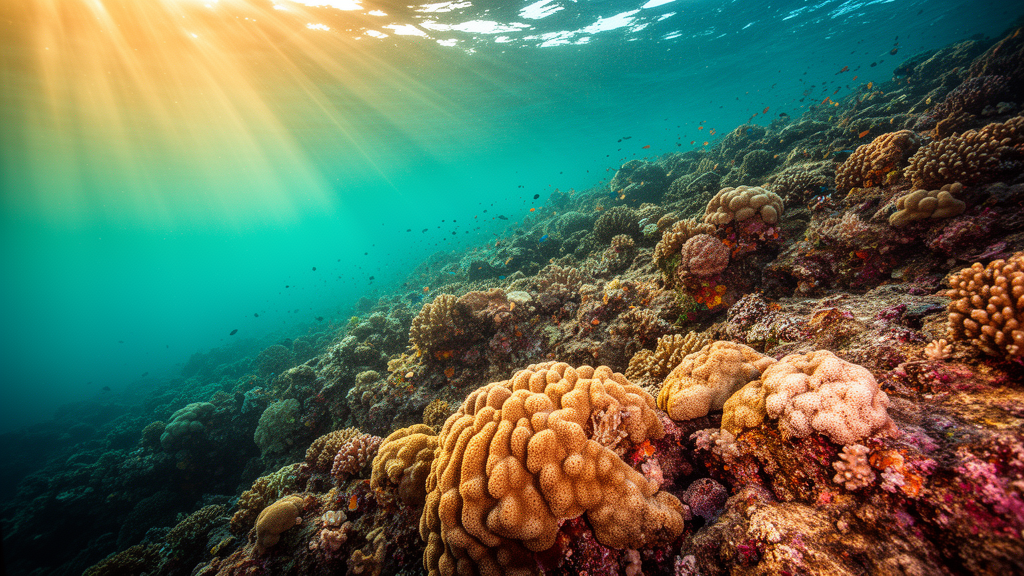
A seasonal survey of shallow-water benthic macrofauna at three sites along the Egyptian Red Sea coast has identified 2,942 individuals representing 60 species from seven phyla, and found that both the time of year and the location of sampling significantly shaped which animals were present and how many were counted. The study, published in BMC Marine Science, combined underwater visual censuses along line transects with simultaneous measurements of temperature, salinity, dissolved oxygen, total dissolved solids, and pH, and reported highly significant differences among seasons and sites for most taxonomic groups.
Surveys took place four times, in spring, summer, and autumn 2021 and winter 2022, with sampling dates spread across June, September, October, and February.
The field method was deliberately non-destructive. At each site, three replicate line transects, each 50 meters long and 2 meters wide, were laid parallel to the shoreline in the littoral zone at depths between 0.5 and 1.5 meters. Five one-square-meter quadrats were placed at 10-meter intervals along each transect, and all visible macrobenthic fauna were identified and counted in situ while snorkeling. Underwater photographs were taken to verify species identities and counts afterward, and no specimens were collected, a choice the authors made to avoid disturbing the habitat. Environmental parameters were measured with a calibrated multiprobe at three fixed points per transect and averaged to seasonal means.
Cnidaria and Mollusca emerged as the dominant groups across all sites and seasons. At NIOF, 1,034 individuals were recorded, with Cnidaria accounting for 36 percent and Mollusca 27 percent of the total, followed by Echinodermata at 22 percent and Porifera at 9 percent. Magawish yielded the highest overall count, 1,072 individuals, with Cnidaria reaching 41 percent and Mollusca 32 percent. El-Hamrawin recorded the fewest individuals, 836, with Cnidaria at 36 percent and Mollusca at 33 percent, and no Arthropoda recorded at that site. Each site returned 60 species, although El-Hamrawin spanned six phyla rather than seven.
Abundance followed a clear seasonal rhythm. At all three sites, the number of benthic individuals peaked in spring and fell to its lowest levels in winter. Molluscan assemblages showed a related but distinct pattern: species richness and Shannon–Wiener diversity generally rose from spring to maxima in summer and sometimes autumn, then declined markedly in winter, when both metrics reached their lowest values. Total abundance, by contrast, was consistently highest in spring at all sites and decreased through summer and autumn before reaching its minimum in winter.
Two-way analysis of variance confirmed that these patterns were statistically robust. Site differences were significant for Porifera, Cnidaria, Mollusca, Echinodermata, Annelida, and Arthropoda, with Bryozoa showing weaker site-related differences. Seasonal variation was significant for Cnidaria, Mollusca, Echinodermata, and Annelida, while Porifera and Arthropoda showed only marginal seasonal effects and Bryozoa none. Notably, no significant interaction between season and site was detected for any group, indicating that seasonal patterns were consistent across locations. The models explained a substantial share of the variation, with R-squared values ranging from 0.40 for Bryozoa to 0.79 for Cnidaria.
Canonical correspondence analysis linked the community patterns to specific environmental gradients. The first two canonical axes explained 59.8 percent and 94.5 percent of the variance in the species–environment relationship, with eigenvalues of 0.004 and 0.003. Temperature and salinity were the primary drivers of variation in community composition, strongly influencing Mollusca and Cnidaria, whereas Porifera and Echinodermata showed stronger associations with dissolved oxygen and total dissolved solids. The measured environmental values themselves varied spatially and seasonally: temperature at NIOF peaked at 29.53 degrees Celsius in summer, the highest salinity of 41.41 ppt was recorded at NIOF in spring, and dissolved oxygen reached its lowest mean of 7.33 ppm at NIOF in spring.
The three sites told notably different ecological stories. The authors characterized NIOF as mainly populated by Cnidaria and Mollusca with moderate representation of Echinodermata and Porifera, indicating a reef with diverse habitats. Magawish had the highest relative abundance of Cnidaria along with substantial numbers of Mollusca and Echinodermata, though human activity associated with the tourist village may have contributed to a slight decrease in Porifera. El-Hamrawin showed lower overall abundance and diversity, a pattern the authors attribute to stress from phosphate dust dispersal during shipping operations, which can reduce light penetration, alter sediment composition, and increase toxicity. The discussion notes that El-Hamrawin was dominated by tolerant species such as Capitella capitata and Cirratulus sp., which are indicators of organic pollution and sediment disturbance.
The authors also flagged an important methodological caveat. Because permanent quadrats or fixed transects were not verified during the field surveys, slight spatial variability in sampling locations across seasons may have contributed to the observed temporal patterns. This fine-scale patchiness could particularly affect recorded abundances of sessile organisms such as certain sponges and bryozoans, and the authors recommend that future monitoring programs use permanent markers to better separate true seasonal shifts from spatial variability. They further suggest that longer temporal scales, more detailed habitat assessments, and pollution source tracking would strengthen adaptive management along the coast.
The study’s broader significance lies in its demonstration that benthic macrofauna function as sensitive recorders of both natural seasonal variability and local human pressure. Because no significant season-by-site interaction was detected across the three studied sites, the results indicate that seasonal patterns in benthic abundance were consistent at these locations, while site-specific conditions, from a sheltered lagoon to an industrial harbor, were associated with differences in baseline abundance and diversity. The authors argue that incorporating benthic indicators into regular monitoring frameworks would improve environmental management in the Red Sea, where detailed seasonal studies of benthic macrofauna along the Egyptian coast have remained scarce despite the region’s ecological importance.
Subject of Research: Seasonal and spatial variation in benthic macrofaunal biodiversity at three sites along the Egyptian Red Sea coast
Article Title: Impact assessment of seasonal variations on the biodiversity of marine benthos from the Red Sea coast
Article References: Omer, M. Y., El-Sayed, M. F., Yousef, E. A., & Emam, B. M. (2026). Impact assessment of seasonal variations on the biodiversity of marine benthos from the Red Sea coast. BMC Marine Science, 1(1), Article 3. https://doi.org/10.1186/s44479-026-00001-4
Image Credits: AI Generated
DOI: 10.1186/s44479-026-00001-4
Keywords: Red Sea, benthic macrofauna, biodiversity, seasonal variation, Cnidaria, Mollusca, two-way ANOVA, canonical correspondence analysis, phosphate harbor, Egypt, marine monitoring, environmental factors
News Source: Margaret Porter. (October 28, 2026). Seasonal Shifts and Site Conditions Drive Red Sea Benthic Biodiversity Patterns. Scienmag.