Engineers have built a tracheal tube whose cuff can feel the wall of the airway it is meant to seal, and bench tests suggest the trick could one day help clinicians inflate the cuff to the right pressure for each patient rather than relying on a single number for everyone. The device, described in BMC Biomedical Engineering, embeds fibre Bragg grating optical sensors inside the cuff of a standard high-volume, low-pressure tube and reports when the cuff first presses against the tracheal wall.
The clinical problem the team set out to address is deceptively simple. Cuffed tracheal tubes secure the airway during mechanical ventilation, and the inflatable cuff is supposed to create a gas-tight seal while keeping secretions from the mouth and stomach out of the lungs. If the cuff is under-inflated, gas can leak and contaminated fluid can slip past it, raising the risk of ventilator-associated pneumonia. If it is over-inflated, the cuff squeezes the delicate tracheal mucosa, restricting blood flow and potentially causing inflammation, ulceration, scarring and tracheal stenosis, a particular concern for critically ill patients who remain intubated for long periods.
Current practice, the researchers note, is essentially one-size-fits-all: guidelines from bodies including the Royal College of Anaesthetists and the American Society of Anesthesiologists cap inflation pressure at 30 cmH2O for all adults. But intracuff pressure is only a surrogate for the actual contact pressure between cuff and trachea, and it can differ significantly between patients because it ignores cuff shape and volume variations. No existing commercial device, the authors say, uses sensors embedded within the cuff itself to indicate contact; devices such as the Venner PneuX and TRACOE smart Cuff Manager monitor pressure externally, and an earlier experimental approach attached an elastoresistive sensor to the outside of the cuff to detect tracheal rings without directly measuring contact.
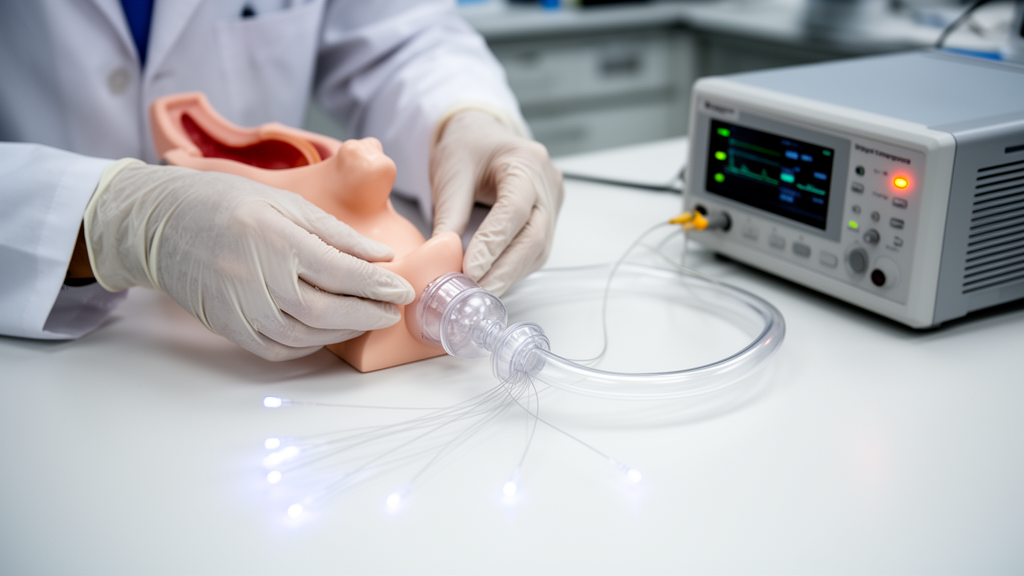
The new sensor is built around two fibre Bragg gratings, periodic patterns inscribed into single-mode optical fibres that reflect specific wavelengths of light. Each grating, 3 mm long with central wavelengths of 1540 and 1550 nm, was bonded with UV-cured medical adhesive onto opposite surfaces of a 3D-printed cantilever made from biocompatible resin. When pressure pushes on the cantilever, the upper fibre is stretched and the lower one compressed, shifting their reflected wavelengths in opposite directions. The fibres were pre-strained with a 50 g mass before curing to sharpen their response, then sheathed in protective tubing.
To turn the sensor into a working tube, the team threaded the optical fibres through the subglottic suction lumen of an 8 mm internal diameter tracheal tube, spliced them to connectorised pigtails, and glued the sensor holder, complete with its pressure pusher, to the inner surface of a size 8 high-volume low-pressure cuff just above the Murphy eye. The fibres exit proximally to an interrogation unit, so the whole assembly reads out from the top end of the tube. After fabrication the cuff was inflated to confirm it held pressure without leaking.
Testing then proceeded in three tiers of realism. Five cylindrical tracheal models with internal diameters from 15 to 26 mm, built to the ISO 5361:2023 standard, were joined by a bio-inspired model cast from PDMS gels using a CT scan of a non-pathological adult human trachea, complete with stiff C-shaped cartilage rings and a softer posterior trachealis wall tuned to reported tissue stiffnesses. Finally, three ex vivo tracheas from adult female Tamworth pigs, chosen for their anatomical similarity to human airways, were tested on both cartilage and muscle sides. In each contact test the cuff was inflated from zero to 100 cmH2O over about 30 seconds while the optical and manometer signals were recorded simultaneously.
The contact signature is a reversal in the FBG signal. Before contact, the cuff expands freely and the sensor signal moves with inflation; when the pusher meets the tracheal wall, the signal reverses direction, and the pressure at that moment is read from the synchronised manometer. Using this criterion, the device detected contact in every model and every ex vivo sample. The pressure at contact rose steadily with model diameter: essentially zero for the 15 mm model, where the cuff was already touching the wall on insertion, then 14.8, 27.2, 30.1 and 34.2 cmH2O for the 20, 22, 24 and 26 mm models respectively. The bio-inspired model contacted at about 20.5 cmH2O on both cartilage and muscle regions, with no statistically significant difference between them, though the signal shapes differed, with the compliant posterior wall producing only a brief reversal before the signal climbed again.
The decisive test was sealing. Following the leakage protocol of EN ISO 5361:2023, the team filled each model with distilled water held 5 cm above the cuff and weighed what leaked past over ten minutes, comparing a standard 27 cmH2O inflation with the contact-guided pressure for each model. In the two largest models the sensor-guided approach was dramatically better: leakage in the 24 mm model fell from 277 to 4 mL per hour, and in the 26 mm model from 4096 mL per hour, the worst of any model, to just 1 mL per hour at the 34 cmH2O contact-guided pressure. The 22 mm cylindrical model showed no significant difference, since its contact pressure coincided with the standard value. But in the smaller models the trend reversed: the 15 mm model leaked 859 versus 501 mL per hour and the 20 mm model 124 versus 39 mL per hour at contact-guided pressures, because the cuff, already cramped in the narrow lumen, folded as it inflated and the folds created leakage pathways. The bio-inspired model showed a slight increase in leakage at its contact-guided pressure, 150 versus 131 mL per hour.
The authors interpret these divergent results as a geometry problem rather than a sensor failure. In tracheas large enough for the cuff to expand uniformly, inflating until contact is detected yields a snug, even seal at the lowest pressure that achieves it. In narrow airways, the cuff cannot expand properly, folds over on itself, and the folds channel fluid past the seal regardless of how contact is detected. They suggest that the best future performance may come from combining contact sensing with a lower-volume cuff design, and that miniaturising the sensor would allow it to sit inside smaller cuffs with less influence on cuff mechanics. Placing sensors over both cartilage and muscle regions, they add, might even help assess tube positioning and orientation during intubation.
The team is careful about scope. This is bench testing: cylindrical phantoms, one bio-inspired model and three ex vivo porcine samples, with a single tube size, repeated measurements limited by tissue degradation in the biological samples, and greater signal variability in the ex vivo tracheas attributed to low mucosal friction that occasionally shifted the sensor pusher. No patient has been ventilated with the device. Still, the demonstration that embedded optical fibres can reliably flag the moment cuff meets airway wall, across rigid, anatomically realistic and biological models, lays the groundwork the authors say is needed before progression to in vivo use, and points toward a future in which cuff inflation is tailored to the individual airway rather than set by a single universal number.
Subject of Research: Bench testing of a tracheal tube with fibre Bragg grating sensors embedded in the cuff to detect cuff–trachea contact and guide cuff inflation pressure
Article Title: Bench testing a contact sensing tracheal tube for monitoring the cuff–trachea interface
Article References: Agbiki, T. B., Erdody, S., Correia, R., Korposh, S., Hewson, D. W., Norris, A. M., Hayes-Gill, B. R., & Morgan, S. P. (2026). Bench testing a contact sensing tracheal tube for monitoring the cuff–trachea interface. BMC Biomedical Engineering, 8(1), Article 10. https://doi.org/10.1186/s42490-026-00113-y
Image Credits: AI Generated
DOI: 10.1186/s42490-026-00113-y
Keywords: tracheal tube, endotracheal cuff, fibre Bragg grating, optical fibre sensors, mechanical ventilation, cuff pressure, airway seal, trachea models, bench testing, ventilator-associated pneumonia, biomedical engineering, contact sensing
News Source: Denise Maddox. (October 28, 2026). Optical fibre sensor inside tracheal tube cuff detects airway wall contact in bench tests. Scienmag.