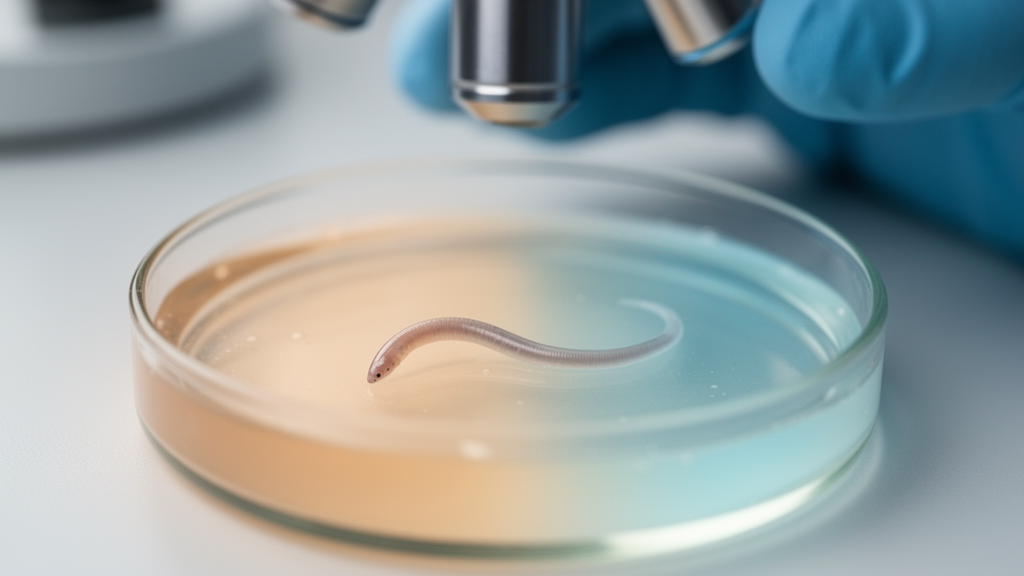
When a nematode crawls across a temperature gradient, it can hold a remarkably precise course along a single isotherm for several minutes, tracking the temperature at which it last encountered food. A new study published in EMBO Reports on 14 October 2026 identifies a molecular mechanism behind that persistence: GRK-1, the Caenorhabditis elegans homolog of the human GPCR kinase GRK5, acts in two premotor interneurons to keep the behavior running minute after minute even as the animal’s own movement constantly changes the sensory input it receives.
The research team, led by Tzu-Ting Huang, Shunji Nakano and colleagues with senior author Ikue Mori, used a customized Multi-Worm Tracker to follow roughly 100 to 150 worms simultaneously on a linear gradient of about 0.5 degrees Celsius per centimeter for a full hour. Isothermal tracking was defined as continuous forward movement within 25 degrees of an isothermal direction for more than 20 seconds, and the researchers quantified it as the fraction of total forward-moving time spent in such tracks. Well-fed wild-type animals cultivated at 20 degrees Celsius showed a significant increase in this fraction near their cultivation temperature after 20 minutes on the gradient, with no significant difference between the later time windows of the assay.
In a candidate screen for mutants with shortened isothermal tracking, the researchers found that loss of grk-1 produced exactly that phenotype. Both the grk-1(nj296) and grk-1(gk1192) large-deletion mutants showed a significant reduction in the fraction of isothermal tracking near the cultivation temperature, and their isothermal tracking bouts were significantly shorter than those of wild-type animals, with Kaplan-Meier survival analysis of bout durations yielding a p-value below 0.0001. The mutants also showed significantly greater dispersion from the cultivation temperature on the gradient than wild-type animals. The defect was reproduced when animals were cultivated at a lower temperature of 17 degrees Celsius and assayed on a correspondingly shifted gradient, indicating that grk-1 regulates isothermal tracking persistence across different cultivation temperatures.
Small deletions confined to the grk-1 kinase domain produced similar reductions in isothermal tracking fraction and bout durations, suggesting that the kinase domain of GRK-1 is important for maintaining the behavior. Interestingly, these small-deletion mutants did not show the increased dispersion from the cultivation temperature seen in the large-deletion mutants, hinting that different parts of the protein may contribute to different aspects of the phenotype.
The behavioral defect was not limited to the thermal environment. On a plate held at a constant 20 degrees Celsius with no gradient at all, grk-1 mutants showed higher frequencies of reversal turns and omega turns than wild-type animals in all moving directions, and they consistently displayed significantly shortened forward-run bouts. This mirrors the reduced isothermal tracking bout durations seen on the gradient, indicating that grk-1 maintains general forward-run persistence at the cultivation temperature. On the gradient itself, the mutants showed elevated reversal and omega turn frequencies only when moving in certain directions, and no significant difference in curving bias was detected, suggesting that the isothermal tracking phenotype does not reflect a failure of moment-by-moment steering.
To locate where grk-1 acts, the researchers first examined its expression pattern using a 3882-base-pair promoter fragment driving mCherry, which showed widespread expression in both neuronal and non-neuronal cells, including the thermosensory neurons AFD and AWC, the interneurons AIY and RIA, and the premotor interneurons RIM and AVA. Genetic experiments using a Cre-LoxP system showed that removing grk-1 specifically from all neurons phenocopied the null mutant’s reduced isothermal tracking fraction, and two independent pan-neuronal rescue lines fully restored the defect to wild-type levels. Neuronal grk-1 expression is therefore both required and sufficient. Cell-type-specific knockouts revealed that removing grk-1 from glutamatergic neurons, identified by the eat-4 promoter, reproduced the short isothermal tracking defect, whereas removal from cholinergic or GABAergic neurons did not.
Pinpointing the exact neurons required a series of rescue experiments. Expressing grk-1 in AFD, AWC, AIY and RIA together produced no rescue at all. Expression under the nmr-1 promoter, which drives expression in six premotor interneurons including AVA and RIM, significantly increased the isothermal tracking fraction compared with the null mutant. Using an FLP/FRT recombination strategy to restrict expression to subsets of these neurons, the researchers found that co-expression of grk-1 in RIM and AVA, but not in either neuron alone, fully rescued the short isothermal tracking defect. Because the tdc-1 promoter used in these experiments also drives expression in RIC, the authors note that a contribution from RIC cannot be formally excluded, although they did not detect RIC expression under the grk-1, nmr-1 or eat-4 promoters and consider it less likely that grk-1 in RIC significantly contributes.
The circuit-level logic emerged from silencing experiments. Recent work has shown that AVA sustains forward locomotion through tonic signaling while triggering reversals through phasic signaling, and that RIM lengthens forward runs when hyperpolarized. The researchers hypothesized that GRK-1 maintains a neuronal state in RIM and AVA that favors forward locomotion. Using a histamine-gated chloride channel with exogenous histamine applied to the assay plate, they simultaneously inhibited RIM and AVA. In wild-type animals, this inhibition did not further prolong isothermal tracking, suggesting these interneurons are already in a suppressed state during normal isothermal tracking. In the grk-1 null mutant, however, simultaneous inhibition significantly increased the isothermal tracking fraction and the durations of isothermal tracking and forward-run bouts, restoring the defect. Together with the rescue results, this suggests that grk-1 acts cell-autonomously to maintain isothermal tracking while RIM and AVA normally remain suppressed.
Calcium imaging of RIM in immobilized animals exposed to programmed temperature profiles added nuance. Under oscillating temperatures simulating head swinging near the cultivation temperature, no clear temperature-evoked RIM activation or genotype differences were observed. Under a warming program from 17 to 20 degrees Celsius, RIM activity was suppressed in both wild-type and mutant animals as temperature approached the cultivation temperature, indicating that grk-1 does not modulate this suppression. Under a cooling program from 23 to 20 degrees Celsius, however, RIM in the grk-1 mutant showed more frequent neuronal activation than in wild-type animals, suggesting that loss of grk-1 alters RIM excitability under that specific thermal condition. The authors caution that these results do not directly support a simple model in which GRK-1 directly inhibits RIM activity during isothermal tracking, and they propose that future closed-loop optogenetic experiments during ongoing behavior will help clarify how RIM and AVA states actively maintain or terminate isothermal tracking bouts.
The study builds on earlier circuit analyses showing that genetic ablation or acute inhibition of either RIM or AVA alone does not markedly impair isothermal tracking near the cultivation temperature, and that ablation of the interneuron AIB, which is presynaptic to both, increases the isothermal tracking fraction. The authors propose a model in which RIM and AVA are maintained in a suppressed state during normal isothermal tracking, likely through signals from AIB, and this suppressed state requires active GRK-1 function in both neurons to favor forward runs once initiated along isothermal directions. GPCR kinases are best known for phosphorylating activated GPCRs, leading to receptor trafficking, signaling attenuation or desensitization, but how they contribute to sustained behaviors has remained elusive. By identifying a previously unknown role for a GPCR kinase in sustaining forward locomotion, the work offers a molecule-to-circuit account of how a nervous system stabilizes a behavioral state over time. The authors also note that isothermal tracking near the cultivation temperature has been observed in multiple wild isolates of C. briggsae, a species that diverged from C. elegans roughly 20 million years ago, providing a comparative foundation for exploring how such thermosensory circuits evolved.
Subject of Research: A GPCR kinase in C. elegans that sustains minute-scale isothermal tracking behavior through RIM and AVA interneurons.
Article Title: C. elegans GPCR kinase GRK-1 maintains behavioral persistence in a dynamic thermal environment
Article References: Huang, T.-T., Nakano, S., Lukova, M., Matsuyama, H. J., Cesar, L. C., Tsukada, Y., & Mori, I. (2026). C. elegans GPCR kinase GRK-1 maintains behavioral persistence in a dynamic thermal environment. EMBO Reports. https://doi.org/10.1038/s44319-026-00926-x
Image Credits: AI Generated
DOI: 10.1038/s44319-026-00926-x
Keywords: C. elegans, GRK-1, GRK5, isothermal tracking, thermotaxis, RIM interneuron, AVA interneuron, GPCR kinase, behavioral persistence, neural circuits, calcium imaging, temperature gradient
News Source: Drew Townsend. (October 28, 2026). Worm kinase keeps a temperature-tracking behavior running for minutes on end. Scienmag.