Charcoal does not simply sit inertly in soils and rivers. The speed at which these molecules pass electrons back and forth rises dramatically with the temperature at which the original biomass was charred, and the molecular structures responsible for that speed have now been identified in detail.
From each of the ten biochar samples they extracted dissolved black carbon and measured its apparent electron transfer rate constant, abbreviated k0, using cyclic voltammetry in a three-electrode system. This kinetic parameter, which prior studies of dissolved black carbon had largely neglected in favor of thermodynamic capacity measures, describes how rapidly a substance undergoes redox cycling and exchanges electrons with partners such as microorganisms, contaminants, or electrode surfaces.
For dissolved black carbon derived from rice straw, the k0 value rose from about 0.54 × 10⁻⁷ centimeters per second at 200 degrees Celsius to about 1.13 × 10⁻² centimeters per second at 600 degrees Celsius—an increase of roughly 200,000-fold. Sawdust-derived samples showed the same direction of change, climbing from about 1.05 × 10⁻⁴ to 6.18 × 10⁻² centimeters per second, an approximately 500-fold increase. The logarithm of k0 correlated linearly with pyrolysis temperature for both feedstocks, with correlation coefficients of 0.97 and P values below 0.001. At medium and high charring temperatures, the measured rate constants far exceeded those of natural dissolved organic matter collected from wetlands, soils, rivers, and lakes.
Feedstock mattered as well. At any given pyrolysis temperature, dissolved black carbon from sawdust—a woody material—generally showed larger k0 values and higher electrochemical activity per unit of organic carbon than the herbaceous rice straw material. The authors conclude that dissolved black carbon derived from herbaceous plants is less efficient at shuttling electrons than material derived from woody plants, a distinction with implications for how post-fire landscapes cycle carbon and nutrients.
Why does hotter charring produce a better electron shuttle? The answer lies in what the heat does to the organic molecules. As pyrolysis temperature increased, the molecular makeup of the dissolved black carbon shifted markedly, as revealed by Fourier transform ion cyclotron resonance mass spectrometry. In the rice straw samples, the relative intensity of condensed aromatic compounds rose from 0.75 percent at 200 degrees Celsius to 55.20 percent at 600 degrees Celsius, while tannin-like compounds climbed from 7.53 percent to 31.59 percent. Lignin-like compounds, by contrast, declined sharply with temperature. The same pattern appeared in the sawdust samples, where condensed aromatic compounds rose from 0.73 percent to 33.37 percent and tannin-like compounds from 0.79 percent to 19.97 percent.
Statistical analysis tied these compositional shifts directly to electron transfer kinetics. The logarithm of k0 correlated positively with the relative intensities of CHNOS compounds, condensed aromatic compounds, and tannin-like compounds, and negatively with molecular number, mass-to-charge ratio, oxygen content, and the relative intensity of lignin-like molecules. Among the most strongly correlated molecules, 20 of 30 positively correlated compounds were condensed aromatic structures and 9 were tannin-like, while all 35 negatively correlated molecules were lignin-like. The researchers attribute the enhancing effect of condensed aromatic and tannin-like structures to their extensive conjugated π-electron systems and redox-active groups such as quinones and phenols, which readily donate and accept electrons. Lignin-like molecules, built from highly substituted phenylpropane units, have saturated propyl chains that physically interrupt π-electron conjugation between benzene rings, hindering electron delocalization and slowing transfer.
The team went beyond correlation and ran a direct experimental test. Adding tannic acid to low-temperature samples increased the tannin-like fraction of the rice straw material from 7.53 percent to 63.81 percent and of the sawdust material from 0.79 percent to 68.39 percent, and k0 rose significantly in both cases—from 0.54 × 10⁻⁷ to 14.12 × 10⁻⁷ centimeters per second for the rice straw sample and from 1.05 × 10⁻⁴ to 2.52 × 10⁻⁴ centimeters per second for the sawdust sample. Conversely, adding lignin to medium-temperature samples reduced k0, from 3.23 × 10⁻³ to 0.12 × 10⁻³ centimeters per second for the rice straw sample and from 15.90 × 10⁻³ to 2.25 × 10⁻³ centimeters per second for the sawdust sample. The authors note a key limitation: the added compounds behave as physical mixtures, so the observed changes may partly reflect the additives acting as independent electron shuttles alongside the dissolved black carbon rather than alterations to its intrinsic structure. Even so, they argue, in a complex mixture the contribution of tannin-like and lignin-like molecules to overall electron shuttling holds regardless of whether they are covalently integrated into the dissolved black carbon or present as discrete entities.
Diffusion emerged as a second, previously unquantified control on shuttling speed. Particle size analysis showed that average particle diameters fell from 133.9 nanometers to 12.3 nanometers for rice straw material and from 331.9 nanometers to 12.4 nanometers for sawdust material as pyrolysis temperature rose from 200 to 600 degrees Celsius. The apparent diffusion coefficient increased correspondingly, and the logarithm of k0 correlated strongly with the logarithm of the diffusion coefficient for both feedstocks, with correlation coefficients of 0.96 and 0.97. Filtering out large particles above 220 nanometers from one sample raised its k0, while samples already below that size showed no change. The electron shuttle ability of dissolved black carbon, the study concludes, is governed jointly by its redox activity and its diffusivity. The authors also caution that calcium and magnesium ions, which are more abundant in natural waters than in these solutions, can promote aggregation through cation bridging and charge screening, so diffusion and shuttling ability may need re-evaluation under realistic environmental chemistry.
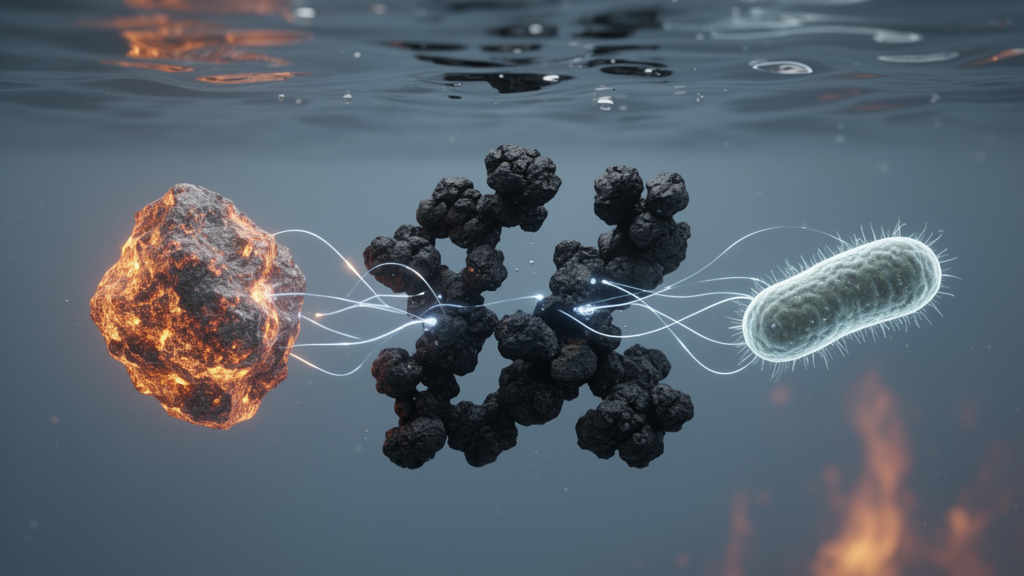
The kinetic measurements also proved functionally meaningful in a biological context. In anaerobic three-electrode systems containing the metal-reducing bacterium Shewanella oneidensis MR-1, both peak currents and steady currents increased with the pyrolysis temperature of the added dissolved black carbon, and both correlated linearly with the logarithm of k0, with correlation coefficients between 0.76 and 0.89. This indicates that the logarithm of k0 can accurately characterize how strongly dissolved black carbon enhances microbial extracellular electron transfer—the process by which such shuttles facilitate reactions including microbial iron reduction, pollutant degradation, and electron transfer between bacteria and methanogens.
The compositional contrast with natural dissolved organic matter explains why charred material is such a potent shuttle. Natural dissolved organic matter from soils, rivers, and lakes is dominated by lignin-like compounds, which make up 59.64 to 77.33 percent of relative intensity, while tannin-like and condensed aromatic compounds each generally fall below 10 percent. Medium- and high-temperature dissolved black carbon shows the opposite profile: low lignin-like content and high levels of tannin-like and condensed aromatic compounds. Because electron exchange capacities alone do not capture reaction rates, the authors argue that the apparent electron transfer rate constant offers a more dynamic and more easily measured description of shuttling ability. As wildfires intensify under global warming and dissolved black carbon fluxes—already roughly 10 percent of the dissolved organic matter exported by rivers to the ocean—grow, the study suggests that accurately assessing its environmental impact will require attention to both the temperature and the feedstock of the char that produced it.
Subject of Research: Electron transfer kinetics and molecular structural basis of dissolved black carbon as an electron shuttle
Article Title: Electron transfer kinetics and molecular structural basis of dissolved black carbon as an electron shuttle
Article References: Wu, Y., Zhang, P., Li, H., He, T., Tao, W., Chang, Z., & Pan, B. (2026). Electron transfer kinetics and molecular structural basis of dissolved black carbon as an electron shuttle. Carbon Research, 5(1), Article 56. https://doi.org/10.1007/s44246-026-00299-9
Image Credits: AI Generated
DOI: 10.1007/s44246-026-00299-9
Keywords: dissolved black carbon, electron shuttle, electron transfer kinetics, biochar, pyrolysis temperature, condensed aromatic compounds, tannin-like molecules, lignin-like molecules, FT-ICR mass spectrometry, Shewanella oneidensis, diffusion, natural dissolved organic matter
News Source: Bethany Barker. (October 28, 2026). How hot the fire was decides how fast dissolved black carbon shuttles electrons. Scienmag.