• HOME
  • NEWS
  • EXPLORE
    • CAREER
      • Companies
      • Jobs
    • EVENTS
    • iGEM
      • News
      • Team
    • PHOTOS
    • VIDEO
    • WIKI
  • BLOG
  • COMMUNITY
    • FACEBOOK
    • INSTAGRAM
    • TWITTER
Thursday, October 29, 2026
BIOENGINEER.ORG
No Result
View All Result
  • Login
  • HOME
  • NEWS
  • EXPLORE
    • CAREER
      • Companies
      • Jobs
        • Lecturer
        • PhD Studentship
        • Postdoc
        • Research Assistant
    • EVENTS
    • iGEM
      • News
      • Team
    • PHOTOS
    • VIDEO
    • WIKI
  • BLOG
  • COMMUNITY
    • FACEBOOK
    • INSTAGRAM
    • TWITTER
No Result
View All Result
Bioengineer.org
No Result
View All Result
Home NEWS Science News Technology

Comparing methods for predicting missing links in email and covert networks

by
October 28, 2026
in Technology
Reading Time: 2 mins read
0
Comparing methods for predicting missing links in email and covert networks

Comparing methods for predicting missing links in email and covert networks

Share on FacebookShare on TwitterShare on LinkedinShare on RedditShare on Telegram

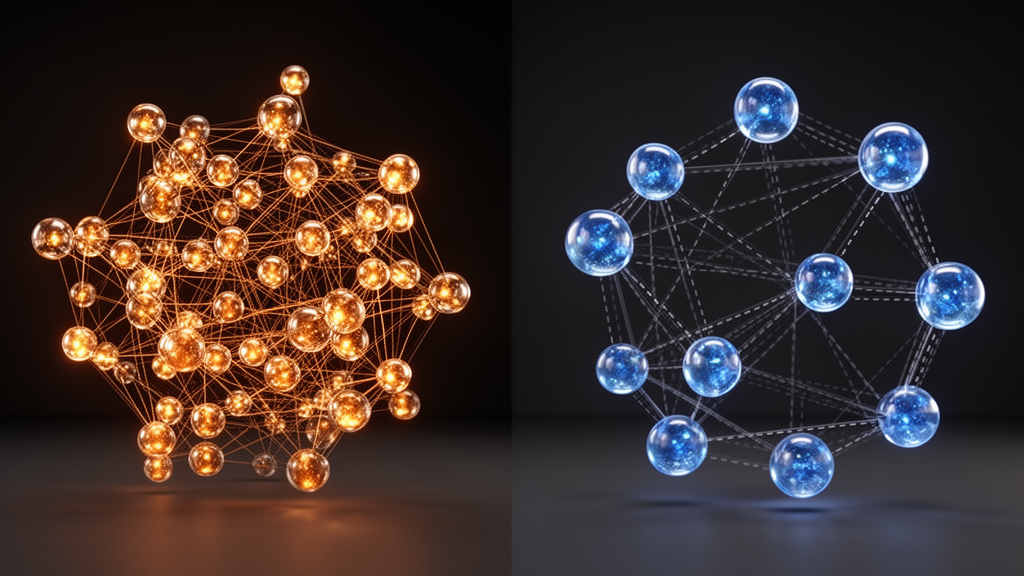
Networks are rarely observed in full. When some connections between people or organisations go unrecorded, researchers must infer them from the incomplete graph that remains. A new study in EPJ Data Science systematically compares three families of methods for this task of missing-link inference: dyadic link prediction, hyperlink prediction, and estimation of exponential random graph models (ERGMs), evaluated across public email and covert-network datasets.

Link prediction serves as the primary baseline in the evaluation. It relies on classical heuristics computed directly on the observed graph to score which unobserved dyadic ties are most likely to exist. Hyperlink prediction extends this framework to higher-order structures: instead of considering only pairs of nodes, it scores candidate higher-order group structures such as cliques. This is done in two ways, by lifting dyadic scores to the higher-order level and through a dedicated method called the CHEbyshev Spectral HyperlInk pREdictor, or CHESHIRE.

To make the comparison fair, all methods are assessed under a common masking protocol. The protocol removes dyadic evidence induced by held-out hyperlinks, so that each method faces the same partially observed network and the results remain comparable across approaches and datasets.

The findings draw a clear division of labour. For recovering missing dyadic links, classical link prediction remains strong across the public email and covert-network data. When the inferential target is higher-order group structure rather than individual ties, hyperlink prediction provides gains, with CHESHIRE performing particularly well in that setting. ERGMs offer a complementary route: because they are estimated statistical models of network dependence, they can express the probability of a tie conditional on the rest of the observed network, giving an interpretable benchmark grounded in dependence assumptions.

The study’s contribution is a comparative, reproducible evaluation that clarifies when each of the three approaches is most appropriate under network missingness. Rather than crowning a single winner, it shows that the right choice depends on the inferential target: dyadic recovery, higher-order group structure, or interpretable conditional tie probabilities. For analysts working with incomplete social, communication or covert networks, the results provide a practical guide to matching method to task.

Subject of Research: Comparative evaluation of link prediction, hyperlink prediction and ERGM estimation for missing-link inference in partially observed networks

Article Title: Missing links in public email and covert networks: a comparative evaluation of link prediction, hyperlink prediction, and ERGM estimation

Article References: Boudourides, M. (2026). Missing links in public email and covert networks: a comparative evaluation of link prediction, hyperlink prediction, and ERGM estimation. EPJ Data Science. https://doi.org/10.1140/epjds/s13688-026-00708-4

Image Credits: AI Generated

DOI: 10.1140/epjds/s13688-026-00708-4

Keywords: link prediction, hyperlink prediction, ERGM, network missingness, higher-order networks, CHESHIRE, covert networks, email networks, cliques, network inference, Missing, links

News Source: Denise Maddox. (October 28, 2026). Comparing methods for predicting missing links in email and covert networks. Scienmag.


Tags: CHESHIREcliquescovert networksemail networksERGMhigher-order networkshyperlink predictionlink predictionlinksmissingnetwork inferencenetwork missingness
Share12Tweet7Share2ShareShareShare1

Related Posts

Nanoparticles Move From Lab to Field as Agriculture Seeks Precision Tools

Nanoparticles Move From Lab to Field as Agriculture Seeks Precision Tools

October 29, 2026
Three-Branch AI Fusion Reaches 99.3% Accuracy in White Blood Cell Classification

Three-Branch AI Fusion Reaches 99.3% Accuracy in White Blood Cell Classification

October 29, 2026

Research report: The Hidden Cost of Reproducibility: Commercial Software Dependency in Published Research and the Version Accessibility Gap

October 29, 2026

Circular Hydroponics Framework Aims to Turn Farm Waste into Closed-Loop Resources

October 29, 2026

POPULAR NEWS

  • Terbium-161 Shows Dose-Dependent Edge Over Lutetium-177 in Mouse Neuroendocrine Tumor Model

    Terbium-161 Shows Dose-Dependent Edge Over Lutetium-177 in Mouse Neuroendocrine Tumor Model

    29 shares
    Share 12 Tweet 7
  • Gas Drainage Lags Pressure Relief by 151.6 Metres in Deep Protective Seam Mining

    29 shares
    Share 12 Tweet 7
  • African Wild Lettuce Shows Anticancer Activity in Lab Studies, Review Finds

    29 shares
    Share 12 Tweet 7
  • SLC7A5 emerges as a central player in cancer amino acid metabolism

    29 shares
    Share 12 Tweet 7

About

We bring you the latest biotechnology news from best research centers and universities around the world. Check our website.

Follow us

Recent News

Nanoparticles Move From Lab to Field as Agriculture Seeks Precision Tools

Three-Branch AI Fusion Reaches 99.3% Accuracy in White Blood Cell Classification

Research report: The Hidden Cost of Reproducibility: Commercial Software Dependency in Published Research and the Version Accessibility Gap

Subscribe to Blog via Email

Enter your email address to subscribe to this blog and receive notifications of new posts by email.

Join 85 other subscribers
  • Contact Us

Bioengineer.org © Copyright 2023 All Rights Reserved.

Welcome Back!

Login to your account below

Forgotten Password?

Retrieve your password

Please enter your username or email address to reset your password.

Log In
No Result
View All Result
  • Homepages
    • Home Page 1
    • Home Page 2
  • News
  • National
  • Business
  • Health
  • Lifestyle
  • Science

Bioengineer.org © Copyright 2023 All Rights Reserved.