


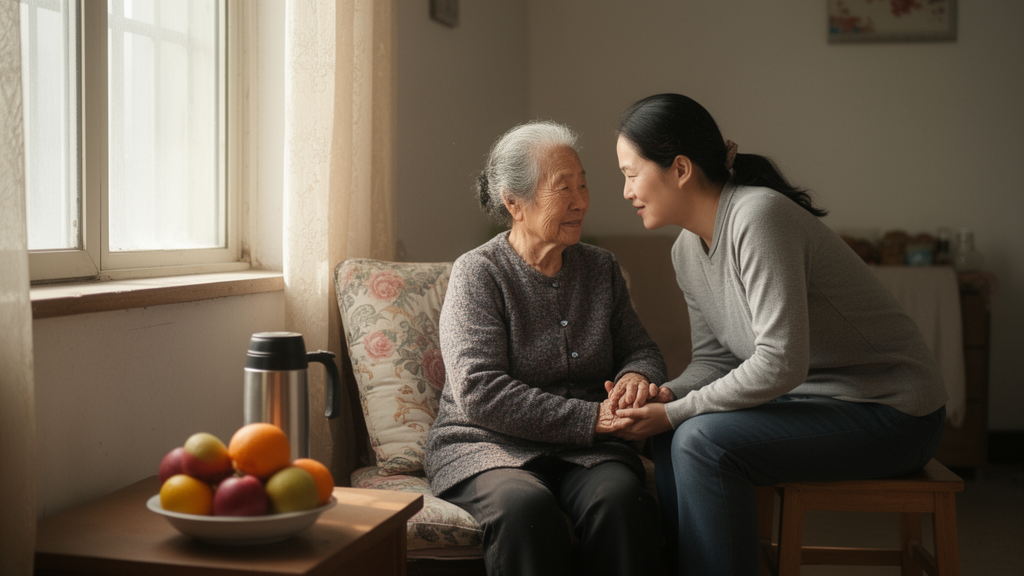
Older adults living with chronic diseases who describe their families as cohesive and adaptable tend to hold more positive expectations about what a good death looks like, according to a cross-sectional study of 300 community-dwelling people aged 60 and over in China. The research, published in Frontiers in Public Health, also found that the way these older adults perceive their illnesses—their sense of threat, emotional response, and understanding of their conditions—appeared to account for roughly a quarter of that association, acting as a statistical bridge between family life and end-of-life outlook.
The study was conducted between November 2025 and March 2026 at three community health centers in a single Chinese city, which the authors anonymized as X City. Using convenience sampling, research assistants approached potential participants during routine health visits or community health promotion activities. To be eligible, individuals had to be at least 60 years old, carry a physician-confirmed diagnosis of at least one chronic disease such as hypertension, diabetes, or coronary heart disease, and be able to communicate normally. People with severe organ failure or terminal illness, significant cognitive impairment defined as a Mini-Mental State Examination score below 24, severe mental illness, or major negative life events within the previous six months were excluded. Of 312 questionnaires distributed, 300 valid responses were returned, a valid response rate of 96.15 percent.
Three validated instruments anchored the measurements. Family functioning was assessed with the Family Adaptability and Cohesion Evaluation Scales, a 30-item measure covering cohesion and adaptability that was adapted for Chinese populations; its Cronbach’s alpha in this sample was 0.934. Illness perception was measured with the Brief Illness Perception Questionnaire, nine items spanning cognitive representations, emotional representations, and illness comprehensibility, scored so that higher totals indicate greater perceived threat from illness; alpha was 0.734. Good death expectations were captured with the Good Death Expectation Scale developed by Chen, a 31-item instrument spanning six dimensions: psychological and spiritual support, autonomy, respect, social support, healthcare system support, and physical comfort; alpha was 0.960. Trained researchers read questions aloud for participants with lower literacy and checked missing or inconsistent items on site.
The descriptive picture showed mean scores of 102.62 for family functioning, 22.41 for illness perception, and 125.06 for good death expectations. Within the good death expectations scale, the autonomy dimension registered the lowest mean, 12.03, which the authors interpreted as suggesting limited perceived control over end-of-life decisions. Within the illness perception measure, the comprehensibility dimension was lowest at 2.21, pointing to limited understanding of participants’ own conditions, while the emotional representation dimension averaged 5.77.
The core correlational findings were straightforward. Family functioning was positively correlated with good death expectations, with a Pearson coefficient of 0.561, and negatively correlated with illness perception at −0.482. Illness perception itself was negatively correlated with good death expectations at −0.506. All three correlations were statistically significant at p < 0.01. In plain terms, older adults who reported stronger family cohesion and adaptability tended to view their illnesses as less threatening and to describe richer, more positive expectations for their eventual deaths, while those who perceived their illnesses as more threatening tended to report weaker good death expectations.
The mediation analysis went a step further. Using the PROCESS macro with bias-corrected bootstrapping over 5,000 resamples, and adjusting for gender, age group, marital status, education level, living arrangements, number of chronic diseases, hospitalization frequency, and knowledge of chronic diseases, the researchers estimated a total effect of family functioning on good death expectations of 0.5043. The direct effect was 0.3726, and the indirect effect running through illness perception was 0.1317, with a 95 percent confidence interval of 0.0804 to 0.1912 that excludes zero. That indirect pathway accounted for 26.12 percent of the total effect, and the overall model explained 44.3 percent of the variance in good death expectations. All coefficients were unstandardized.
The theoretical scaffolding comes from Leventhal’s Common-Sense Model of self-regulation, which holds that people form cognitive and emotional representations of illness that shape their coping and health outcomes, and that these representations are influenced by inputs from the social environment, including family feedback. The authors reasoned that cohesive family functioning might reduce negative illness perceptions—feelings of high threat or uncontrollability—which in turn could allow older adults to engage in future-oriented thinking and develop more positive expectations about dying well. They selected illness perception as the mediator because of its theoretical position as the most proximal cognitive pathway linking contextual inputs to health expectations within that framework.
The authors themselves are careful about what the design can and cannot show. Because the data are cross-sectional, the mediation analysis is exploratory and cannot establish causality; reverse directionality remains possible, since older adults with more positive death expectations might perceive their illnesses as less threatening and their families as more supportive rather than the other way around. Unmeasured third variables such as dispositional optimism, spiritual beliefs, or prior family experiences with end-of-life care could underlie all three constructs. Convenience sampling from three communities in one city limits generalizability, self-report measures invite social desirability and common method bias, and clinical variables such as disease severity, functional status, and depression were not controlled. Cultural factors, including Chinese taboos around death and Confucian filial piety, may also have shaped responses and restrict cross-cultural transferability. The authors note that roughly 55.7 percent of the variance in good death expectations remains unexplained and describe the findings as hypothesis-generating.
Subgroup analyses added texture to the picture. Good death expectations differed significantly by gender, age group, marital status, education level, living arrangements, number of chronic diseases, hospitalization frequency, and knowledge of chronic diseases, with men, married participants, those with at least elementary schooling, and those living with family in urban areas scoring higher on average. Participants living alone in rural areas had the lowest mean score at 111.57, and those aged 80 and over scored lower than younger groups. No significant differences emerged for primary caregiver type, self-rated health, medical payment method, source of income, or awareness of advance directives.
For now, the practical takeaway is modest and appropriately hedged. The authors suggest that nursing assessments for this population might reasonably include attention to patients’ emotional responses to illness, and that community health education could integrate good death concepts into chronic disease management through family meetings and advance directive promotion. Cognitive-behavioral approaches and motivational interviewing, which have shown efficacy in modifying illness perceptions in other chronic disease populations, are flagged as candidates for future investigation rather than recommendations. The authors call for longitudinal and intervention studies to test whether the hypothesized pathway—family support, cognitive management of illness perceptions, and end-of-life expectations—holds up under designs that can establish temporal precedence. Until such studies are done, the association between warm family functioning, calmer illness perceptions, and more hopeful visions of a good death remains an intriguing correlation, not a prescription.
Subject of Research: Cross-sectional research on how family functioning and illness perception relate to good death expectations among community-dwelling older adults with chronic diseases in China
Article Title: The association between illness perception and family functioning with good death expectations in community-dwelling older adults with chronic diseases
Article References: Liang, Y., & Wang, Y. (2026). The association between illness perception and family functioning with good death expectations in community-dwelling older adults with chronic diseases. Frontiers in Public Health, 14, 2001715. https://doi.org/10.3389/fpubh.2026.2001715
Image Credits: AI Generated
DOI: 10.3389/fpubh.2026.2001715
Keywords: good death expectations, family functioning, illness perception, older adults, chronic disease, cross-sectional study, mediation analysis, community health, end-of-life care, China, public health, psychology
News Source: Glenn Wilkins. (October 28, 2026). Family Ties and Death Expectations: How Illness Views Shape End-of-Life Hopes in Older Chinese Adults. Scienmag.



