

• HOME
  • NEWS
  • EXPLORE
    • CAREER
      • Companies
      • Jobs
    • EVENTS
    • iGEM
      • News
      • Team
    • PHOTOS
    • VIDEO
    • WIKI
  • BLOG
  • COMMUNITY
    • FACEBOOK
    • INSTAGRAM
    • TWITTER
Thursday, October 29, 2026
BIOENGINEER.ORG
No Result
View All Result
  • Login
  • HOME
  • NEWS
  • EXPLORE
    • CAREER
      • Companies
      • Jobs
        • Lecturer
        • PhD Studentship
        • Postdoc
        • Research Assistant
    • EVENTS
    • iGEM
      • News
      • Team
    • PHOTOS
    • VIDEO
    • WIKI
  • BLOG
  • COMMUNITY
    • FACEBOOK
    • INSTAGRAM
    • TWITTER
No Result
View All Result
Bioengineer.org
No Result
View All Result
Home NEWS Science News Technology

Physics-informed AI extracts concrete fracture parameters from stress images

by
October 28, 2026
in Technology
Reading Time: 2 mins read
0
Physics-informed AI extracts concrete fracture parameters from stress images

Physics-informed AI extracts concrete fracture parameters from stress images

Share on FacebookShare on TwitterShare on LinkedinShare on RedditShare on Telegram

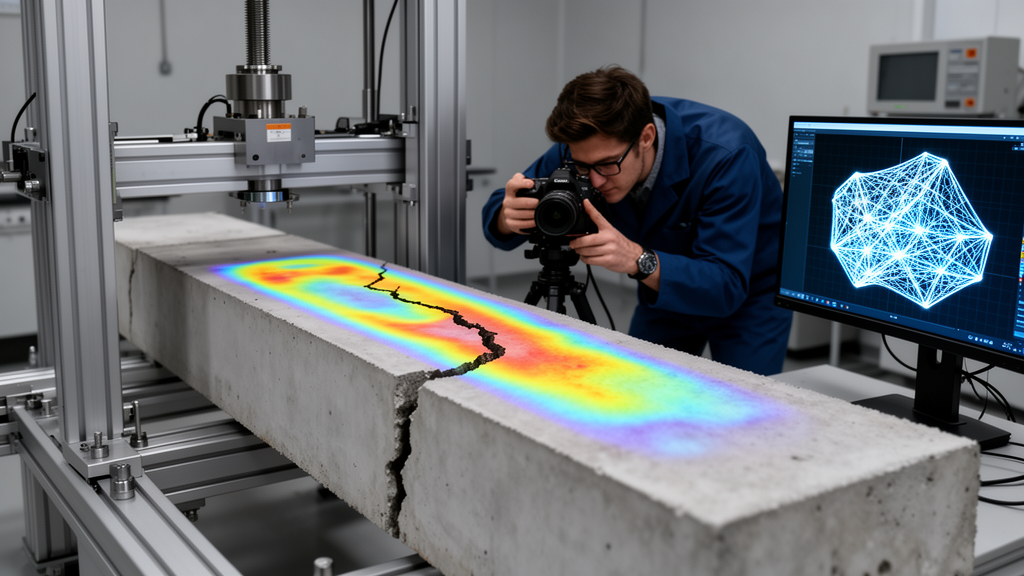
Engineers have long struggled to measure fracture parameters in concrete quickly, because the material’s quasi-brittle behaviour creates a complex, non-linear Fracture Process Zone that resists simple analysis. A new open-access study published in Discover Applied Sciences on 27 October 2026 proposes a hybrid physics-informed deep learning framework designed to extract these quantitative parameters directly from full-field stress images, offering a faster alternative to traditional iterative finite element inverse analysis.

The framework, developed by Winsyahputra Ritonga, Ahmad Andi Solahuddin, Budiman Nasution and Habibi Azka Nasution, integrates a physics-based loss function into a convolutional neural network. The loss enforces the relationship between the strain energy release rate and the stress intensity factor, expressed as G = K_I² / E′, so that the model’s predictions remain consistent with thermodynamic and physical constraints. Unlike conventional physics-informed neural networks, which still depend on mesh-dependent forward PDE solutions, the proposed model acts as a surrogate that maps stress images straight to fracture parameters.

The model was trained on a dataset of idealized finite element simulations and then evaluated on more complex test cases. Against the finite element ground truth, it achieved an unscaled test Mean Absolute Error of 0.0851 MPa√m. With a baseline fracture toughness of approximately 1.0 MPa√m, this corresponds to an error margin of roughly 3.9 percent. The framework also recorded an R² of 0.9565, indicating strong physical consistency between predictions and the underlying physics.

Speed is a central claim of the work. Iterative finite element solvers used in inverse analysis are described as computationally prohibitive for real-time applications, whereas the trained network provides a significant reduction in computational latency during inference. The authors position this efficiency as a bridge between idealized simulations and potential real-world Structural Health Monitoring applications, where rapid assessment of concrete structures could matter. Because the article is being shared early as a peer-reviewed accepted manuscript, it remains subject to further edits before the final Version of Record appears, and the reported performance reflects evaluation against simulated ground truth rather than field measurements.

Subject of Research: A hybrid physics-informed deep learning framework that extracts quantitative fracture parameters in concrete from full-field stress images.

Article Title: A hybrid physics-informed deep learning framework for quantitative parameter extraction in concrete fracture

Article References: Ritonga, W., Solahuddin, A. A., Nasution, B., & Nasution, H. A. (2026). A hybrid physics-informed deep learning framework for quantitative parameter extraction in concrete fracture. Discover Applied Sciences. https://doi.org/10.1007/s42452-026-09772-x

Image Credits: AI Generated

DOI: 10.1007/s42452-026-09772-x

Keywords: concrete fracture, physics-informed deep learning, fracture process zone, stress intensity factor, convolutional neural network, finite element method, structural health monitoring, inverse analysis, fracture toughness, surrogate model, hybrid, physics-informed

News Source: Katie Riggs. (October 28, 2026). Physics-informed AI extracts concrete fracture parameters from stress images. Scienmag.


Tags: concrete fractureconvolutional neural networkfinite-element methodfracture process zonefracture toughnessHybridinverse analysisphysics-informedphysics-informed deep learningstress intensity factorStructural Health Monitoringsurrogate model
Share12Tweet7Share2ShareShareShare1

Related Posts

Midday Sunlight Yields Smaller Copper Nanoparticles With Stronger Antibacterial Activity

Midday Sunlight Yields Smaller Copper Nanoparticles With Stronger Antibacterial Activity

October 29, 2026
Few-Shot AI Tool Reads Cancer Genome Rearrangements from Single-Cell Hi-C Data

Few-Shot AI Tool Reads Cancer Genome Rearrangements from Single-Cell Hi-C Data

October 29, 2026

New Numerical Schemes Keep Dispersive Wave Simulations Energy-Conserving

October 29, 2026

Tensor-Compressed Federated Learning Keeps Patient Data Private While Cutting Edge Latency

October 29, 2026

POPULAR NEWS

  • Global Financing Facility falls short on adolescent health funding in three country case studies

    Global Financing Facility falls short on adolescent health funding in three country case studies

    29 shares
    Share 12 Tweet 7
  • Prostate Cancer Detection Rose After MRI Arrived, But a Single-Centre Study Says the Reason Stays Unclear

    29 shares
    Share 12 Tweet 7
  • Midday Sunlight Yields Smaller Copper Nanoparticles With Stronger Antibacterial Activity

    29 shares
    Share 12 Tweet 7
  • Never-Smoker COPD Shows Stronger Lung Function Gains from Salbutamol and Glycopyrronium

    29 shares
    Share 12 Tweet 7

About

We bring you the latest biotechnology news from best research centers and universities around the world. Check our website.

Follow us

Recent News

Global Financing Facility falls short on adolescent health funding in three country case studies

Prostate Cancer Detection Rose After MRI Arrived, But a Single-Centre Study Says the Reason Stays Unclear

Midday Sunlight Yields Smaller Copper Nanoparticles With Stronger Antibacterial Activity

Subscribe to Blog via Email

Enter your email address to subscribe to this blog and receive notifications of new posts by email.

Join 86 other subscribers
  • Contact Us

Bioengineer.org © Copyright 2023 All Rights Reserved.

Welcome Back!

Login to your account below

Forgotten Password?

Retrieve your password

Please enter your username or email address to reset your password.

Log In
No Result
View All Result
  • Homepages
    • Home Page 1
    • Home Page 2
  • News
  • National
  • Business
  • Health
  • Lifestyle
  • Science

Bioengineer.org © Copyright 2023 All Rights Reserved.
