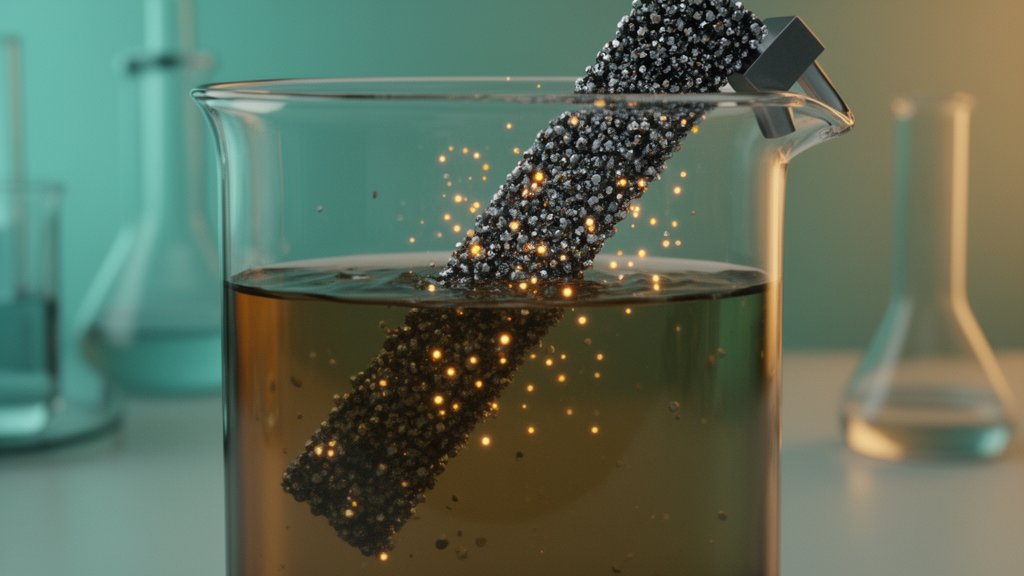
Researchers have built a magnetically recoverable biosorbent that combines fungal biomass with metal oxide nanoparticles and a metal–organic framework, and used it to pull cadmium ions out of both synthetic solutions and real industrial wastewaters. The study, published in BMC Chemistry, reports cadmium removal efficiencies of up to 99.17 percent under optimized conditions, with the composite retaining more than 90 percent of its initial performance after repeated reuse cycles.
The material is based on biomass of the fungus Fusarium oxysporum, functionalized with copper ferrite (CuFe2O4) nanoparticles and the zeolitic imidazolate framework ZIF-67. Structural characterization by scanning electron microscopy, energy-dispersive X-ray mapping, BET surface analysis, vibrating-sample magnetometry and X-ray diffraction confirmed successful formation of the composite. The specific surface area rose dramatically from 1.569 to 123 square meters per gram after the magnetic and MOF modification, a change that greatly expands the surface available for binding metal ions.
Fourier-transform infrared spectroscopy revealed the presence of hydroxyl, carboxyl, amine and metal–oxygen functional groups on the composite surface. The point of zero charge was measured at approximately pH 6.5, indicating favorable electrostatic interactions with positively charged cadmium ions at near-neutral pH. The composite exhibited a saturation magnetization of 11.179 emu per gram, enabling rapid magnetic separation of the spent adsorbent from treated water.
To optimize operating conditions, the team used response surface methodology based on a central composite design. The quadratic model showed excellent predictive accuracy, with an R-squared of 0.9994, an adjusted R-squared of 0.999 and a predicted R-squared of 0.9982. Under the optimized conditions, cadmium removal reached 99.17 percent in the synthetic systems.
The maximum adsorption capacity was 33.64 milligrams per gram. Thermodynamic analysis yielded a negative standard Gibbs free energy and a standard enthalpy change of 67.6 to 75.9 kilojoules per mole, indicating that the process is spontaneous and endothermic over the studied temperature range.
The composite was also evaluated in real industrial wastewaters from electroplating, battery and pigment operations. Despite the presence of competing ions, the composite reduced cadmium concentrations from a range of 2.35 plus or minus 0.12 to 0.94 plus or minus 0.05 milligrams per liter down to 0.41 plus or minus 0.03 to 0.28 plus or minus 0.02 milligrams per liter, corresponding to removal efficiencies of 70.2 to 82.6 percent. In electroplating wastewater specifically, cadmium fell from 2.35 plus or minus 0.12 to 0.41 plus or minus 0.03 milligrams per liter.
The treated effluents also showed a shift toward near-neutral pH values of roughly 6.6 to 6.9, which the authors interpret as amphoteric buffering behavior of the composite surface. Regeneration tests demonstrated that the adsorbent retained over 90 percent of its initial efficiency after four adsorption–desorption cycles, a key requirement for any adsorbent intended for repeated industrial use.
The composite combines fungal biomass functionalized with CuFe2O4 nanoparticles and ZIF-67, and its modification increased the specific surface area from 1.569 to 123 square meters per gram while enabling magnetic recovery.
The authors highlight the composite's applicability for cadmium removal from complex industrial wastewater systems, citing its removal efficiency, magnetic recovery and retained performance across reuse cycles. Because the study evaluated the material in synthetic solutions and three types of real wastewater, the reported performance figures reflect both idealized and realistic operating environments, although longer-term pilot-scale testing would be needed to establish full-scale viability.
With surface areas more than seventy times greater than the unmodified biomass, near-complete cadmium capture under optimized conditions, and magnetic separation enabling straightforward recycling, the Fusarium oxysporum–CuFe2O4/ZIF-67 biocomposite offers a technically grounded route for treating cadmium-laden industrial effluents while keeping the adsorbent itself out of the discharge stream.
Subject of Research: A magnetically recoverable Fusarium oxysporum–CuFe2O4/ZIF-67 biocomposite for cadmium removal from water and industrial wastewater
Article Title: Magnetically recoverable Fusarium oxysporum–CuFe₂O₄/ZIF-67 biocomposite for efficient Cd²⁺ removal from aquatic systems
Article References: Khosravi, S., Madani, M., Ramavandi, B., Emami, Z., & Peighambardoust, S. J. (2026). Magnetically recoverable Fusarium oxysporum–CuFe₂O₄/ZIF-67 biocomposite for efficient Cd²⁺ removal from aquatic systems. BMC Chemistry. https://doi.org/10.1186/s13065-026-01943-6
Image Credits: AI Generated
DOI: 10.1186/s13065-026-01943-6
Keywords: cadmium removal, biosorbent, Fusarium oxysporum, CuFe2O4 nanoparticles, ZIF-67 metal–organic framework, magnetic separation, industrial wastewater, adsorption kinetics, Freundlich isotherm, response surface methodology, regeneration cycles, water treatment
News Source: Bethany Barker. (October 28, 2026). Magnetic fungal–MOF composite strips cadmium from industrial wastewater. Scienmag.