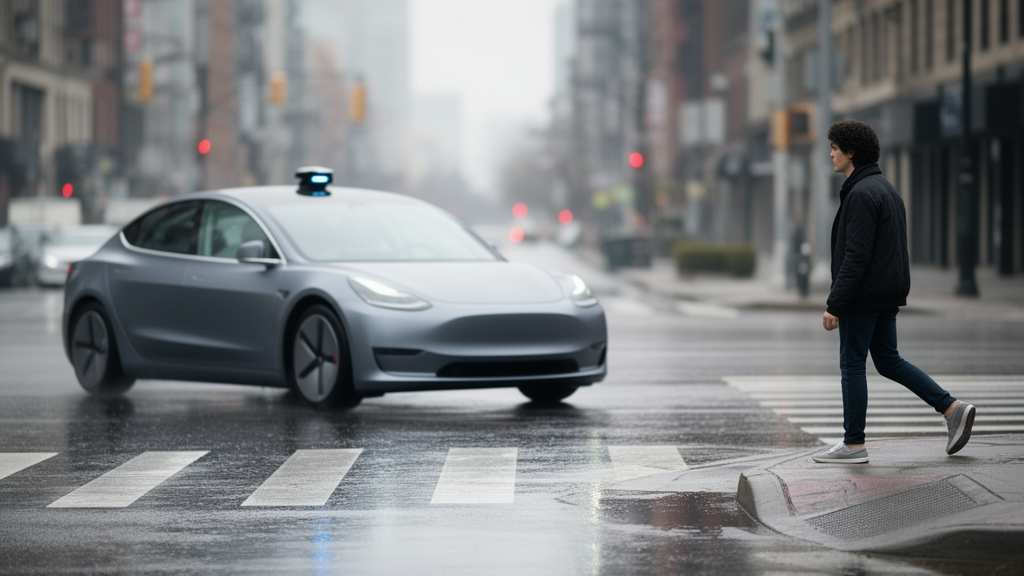
When a highly automated vehicle glides through a shared city space with no lane markings, no curbs and no traffic signals, pedestrians appear to make up their minds almost entirely from the way the vehicle moves. That is the central finding of a new video-based experiment published in the European Transport Research Review, in which 136 participants judged whether they would cross in front of an approaching automated car. The study, conducted by Marc Wilbrink, Sarah Stelter and Michael Oehl, systematically varied the vehicle’s kinematics, an external light-based display, and the behavior of a second pedestrian, and found that the vehicle’s motion was by far the strongest determinant of both willingness to cross and perceived safety.
Shared spaces are an increasingly popular urban design concept in which road users have equal rights and coordination relies on low speeds and mutual consideration rather than formal right-of-way rules. This makes them a particularly demanding environment for automated vehicles, because pedestrians normally coordinate with drivers through eye contact, head orientation and informal gestures. In a vehicle without a driver, those channels disappear, and pedestrians must instead infer intent from vehicle kinematics and any external communication the car provides. The researchers set out to test how these cues combine in a negotiation-based setting, where prior research has largely focused on simpler one-to-one encounters.
The experiment was conducted as an online questionnaire in which participants watched twelve pre-rendered three-dimensional video clips created in Unreal Engine 5.1. Each clip lasted nine seconds and showed a shared-space scene from a first-person pedestrian viewpoint at eye height, in bright daylight and without audio. Participants were told to imagine they wanted to cross the space to reach a subway station while a highly automated vehicle approached from their left. The clips faded to black at a standardized decision point after seven seconds, before the vehicle came to a complete stop, so that judgments rested on ongoing vehicle behavior rather than an observed final stop. The study used a 3 by 2 by 2 within-subjects design, meaning every participant saw every combination of the manipulated factors once, in a fully randomized order.
The vehicle kinematics factor had two levels. In the non-yielding condition, the simulated car, visualized as a VW Passat Variant, maintained a constant speed of 20 kilometers per hour throughout the clip. In the yielding condition, it began decelerating at a distance of 22 meters from the participant with a linear deceleration of 1.0 meters per second squared, a magnitude chosen to represent a moderate and comfortable yielding maneuver rather than abrupt braking. The external human-machine interface, when present, took the form of a 360-degree LED light band in cyan, a color chosen for perceptual salience and regulatory considerations. The display used a two-stage communication concept: a steady cyan illumination indicated that the vehicle was operating in automated mode, and in yielding trials the band switched to a pulsing pattern at 0.66 hertz precisely at the onset of deceleration. Because these two components were not manipulated independently, the authors note that the observed effects must be interpreted as effects of the combined concept rather than of either message alone.
The third factor was the behavior of an additional pedestrian, who was either absent, stopped before entering the vehicle’s path, or continued walking. In the stopping condition, the pedestrian turned their head toward the approaching vehicle while halting; in the continuing condition, the pedestrian briefly oriented toward the vehicle but then returned their gaze forward and kept walking until the fade-out. After each clip, participants rated their willingness to cross in front of the vehicle and how safe they would feel while crossing, both on seven-point Likert scales, along with exploratory ratings of how helpful each cue had been for their decision.
The results were striking in their asymmetry. Vehicle kinematics produced enormous effects on both outcomes, with partial eta squared values of 0.869 for willingness to cross and 0.826 for perceived safety, far beyond the conventional threshold for a large effect. A large eHMI-by-kinematics interaction showed that the light band increased willingness to cross by a mean difference of 1.11 scale points and perceived safety by 1.10 points under yielding kinematics, but had essentially no effect when the vehicle did not yield, with mean differences of only 0.03 and 0.04 points that were not statistically significant. In other words, the display was beneficial only when its signal was congruent with what the vehicle was actually doing.
Importantly, the study found no evidence of the overreliance effect that has concerned some researchers in the field. The authors had hypothesized that a steady automation-status light might raise willingness to cross even when the vehicle did not yield, a potential miscalibration with safety implications. The data contradicted this hypothesis: under non-yielding kinematics, the presence of the eHMI did not increase either outcome. The researchers interpret this as reassuring from a traffic safety perspective, suggesting that pedestrians prioritized vehicle kinematics over automation labeling when the motion indicated that crossing would be unsafe. They caution, however, that the experimental setting involved short video exposures and explicit instructions that the vehicle might or might not yield, which may have encouraged conservative responding, and that overreliance effects could still emerge under distraction, time pressure, reduced visibility or repeated real-world exposure.
The social cue showed a similarly conditional pattern. The behavior of the additional pedestrian affected willingness to cross and perceived safety only when the HAV displayed yielding kinematics. In yielding trials, participants reported higher willingness to cross when the additional pedestrian continued walking than when the pedestrian stopped, with a mean difference of 0.36 points, and higher perceived safety, with a mean difference of 0.27 points. Under non-yielding kinematics, neither outcome differed as a function of the pedestrian’s behavior. The authors suggest that social influence in shared spaces operates as a context-sensitive additional information source: pedestrians attend to the behavior of others when vehicle-based cues indicate that crossing is feasible, but they do not simply follow the crowd when vehicle kinematics strongly signal danger. Exploratory helpfulness ratings reinforced this picture, with the eHMI rated as substantially more helpful in yielding trials, where it averaged 5.92 on the seven-point scale, than in non-yielding trials, where it averaged 4.80, and the pedestrian’s behavior perceived as most helpful when it was congruent with the vehicle’s kinematics.
The study has several limitations that the authors discuss in detail. The findings concern self-reported judgments under standardized video exposure and should not be interpreted as direct evidence of actual crossing behavior, since the fixed-viewpoint clips cannot reproduce the perceptual and motor demands of real-world crossings, where pedestrians actively move and gather information through head movements and peripheral vision. The sample was recruited in Germany, and shared-space negotiation norms may differ across traffic cultures, so cross-cultural replication is needed before generalizing the effect patterns. Participants’ limited real-world exposure to highly automated vehicles may also shape how they weight the cues, and reliance on external signals could shift as familiarity grows. The single-item measures of willingness and perceived safety, while common in this research area, limit the assessment of broader dimensions of perceived safety. The authors recommend future work using embodied virtual reality, Wizard-of-Oz field studies or test-track designs, as well as conditions that increase cognitive load, to determine whether the observed cue-integration patterns hold in more naturalistic settings.
Overall, the study suggests that in negotiation-based urban environments, predictable vehicle kinematics form the primary basis for pedestrian judgment, external communication adds value when it is synchronized with those kinematics, and social cues provide supplementary context only when the vehicle’s behavior already supports crossing.
Subject of Research: How pedestrians integrate vehicle kinematics, external human-machine interfaces and social cues when judging whether to cross in front of highly automated vehicles in shared spaces.
Article Title: Pedestrian interaction with highly automated vehicles in shared spaces: the roles of vehicle kinematics, external human–machine interfaces, and social cues
Article References: Wilbrink, M., Stelter, S., & Oehl, M. (2026). Pedestrian interaction with highly automated vehicles in shared spaces: the roles of vehicle kinematics, external human–machine interfaces, and social cues. European Transport Research Review, 18(1), Article 90. https://doi.org/10.1186/s12544-026-00852-y
Image Credits: AI Generated
DOI: 10.1186/s12544-026-00852-y
Keywords: highly automated vehicles, shared spaces, pedestrian crossing, external human-machine interface, vehicle kinematics, perceived safety, willingness to cross, social cues, eHMI, traffic safety, urban mobility, human-vehicle interaction
News Source: Denise Maddox. (October 28, 2026). Vehicle Movement, Not Lights or Crowds, Dominates Pedestrian Judgments of Automated Cars. Scienmag.