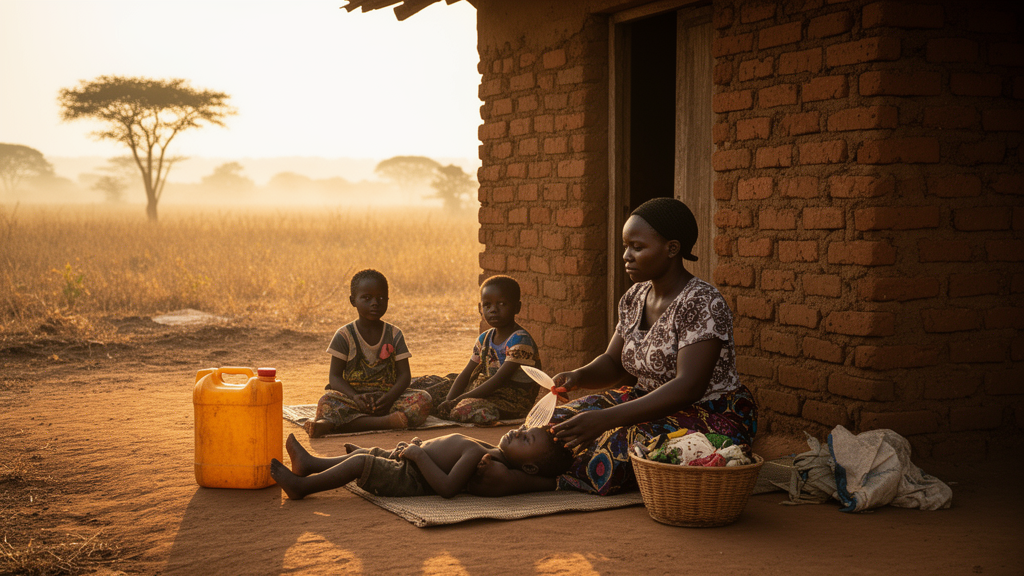
A one-standard-deviation rise in temperature above the long-term average is associated with a 15 to 26 percent drop in total and non-food consumption among rural Ugandan households, and the squeeze is far deeper for the poorest families, according to a new open-access study published in Agriculture & Food Security. The research, led by Emily Injete Amondo and colleagues drawing on institutions including the Center for Development Research at the University of Bonn and Makerere University, is among the first to examine weather and health shocks jointly rather than in isolation, using high-frequency panel data collected across six survey waves in Uganda between June 2020 and August 2021.
The findings arrive at a moment when the study’s authors argue that compound and cascading shocks are increasingly common in rural areas, yet empirical work on their combined effects remains scarce. Most previous research has treated weather variability and illness separately, a gap the authors say can bias estimates and underestimate the joint burden that climate stress and disease place on household welfare, ultimately distorting the policy interventions designed to cushion it.
To build the dataset, the team surveyed 640 households across eight districts in Uganda’s North, East, and West regions, selected because they had recently experienced climate or price shocks. After removing duplicates, 638 unique households entered the baseline, attrition stayed at or below 2 percent across waves, and the analysis used a balanced panel of 621 households. Households were chosen through multi-stage sampling with probability proportional to size, drawing 80 households per district from sampling frames compiled with community leaders and the Uganda Bureau of Statistics.
Weather exposure was measured by matching each georeferenced household to rainfall data from the Climate Hazards Group InfraRed Precipitation with Station data set, covering 1990 to August 2021, and temperature data from the Moderate Resolution Imaging Spectroradiometer for 2000 to 2021. Shocks were defined as z-scores of two-month rolling averages aligned with each survey wave’s recall period, so that an anomaly captured how atypical conditions were relative to historical norms for the same months. Health shocks came from self-reports of illness and injury over the previous two months, including whether any member was sick for more than 30 days or hospitalized for at least one night.
The headline temperature result is consistent across the paper’s main specifications: a one-standard-deviation increase in temperature is associated with a reduction in non-food consumption of roughly 24 to 26 percent and in total consumption of about 15 to 17 percent. Lagged temperature shocks were also linked to significant declines in total consumption, which the authors interpret as evidence that heat stress may persist beyond the immediate exposure period, although the disaggregated effects on food and non-food spending were not statistically significant, suggesting households may smooth particular spending categories over time.
Quantile regression revealed sharp heterogeneity across the consumption distribution. Temperature shocks reduced total consumption at every quantile, but the negative coefficients were largest at the 20th and 40th percentiles and shrank in magnitude at the 60th and 80th, implying that better-off households are less vulnerable to heat. For non-food consumption, current and lagged high temperatures harmed lower- and middle-income households most, while among poorer households the temperature-non-food association exceeded 30 percent. Rainfall told a more divided story: positive deviations raised average food consumption overall, yet reduced it at the 20th to 40th percentiles while increasing it at the 60th to 80th, and wealthier households benefited nearly twice as much from contemporaneous rainfall as poorer ones.
The interaction terms are where the study’s compound-shock argument becomes concrete. Higher lagged temperatures amplified the hospitalization-food consumption relationship, and the negative coefficient on the interaction between lagged temperature and lagged hospitalization indicates that households facing both elevated temperatures and hospitalizations in the previous period saw food consumption further reduced in the current period. Interactions between prolonged sickness and rainfall z-scores were negative and statistically significant across all consumption quantiles, meaning unusually high rainfall did not translate into higher consumption for sick households; illness limited their ability to capitalize on favorable conditions, a pattern the authors describe as widespread vulnerability rather than one concentrated among the poorest.
On mechanisms, the study found that illness raises health expenditures rather than cutting wage earnings. Current illness increased health expenditures by about 16 units, with lagged effects roughly one-fifth as large, and prolonged illness significantly reduced household family labor supply, indicating a shift in labor within the household rather than in external wage employment. Higher temperatures reduced labor income but increased agricultural family labor, which the authors read as a coping response in which households work more on their farms when off-farm earnings decline. When adverse temperatures coincided with illness, agricultural family labor fell further, pointing to compounded constraints on household capacity.
Coping strategies differed sharply by wealth. The poorest quartiles tended to rely on group networks and loans, with access to credit significantly associated with higher non-food consumption in the bottom and middle quantiles but not the top, while wealthier households more frequently used remittances, which were associated with increased total and non-food consumption in the middle and upper quantiles only. Household savings covered medical costs for 27 percent of all households and 38 percent of households with sick members, and other strategies included selling agricultural produce, selling livestock, and borrowing from friends. More than a third of households hired additional labor, reallocated tasks from ill members to healthy ones, or increased healthy members’ working hours when illness struck.
Consumption proved strikingly mobile over the 12-month study window: 49 percent of households in the poorest quintile in wave one remained there by wave six, while 51 percent moved out, and even households in the richest quartile could find themselves in the lowest consumption categories at certain times of year, particularly during the lean season. The authors caution that, as with any observational study, residual biases cannot be entirely ruled out and the findings should be read as robust correlations rather than definitive causal effects, despite an identification strategy combining household fixed effects, a control function approach using leave-one-out parish-level health instruments, and district-by-time fixed effects. They recommend policies including a national health insurance scheme, flood early-warning systems, and expanded social protection through credit, social networks, safety nets, and remittances to strengthen food system resilience in a country where more than half of sub-Saharan African countries, including Uganda, reported insurance penetration below 1 percent in 2017.
Subject of Research: The joint effects of weather and health shocks on household consumption in rural Uganda
Article Title: Weather and health shocks in rural Uganda: heterogeneous consumption effects and coping strategies
Article References: Amondo, E. I., Kornher, L., Isoto, R. E., Mirzabaev, A., Bashaasha, B., & von Braun, J. (2026). Weather and health shocks in rural Uganda: heterogeneous consumption effects and coping strategies. Agriculture & Food Security, 15(1), Article 42. https://doi.org/10.1186/s40066-026-00607-x
Image Credits: AI Generated
DOI: 10.1186/s40066-026-00607-x
Keywords: Uganda, weather shocks, health shocks, household consumption, food security, temperature, rainfall, quantile regression, coping strategies, social protection, panel survey, rural households
News Source: Sloane Callahan. (October 28, 2026). Heat and illness compound to squeeze rural Ugandan household consumption. Scienmag.