Concrete rarely fails because a single load is too heavy. It fails because the same bridge deck, pavement, or machine foundation is loaded, unloaded, and loaded again millions of times, often at amplitudes that keep changing. A new open-access study published on 15 October 2026 in a Springer Nature concrete and cement journal examines exactly that problem, asking how small doses of carbon fiber change the way concrete cracks, softens, and finally breaks under a stepwise-increasing flexural fatigue protocol.
The research team, led by Clinton Pereira, Chirag Vijay Kumar, Maryam Monazami, and Rishi Gupta, prepared three concrete mixes using an ACI mix design method: a plain control mix targeting 30 MPa compressive strength, and two mixes identical except for the addition of 0.5% and 1.0% PAN-based carbon fibers by volume. The fibers were 18 mm long and 7 microns in diameter, with an elastic modulus of 227 GPa. All mixes used Portland limestone cement, Class F fly ash, and a water-cementitious ratio of 0.44, with superplasticizer dosages adjusted upward as fiber content rose to hold workability near a 120 to 130 mm slump.
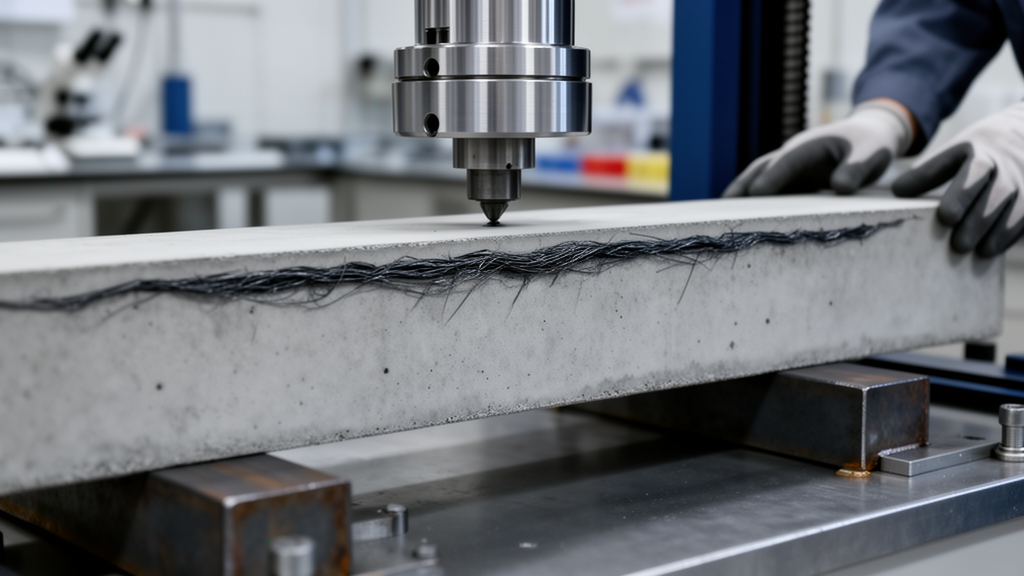
For each mix, the team cast compression cylinders and 100 by 100 by 400 mm beams. The fatigue beams were notched with a 5 mm wide, 30 mm deep saw cut, giving a notch-to-depth ratio of 0.3, and tested in three-point bending over a 300 mm span. A servo-hydraulic actuator applied a sinusoidal load at 1 Hz, raising the upper load limit by 1 kN every 500 cycles while holding a 0.5 kN lower limit to keep the loading head in contact with the specimen. A clip gauge recorded crack mouth opening displacement, an LVDT tracked mid-span deflection, and data were logged at 10 Hz until the beam fractured or the crack opening reached 5 mm.
The headline result concerns fatigue life. The 0.5% carbon fiber mix survived the most cycles to failure, averaging 4709 cycles, while the control concrete managed only 2588. The 1.0% mix fell between the two, still outlasting the plain concrete but short of the lower dosage. Normalized against the control, the fatigue lives improved by factors of 1.82 and 1.62 for the 0.5% and 1.0% dosages respectively. The authors attribute the drop-off at higher fiber content to agglomeration and uneven fiber distribution, which they observed during mixing and which left some regions over-reinforced and others under-reinforced.
Strength measurements told a similar story. All three mixes exceeded the 30 MPa target in compression, but compressive strength declined as fiber content rose, by 6.7% at 0.5% fibers and 12.7% at 1.0%. The static modulus of rupture peaked at the 0.5% dosage, which the paper reports as a 123% improvement over the control, while the cyclic modulus of rupture improved by 74%. At 1.0% fibers, both static and cyclic flexural strength fell back below the 0.5% values, though they remained above the plain concrete baseline. The control beams also showed a higher static modulus of rupture, 3.06 MPa, than cyclic modulus of rupture, 2.47 MPa, a gap the authors link to fatigue-induced microcracking.
The fracture behaviour itself changed dramatically with fiber addition. Under the load-CMOD curves, the control beam behaved elastically until a critical load of about 6 kN, then cracked suddenly with a jump in crack opening to roughly 0.01 mm and immediate failure, showing almost negligible fracture toughness. The fiber-reinforced beams instead displayed nonlinear responses with broad hysteresis loops spanning crack openings from 0.5 to around 3.0 mm, with fibers bridging the crack faces and transferring load after the matrix had split. Fracture energy, calculated from the area under the load-CMOD curve following RILEM TC 50-FMC, reached 312.57 J/m² for the 0.5% mix and 616.71 J/m² for the 1.0% mix, against just 8.29 J/m² for the control.
That toughness advantage grew as cracks widened. At a crack opening of 0.5 mm, raising the fiber dose from 0.5% to 1.0% lifted fracture energy from 194.86 to 253.43 J/m², a 30.1% gain. At 2.0 mm, the same dose increase pushed fracture energy from 312.57 to 616.71 J/m², a 97.3% gain. The authors note this fiber-volume-dependent response mirrors trends reported for steel fiber-reinforced concrete, lending confidence to their measurements, though they stress that the 1.0% mix achieved its higher energy absorption alongside faster stiffness loss and more tortuous crack paths.
To move beyond simple cycle counts, the team built a post-processing damage-assessment framework in MATLAB. The algorithm segmented each load-CMOD history into individual cycles using trough-to-trough detection, then computed a per-cycle secant stiffness from the load and crack-opening extrema, normalized against an early-life reference stiffness. It also integrated the area of each hysteresis loop to obtain dissipated energy per cycle, accumulated that energy over the test, and combined the stiffness and energy terms into a single normalized damage index, with a sensitivity check across weighting factors of 0.25, 0.50, and 0.75 to confirm the interpretation did not hinge on one arbitrary choice.
A two-stage piecewise fit to the normalized stiffness curves identified an approximate transition from initiation-dominated microcracking to propagation-dominated macrocrack growth. The fitted breakpoint landed at the same block midpoint, 1250.5 cycles, for all three representative specimens, simply because the regression selected the third 500-cycle block in each case. What differed was what happened next: the control beam failed shortly after the transition, while both fiber-reinforced beams continued carrying cyclic load for thousands more cycles. The 0.5% specimen, with a fatigue life of 4874 cycles in the representative dataset, showed the most stable stiffness retention and the most gradual damage accumulation, while the 1.0% specimen dissipated the most total energy but degraded faster in the later fatigue stage.
The authors are careful about the limits of what they can claim. Each test used only three specimens, so no statistical significance testing was performed, and the reduction in compressive strength at 1.0% fibers only clearly exceeded measurement variability. The study examined a single PAN-based fiber type and geometry, a narrow dosage range, and loading conditions that do not fully replicate field service, with no environmental factors such as temperature or humidity considered. The analytical framework is explicitly a post-processing interpretation of measured data, not a predictive fatigue-life model. Within those bounds, the practical message is that the optimal carbon fiber dosage depends on the performance target: around 0.5% by volume for the best balance of fatigue life, stiffness retention, and controlled damage growth, and closer to 1.0% where maximum post-cracking fracture energy and energy absorption matter most.
Subject of Research: Fracture and fatigue behaviour of carbon fiber-reinforced concrete under variable-amplitude flexural fatigue loading
Article Title: Exploring fracture characteristics of carbon fiber-reinforced concrete under variable amplitude flexural fatigue loading
Article References: Pereira, C., Kumar, C. V., Monazami, M., & Gupta, R. (2026). Exploring fracture characteristics of carbon fiber-reinforced concrete under variable amplitude flexural fatigue loading. Discover Concrete and Cement, 2(1), Article 83. https://doi.org/10.1007/s44416-026-00126-9
Image Credits: AI Generated
DOI: 10.1007/s44416-026-00126-9
Keywords: carbon fiber-reinforced concrete, flexural fatigue, variable-amplitude loading, fracture mechanics, crack mouth opening displacement, stiffness degradation, hysteresis energy, damage index, modulus of rupture, fiber dosage, post-crack toughness, concrete durability
News Source: Denise Maddox. (October 28, 2026). Carbon fibers give concrete a longer fatigue life under variable-amplitude flexural loading, lab study finds. Scienmag.