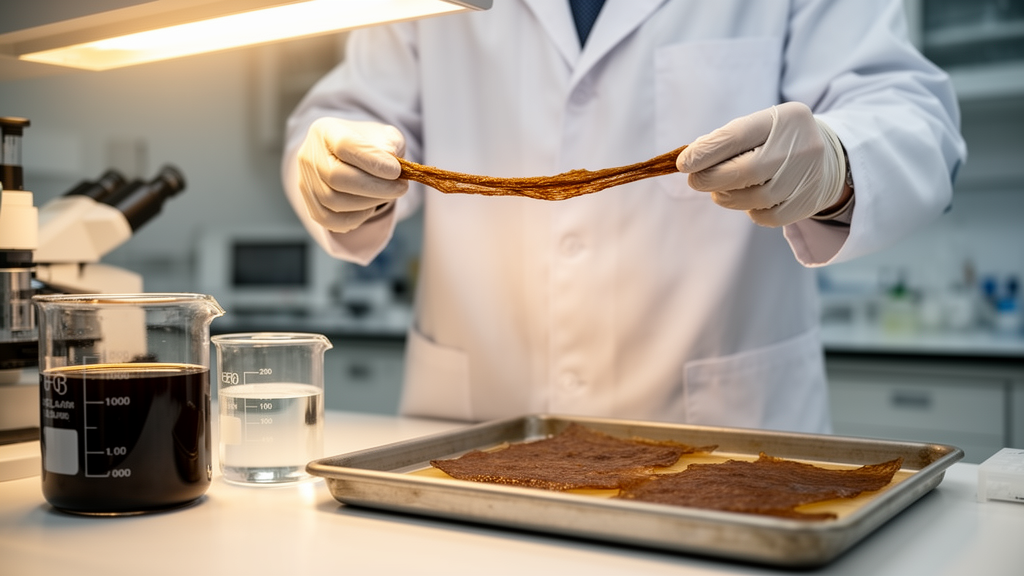
The study, published as an original paper in Polymer Bulletin, systematically varied three organic acids as crosslinkers, their concentration, and the amount of lignin incorporated into each film.
The team tested citric acid, tartaric acid and oxalic acid as crosslinking agents, using crosslinker concentrations between 0.10 and 0.20 percent weight per volume and lignin loadings of one to two grams. Films prepared with each combination were then evaluated for basis weight, thickness, tensile strength, burst strength, tear strength, moisture absorption, swelling percentage, water contact angle and water sensitivity.
Mechanical testing showed a clear ranking among the three crosslinkers. Citric acid produced the strongest films, reaching a maximum tensile strength of 9.2 kilonewtons per metre, a burst strength of 7.361 kilopascals and a tear strength of 99.8 millinewtons. Tartaric acid films achieved intermediate values of 7.7 kilonewtons per metre in tensile strength, 5.981 kilopascals in burst strength and 92.3 millinewtons in tear strength, while oxalic acid films recorded the lowest maxima at 6.5 kilonewtons per metre, 4.912 kilopascals and 91.2 millinewtons respectively.
According to the authors, these differences demonstrate the influence of crosslinker functionality on biofilm development.
Water-related behaviour followed a consistent pattern across the formulations. Moisture absorption, swelling and water dissolution of the biofilms decreased progressively as crosslinker concentration increased, indicating that a denser crosslinked network restricts the uptake and penetration of water. In contrast, the water contact angle increased with higher lignin loading, pointing to a more hydrophobic film surface as lignin content rises.
Structural characterization supported the performance data. Fourier transform infrared spectroscopy confirmed that efficient crosslinking had taken place within the films. X-ray diffraction revealed systematic changes in crystalline regions, which the researchers interpret as evidence of enhanced network organization. Scanning electron microscopy showed uniform morphology across the prepared films.
Thermal analysis added a further line of evidence. Thermogravimetric and differential thermal analysis confirmed improved thermal stability in the films, which the authors attribute to increased crosslink density. Together, the spectroscopic, crystallographic, microscopic and thermal results form a coherent picture of films whose internal structure is tightened by the crosslinking treatment.
The study is framed as an optimisation strategy for converting underutilized lignin into a high-performance sustainable biofilm.
By identifying which crosslinker and which formulation variables deliver the best mechanical and moisture performance, the study offers a practical route for directing this waste stream into value-added film products, although the reported applications remain proposed uses of the material rather than outcomes demonstrated in the laboratory study.
Subject of Research: Development and characterization of lignin-based biofilms crosslinked with citric, tartaric and oxalic acid for sustainable film applications
Article Title: A comprehensive study on development, performance assessment and characterization of lignin based biofilm
Article References: Dev, A., Rana, V., Joshi, G., & Sharma, A. (2026). A comprehensive study on development, performance assessment and characterization of lignin based biofilm. Polymer Bulletin, 83(12), Article 689. https://doi.org/10.1007/s00289-026-06747-1
Image Credits: AI Generated
DOI: 10.1007/s00289-026-06747-1
Keywords: lignin, biofilm, citric acid, crosslinking, tensile strength, biodegradable films, agricultural mulch, FTIR, XRD, thermal stability, industrial waste, sustainable packaging
News Source: Bethany Barker. (October 28, 2026). Lignin waste turned into biofilms as citric acid crosslinking boosts strength. Scienmag.