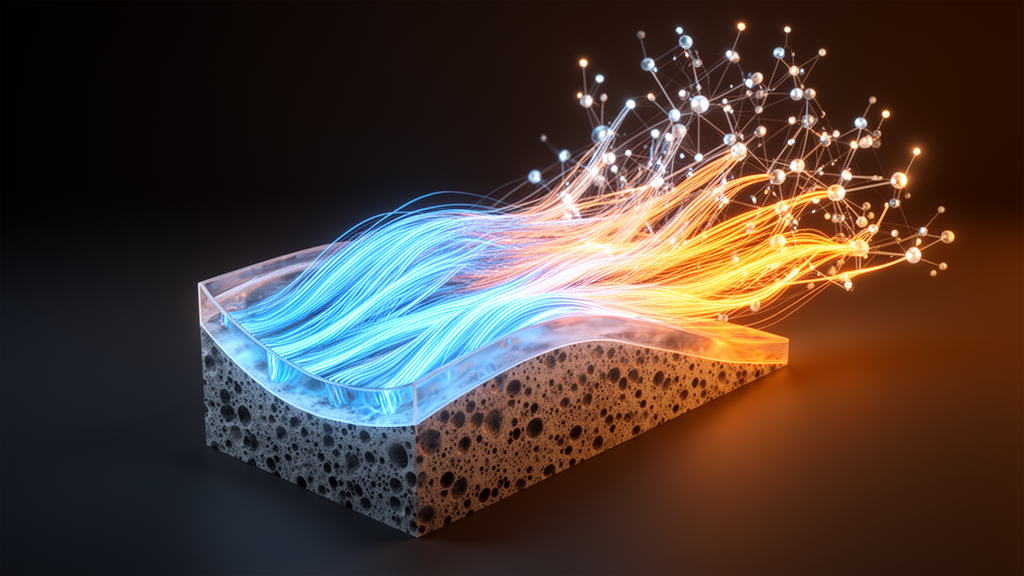
Engineers who design cooling systems, solar collectors, geothermal plants and aerospace components often need to know how a fluid carrying tiny suspended particles will behave when it flows over a wedge-shaped surface, especially when that surface is porous and a magnetic field is switched on. A new computational study published in Discover Nano tackles exactly this problem, and it does so by pairing a classical numerical solver with a machine-learning model that can reproduce the solver’s answers almost perfectly.
The research, led by Abdulbasit A. Darem and colleagues, examines steady two-dimensional magnetohydrodynamic boundary layer flow of a nanofluid over a wedge embedded in a porous medium. The model incorporates a magnetic field, porous-medium resistance, Brownian motion of the nanoparticles, thermophoresis, viscous dissipation and the Falkner–Skan pressure-gradient parameter that characterizes the wedge geometry. Rather than treating these mechanisms separately, the formulation couples them all in a single wedge-flow problem, which the authors identify as the physical gap their study fills.
Mathematically, the governing equations for momentum, energy and nanoparticle concentration are nonlinear partial differential equations. The team used a similarity transformation to reduce them to a system of ordinary differential equations, which were then solved numerically with MATLAB’s Bvp4c boundary-value solver using a collocation scheme with an adaptive mesh. The computational domain extended to a normalized distance of five, with relative and absolute tolerances of 10 to the minus 6 and 10 to the minus 8 respectively, and mesh independence was verified by refining the grid until successive solutions showed negligible differences in the velocity, temperature and concentration profiles.
The numerical solutions were validated against previously published results from Ashwini, Watanabe, and Ullah and colleagues, with the comparison showing good agreement for skin friction and Nusselt number values. Once the solver had produced converged solutions, these served a second purpose: they became the supervised training data for an artificial neural network. A dataset of 500 values was generated by systematically varying the governing physical parameters, and it was split into 70 percent training, 15 percent validation and 15 percent testing sets.
The network itself uses Levenberg–Marquardt backpropagation, an algorithm the authors chose for its fast convergence, numerical stability and good predictive performance on relatively small datasets. The results are striking. For the velocity profile, the best validation mean squared error reached 4.77 times 10 to the minus 9 at epoch 150, with a gradient of 8.4122 times 10 to the minus 7, and regression coefficients for training, validation, testing and overall datasets approached R equal to 1. For the Lewis number case, the best validation performance was 1.9499 times 10 to the minus 7 at the same epoch, with residuals tightly clustered around zero in the error histograms.
For a representative parameter set, the computed engineering quantities were a skin-friction coefficient of 1.9338, a heat-transfer rate of 0.2737 and a mass-transfer rate of 0.1769, expressed as the dimensionless wall derivatives of velocity, temperature and concentration. The authors also tabulated the performance of the network using mean squared error, root mean squared error, mean absolute error and mean absolute percentage error across the training, validation and testing partitions.
Beyond the machine-learning results, the parameter studies reveal how each physical mechanism shapes the flow. Increasing the magnetic parameter suppresses the velocity profile because the transverse magnetic field generates a Lorentz force, a resistive body force that opposes the fluid motion and thins the velocity boundary layer. Raising the Lewis number reduces the concentration profile and the concentration boundary layer thickness, since a higher Lewis number corresponds to lower mass diffusivity, but it enhances the Sherwood number, indicating improved mass transfer at the wall.
The thermal picture is similarly detailed. Higher Prandtl numbers reduce both the temperature profile and the thermal boundary layer thickness because thermal diffusivity falls, yet the heat transfer rate increases. Increasing the Eckert number strengthens viscous dissipation, converting more kinetic energy into heat: the temperature distribution rises sharply near the wall, peaks at a normalized distance of 0.5, and then declines, and the thicker thermal boundary layer comes at the cost of a reduced heat transfer rate. Increasing the Brownian motion parameter raises the temperature profile while lowering the concentration profile, and greater permeability of the porous medium slows the fluid across the entire flow domain through drag. A larger wedge-angle parameter enhances both velocity and temperature through the favorable pressure-gradient effect, while wall suction accelerates the flow.
The authors are explicit about the limits of their approach. Because the analysis relies on similarity transformations and the Bvp4c solver, it applies only to flow configurations whose governing equations can be reduced to ordinary differential equations; more complex geometries and general flows that do not admit similarity solutions cannot be handled directly. They suggest that future work could extend the model to unsteady Williamson hybrid nanoliquid flows and to more advanced machine-learning methods, including deep neural networks, ensemble learning and explainable artificial intelligence, to improve prediction accuracy and interpretability.
What the study ultimately delivers is a data-driven surrogate: once trained on the solver’s output, the neural network can rapidly approximate the nonlinear transport responses of the coupled magnetohydrodynamic porous-wedge problem while the numerical model remains the reference solution. For engineers running repeated design calculations on nanofluid cooling and heat-exchange systems, that combination of a trusted solver and a near-perfectly correlated fast predictor offers a practical route to efficient analysis and optimization.
Subject of Research: Artificial neural network prediction of MHD nanofluid flow and heat transfer over a porous wedge
Article Title: Artificial neural network-based prediction of hydromagnetic boundary layer nanofluid fluid flow and heat transportation over a porous wedge with brownian motion
Article References: Darem, A. A., Majeed, A., Ali, P., Alqahtani, A. S., Namoun, A., & Alhashmi, A. A. (2026). Artificial neural network-based prediction of hydromagnetic boundary layer nanofluid fluid flow and heat transportation over a porous wedge with brownian motion. Discover Nano, 21(1), Article 560. https://doi.org/10.1186/s11671-026-05066-8
Image Credits: AI Generated
DOI: 10.1186/s11671-026-05066-8
Keywords: nanofluid, artificial neural network, Levenberg-Marquardt, Bvp4c, magnetohydrodynamics, porous wedge, Brownian motion, thermophoresis, boundary layer, heat transfer, mass transfer, skin friction
News Source: Blake Davidson. (October 28, 2026). Neural Network Learns to Predict Nanofluid Flow and Heat Transfer Over a Porous Wedge. Scienmag.