Intensive care ventilators run around the clock, and a new bench study suggests that the single biggest factor in how much electricity they burn is not the ventilation mode clinicians choose but the brand of machine they buy. In measurements of nine intensive care ventilators—three devices from each of three manufacturers—researchers at Çiğli Training and Research Hospital in İzmir, Türkiye, found that one brand consumed roughly 22 to 39 watts more than its comparators under identical ventilatory conditions, while every ventilation mode tested was statistically equivalent within a pre-defined margin of 10 watts. The study, published in Frontiers in Medicine, is presented by its authors as proof-of-concept rather than a definitive ranking of manufacturers.
The motivation comes from the carbon arithmetic of modern health care. Health care is estimated to generate 4%–5% of global greenhouse gas emissions, and the intensive care unit is among its most energy-intensive environments, where energy rather than consumables dominates the carbon footprint. A life-cycle assessment of septic shock care cited in the study found daily emissions of 178 kilograms of carbon-dioxide-equivalent per patient in a United States ICU and 88 kilograms in an Australian ICU, with heating, ventilation and air conditioning contributing 87% and 76% respectively. Mechanical ventilators, which power continuously throughout a patient’s respiratory support, are the archetype of the equipment that runs at every bedspace without interruption.
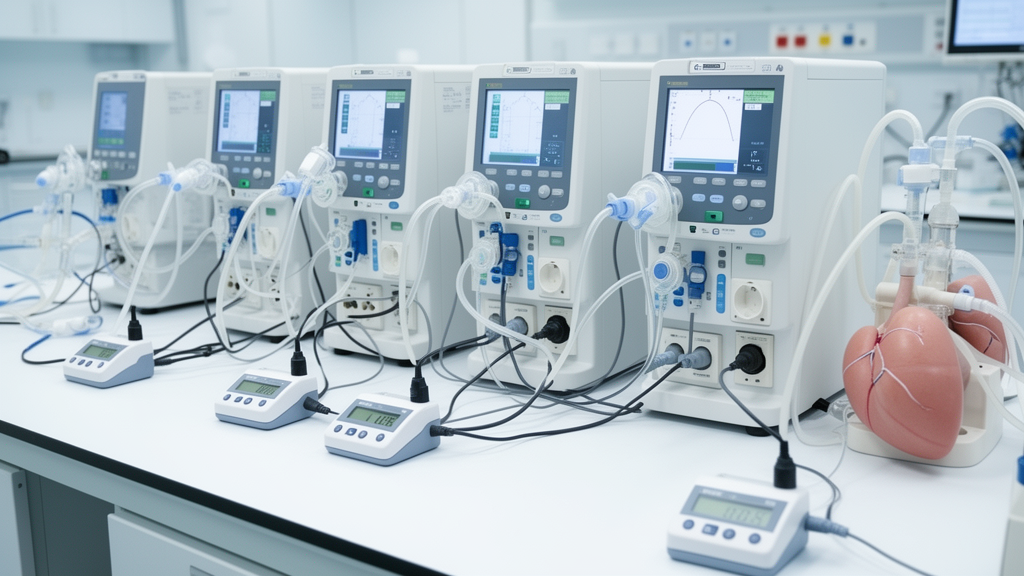
Despite that constant demand, ventilator electricity consumption has rarely been measured directly and had never been compared between brands using multiple devices per brand. The research team measured active power with a single plug-in digital meter on three devices from each of three brands, in every ventilation mode available on each device plus standby, yielding 90 measurements. All nine devices used integral internal gas delivery, meaning the electrical work of generating inspiratory flow was performed by the ventilator itself rather than offloaded to the hospital’s central compressed-air plant, so differences in measured power could be attributed to the machines rather than to hospital infrastructure.
The measurement protocol was deliberately standardised. A single shared breathing circuit and rubber test balloon served as the mechanical load for every device. Ventilator settings were harmonised across brands: tidal volume of 400 millilitres, a respiratory rate of 10 breaths per minute, an inspiratory-to-expiratory ratio of 1:2, positive end-expiratory pressure, and an inspired oxygen fraction of 0.21. Each device ran for 10 minutes per mode to reach steady state, with power read every 60 seconds and the ten readings averaged. Because manufacturers offer different mode portfolios, each proprietary mode was mapped to a harmonised category—standby, volume control, pressure control, pressure-regulated volume control, pressure support/CPAP, synchronised intermittent mandatory ventilation and airway pressure release/bilevel—based on breath-control variable and breath-initiation pattern.
The statistical treatment reflected the small number of independent units. The device, not the individual measurement, was treated as the unit of analysis, giving an effective sample of nine ventilators. The primary analysis was a linear mixed-effects model with brand and harmonised mode as fixed effects and a random intercept for device nested within brand, with a separate residual variance for each brand because residual spread differed markedly between them. Because standard approximations are unreliable at nine devices, the brand and mode effects were additionally tested by parametric bootstrap of the likelihood-ratio statistic. Estimated marginal mean power was 64.9 watts for Brand A, 95.4 watts for Brand B and 56.3 watts for Brand C.
Brand exerted a strong effect, with a parametric bootstrap p-value of 0.003, while mode showed no detectable effect under the tested conditions (bootstrap p = 0.51). Every harmonised mode category was statistically equivalent to the reference category at the pre-specified 10-watt margin in two one-sided tests, and at a tighter 5-watt margin equivalence held for four of five categories, with volume control the exception because it was available on only two of the three brands. A brand-by-mode interaction was not detected (p = 0.27), though the authors note the test had limited power and should be read as finding no evidence of an interaction rather than establishing its absence. Bonferroni-adjusted comparisons showed Brand B consumed more than Brand A (30.5 watts) and Brand C (39.1 watts, 95% CI 17.0–61.2), while Brands A and C were not distinguishable.
Translated into emissions, the difference is potentially consequential but heavily assumption-dependent. The 39.1-watt gap between the most and least consumptive brands projects to approximately 343 kilowatt-hours and 161 kilograms of carbon-dioxide-equivalent per ventilator annually under continuous operation at the Turkish grid consumption-point emission factor of 0.469 kilograms per kilowatt-hour, with a 95% confidence interval of 70 to 252 kilograms. Across three utilisation levels and four grid emission factors spanning fossil-dependent to low-carbon systems, the projected difference ranges from 17 to 161 kilograms per ventilator per year, a roughly tenfold span. The authors stress these are scenario-based projections, not measured quantities, and that the direction and relative ordering of brands are unaffected by the assumptions while the magnitude is imprecisely estimated.
Two secondary findings carry practical weight. First, standby was not a low-power state in any brand: it reached 92.6% of active consumption in Brand A, meaning an idle device drew almost as much electricity as a fully operating one, and Brand B in standby consumed more power than Brand C did during active ventilation. The active-minus-standby increment—4.8, 28.7 and 15.2 watts for Brands A, B and C respectively—placed most of the between-brand difference in the idle baseline rather than in ventilation itself, pointing attention toward continuously energised subsystems such as power supplies, cooling fans, displays and battery float-charging. Second, one Brand B device consumed roughly 25 watts more than its siblings across every mode despite routine maintenance and no recorded fault, with its standby consumption indistinguishable from theirs; the authors suggest an unidentified condition in the gas-delivery path is the most plausible explanation and note that routine biomedical checks verify clinical performance but not energy consumption.
The authors are careful about what the study does and does not establish. All nine devices were approximately ten years old, procured within the same period and in continuous tertiary-level service since, so the platforms measured may not correspond to the models these manufacturers currently market; the findings demonstrate that clinically equivalent ventilators can differ substantially in energy consumption and justify measuring current models before purchase, but do not identify which currently marketed platform is preferable. Brands were anonymised for the same reason. Spontaneous and supported modes were assessed against a passive test balloon without simulated inspiratory effort, so the equivalence bound cannot be extended to patient-triggered ventilation during genuine clinical use. The consumer-grade meter was manufacturer-calibrated but not independently verified, does not report power factor, and its stated 2% accuracy is uncertified, though the observed differences exceed the meter’s stated uncertainty by more than an order of magnitude. Mode order was fixed rather than randomised, revealing a small negative drift of 0.45 watts per sequence position—roughly 4 watts across a full session—that cannot be separated from a genuine mode effect but is an order of magnitude smaller than the between-brand difference and cannot generate it.
Sensitivity analyses supported the robustness of the headline result. Excluding a single outlying Brand A observation of 36.3 watts altered no conclusion, and a post hoc, exploratory analysis excluding the atypical Brand B device attenuated the between-brand differences—Brand B exceeded Brand A by 22.5 watts and Brand C by 31.2 watts—while increasing precision, with the device-level variance component falling from 63.8 to 5.3 and the intraclass correlation coefficient from 0.65 to 0.16. Scaled to a 20-bed intensive care unit with every bed ventilated continuously, selecting the more efficient brand would correspond to approximately 3.2 tonnes of carbon-dioxide-equivalent per year avoided from ventilator electricity alone, an upper bound that falls to roughly 2.4 tonnes at 75% ventilated-bed occupancy. On this basis the authors suggest that ventilator tenders should require measured power consumption to be declared and evaluated as a standardised criterion, and that units adopt protocols for powering ventilators down rather than leaving them in standby—levers that, they argue, impose no clinical trade-off. Confirmation in larger, multicentre samples of contemporary devices, with calibrated instrumentation, a characterised lung simulator, randomised mode order and simulated inspiratory effort, is required before the magnitudes reported here can be relied upon.
Subject of Research: Electricity consumption and carbon emissions of intensive care ventilators by brand and ventilation mode
Article Title: Ventilator brand, not ventilation mode, determines electricity consumption and estimated carbon emissions: a bench study of nine intensive care ventilators
Article References: Sezer, S. S., & Şenoğlu, N. (2026). Ventilator brand, not ventilation mode, determines electricity consumption and estimated carbon emissions: a bench study of nine intensive care ventilators. Frontiers in Medicine, 13, Article 1966196. https://doi.org/10.3389/fmed.2026.1966196
Image Credits: AI Generated
DOI: 10.3389/fmed.2026.1966196
Keywords: mechanical ventilation, intensive care, energy consumption, carbon footprint, greenhouse gas emissions, sustainable health care, green procurement, bench study, standby power, ventilator tenders, health care emissions, medical devices
News Source: Ophelia Keating. (October 28, 2026). Ventilator brand, not mode, drives electricity use in ICU bench study. Scienmag.