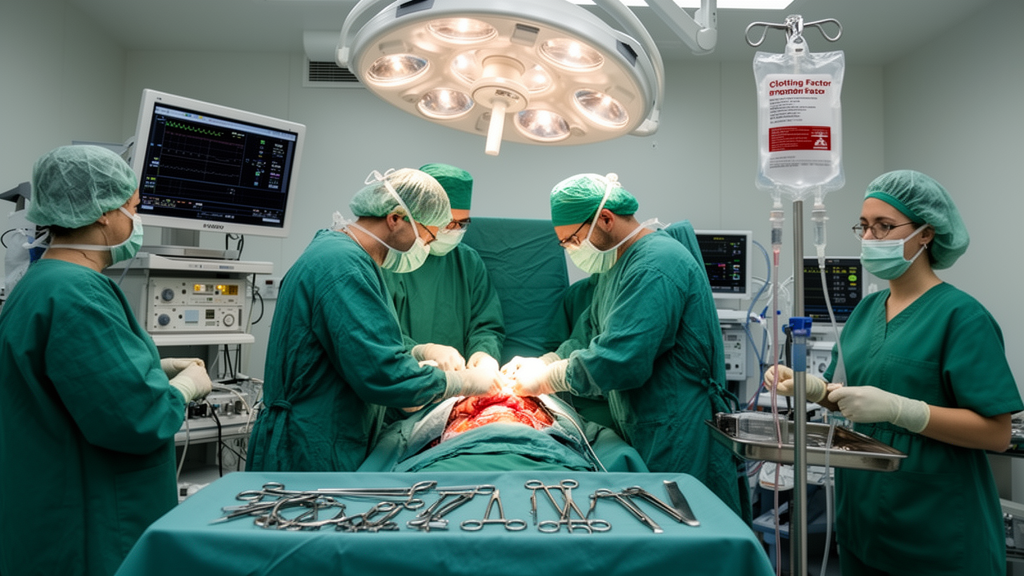
A 63-year-old man with severe hemophilia B has undergone emergency total arch replacement for acute type A aortic dissection using an extended half-life factor IX product, in a case reported in the journal General Thoracic and Cardiovascular Surgery Cases. The patient, whose baseline factor IX activity was below 1 percent, received intermittent doses of eftrenonacog alfa, marketed as Alprolix, before and after a complex operation that required cardiopulmonary bypass and circulatory arrest. The surgical team reports that intraoperative and postoperative bleeding volumes fell within ranges comparable to those seen in standard complex aortic surgery, and that the postoperative course was uneventful.
The case is notable because emergency cardiovascular surgery in patients with severe hemophilia B is extremely rare, and the perioperative coagulation management of such patients is a major challenge. According to the report, published accounts of perioperative management using intermittent administration of an extended half-life factor IX product in this setting remain extremely limited. The authors, led by Tessho Kitamura, describe how the dosing strategy was designed, how anticoagulation was monitored during bypass, and why the team relied on clinical assessment of hemostasis rather than direct factor IX measurements after surgery.
The patient first presented to a local hospital with sudden onset of chest and back pain. Contrast-enhanced computed tomography revealed an acute Stanford type A aortic dissection with a patent false lumen and an entry tear distal to the origin of the left subclavian artery, and he was transferred for emergency surgery. His medical history included severe hemophilia B, diagnosed at age 30 during an evaluation for prolonged activated partial thromboplastin time. He had not been receiving regular prophylactic replacement therapy. On admission he was alert and hemodynamically stable, weighing 63 kilograms, with hemoglobin of 13.5 g/dL, a platelet count of 295,000 per microliter, APTT of 53.8 seconds, fibrinogen of 427 mg/dL, and factor IX activity below 1 percent.
Severe hemophilia B is defined by factor IX activity below 1 percent and is described in the report as particularly rare, with hemophilia B accounting for approximately 3.8 per 100,000 males. Hemophilia is an X-linked inherited bleeding disorder. Advances in replacement therapy have improved life expectancy for patients with hemophilia, which the authors note has resulted in an increased incidence of age-related cardiovascular diseases. However, most reported cases of cardiac surgery in patients with hemophilia involve elective procedures, and emergency surgery for acute type A aortic dissection remains uncommon, leaving limited published guidance for the emergency setting.
Based on World Federation of Hemophilia guidelines, and considering the high bleeding risk associated with cardiopulmonary bypass and circulatory arrest, the team set a target factor IX activity of 80 to 100 percent and administered 5000 IU of eftrenonacog alfa, approximately 80 IU per kilogram. The dosing regimen was determined in consultation with hematologists, taking into account the pharmacokinetic characteristics of the product and the expected reduction in coagulation factor activity during cardiopulmonary bypass. Current guidelines recommend maintaining factor IX activity at 80 to 100 percent during major surgery. During bypass, coagulation factors are reduced through hemodilution and consumption, which necessitates careful perioperative management and additional dosing.
The operation was performed through a median sternotomy. Cardiopulmonary bypass was established with arterial inflow via the right axillary and right femoral arteries and venous drainage via the right atrium. Circulatory arrest was initiated at a rectal temperature of 28 degrees Celsius, with bilateral selective cerebral perfusion. The distal anastomosis was performed in zone 2, between the left common carotid and left subclavian arteries, and a J Graft Open stent measuring 25 by 120 millimeters was deployed. Total arch replacement was completed using a four-branched J-graft of 24 millimeters. Before systemic heparinization, the baseline activated clotting time was 164 seconds; standard-dose heparinization followed, and the activated clotting time was maintained above 500 seconds throughout bypass. Protamine reversal was performed in a standard manner, returning the activated clotting time to 137 seconds. An additional dose of eftrenonacog alfa was given six hours after the initial dose, and the team reports that satisfactory hemostasis was achieved after weaning from bypass.
The operative timeline underscores the scale of the procedure: total operative time was 456 minutes, cardiopulmonary bypass time 246 minutes, aortic cross-clamp time 159 minutes, selective cerebral perfusion time 82 minutes, and circulatory arrest time 59 minutes. Intraoperative blood loss was 1343 milliliters, and the patient received 6 units of red blood cells, 12 units of fresh frozen plasma, and 20 units of platelets. After surgery, drainage was low at 225 milliliters, and no additional transfusion was required beyond autologous salvaged blood. The patient was extubated on postoperative day 3 and discharged from the intensive care unit on postoperative day 5. Postoperative contrast-enhanced computed tomography revealed no anastomotic complications, bleeding, or residual malperfusion, and the patient was discharged in good condition.
A distinctive feature of the case is how postoperative replacement therapy was monitored. Because rapid measurement of factor IX activity was unavailable at the institution, since the assays were outsourced and could not be performed quickly, the team based replacement therapy primarily on clinical assessment of hemostasis, with serial activated partial thromboplastin time measurements used only as supportive information. Intraoperative anticoagulation during bypass was managed with standard activated clotting time monitoring. From postoperative days 1 to 3, 5000 IU of eftrenonacog alfa was administered every 24 hours, followed by 3000 IU every 48 hours on postoperative days 4 and 6. Invasive procedures, including removal of temporary pacing wires and drains, were performed during the factor replacement therapy. The authors are explicit that APTT should not be regarded as a surrogate marker for factor IX activity, because it is influenced by deficiencies of other intrinsic coagulation factors, heparin exposure, lupus anticoagulant, and assay reagents, and because cardiopulmonary bypass itself alters coagulation through hemodilution and factor consumption. No predefined APTT target was adopted; instead, therapy was guided by the planned dosing regimen and clinical assessment, and APTT values remained relatively stable throughout the postoperative period.
The authors contrast this approach with previous reports of emergency acute type A aortic dissection surgery in patients with hemophilia, which described successful management using continuous infusion of standard half-life coagulation factor concentrates with serial factor activity monitoring and no major bleeding complications; both of those patients had mild hemophilia. In the present case, the patient had severe hemophilia B and was managed with intermittent administration of an extended half-life factor IX product, without continuous infusion or serial factor IX activity measurements. Extended half-life products such as eftrenonacog alfa allow less frequent dosing and more stable factor activity owing to their prolonged circulation time, an advantage the authors suggest may be particularly beneficial in emergency cardiovascular surgery, where continuous infusion is often impractical. No excessive bleeding or re-exploration for bleeding occurred, and the authors note that perioperative transfusion requirements were within the range reported in contemporary acute type A aortic dissection surgery, while acknowledging that direct comparison is difficult because of differences in patient characteristics, surgical procedures, and institutional transfusion practices.
The report carries clear limitations. Serial factor IX activity measurements were unavailable, so the achievement and maintenance of the intended target activity of 80 to 100 percent could not be directly confirmed. The authors also caution that direct comparison with previous reports is limited by differences in patient characteristics and surgical procedures, and they state that further clinical experience is required to establish the optimal dosing strategy and monitoring protocol. Within those constraints, they conclude that intermittent administration of an extended half-life factor IX product may be a practical option for perioperative coagulation management during emergency aortic surgery in patients with severe hemophilia B, and that the prolonged half-life of eftrenonacog alfa may facilitate replacement therapy in emergency settings where continuous infusion is impractical. As a single-patient case report, the findings describe one successful clinical experience rather than evidence of general efficacy, but they document a feasible approach to a rare and high-stakes perioperative problem.
Subject of Research: Perioperative coagulation management with extended half-life factor IX during emergency aortic dissection surgery in a patient with severe hemophilia B
Article Title: Perioperative management of acute type A aortic dissection using extended half-life factor IX (Alprolix) in a patient with severe hemophilia B: a case report
Article References: Kitamura, T., Ryu, Y., Nakaji, S., & Taniguchi, S. (2026). Perioperative management of acute type A aortic dissection using extended half-life factor IX (Alprolix) in a patient with severe hemophilia B: a case report. General Thoracic and Cardiovascular Surgery Cases, 5(1), Article 47. https://doi.org/10.1186/s44215-026-00282-1
Image Credits: AI Generated
DOI: 10.1186/s44215-026-00282-1
Keywords: hemophilia B, factor IX, eftrenonacog alfa, Alprolix, aortic dissection, total arch replacement, cardiopulmonary bypass, circulatory arrest, APTT, coagulation management, case report, emergency surgery
News Source: Ophelia Keating. (October 28, 2026). Emergency Aortic Dissection Surgery in Severe Hemophilia B Managed with Extended Half-Life Factor IX. Scienmag.