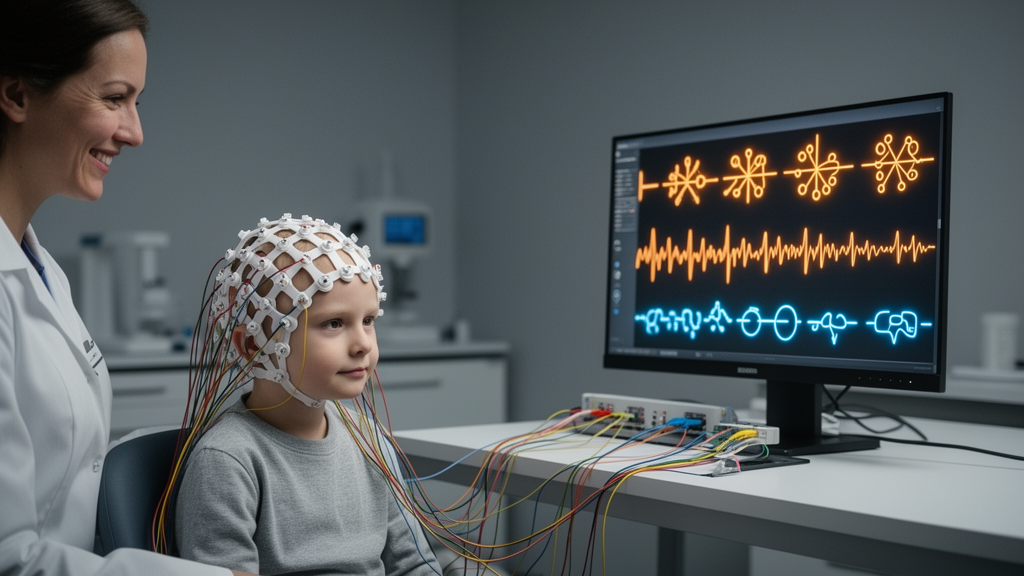
Researchers have combined a nonlinear way of rewriting brain signals into symbolic sequences with a deep learning network that reads those sequences over time, reporting that the pairing can tell the EEG recordings of children with attention deficit hyperactivity disorder apart from those of typically developing children with a mean cross-validated accuracy of 96 percent. The study, published in BMC Biomedical Engineering, analyzed electroencephalogram data collected from 61 children diagnosed with ADHD and 60 age-matched healthy controls while the children performed a visual attention task.
The EEG recordings were made with 19 electrodes placed according to the international 10-20 system, referenced to earlobe electrodes, at a sampling rate of 128 Hz with 16-bit resolution. The children with ADHD, 48 boys and 13 girls with an average age of 9.62 years, had been diagnosed by a child psychiatrist using DSM-IV criteria at Roozbeh Hospital in Tehran. The control group, 50 boys and 10 girls averaging 9.85 years, was recruited from local primary schools and confirmed to have no psychiatric conditions. All participants were right-handed, school-aged children, and parents provided written consent under an approved ethical protocol.
During the recording session, each child counted characters displayed in a series of 20 images, with the number of characters per image ranging randomly from 5 to 16. A new image appeared immediately after the child responded, keeping stimulation continuous throughout the session. No feedback or rewards were given for correct or incorrect answers. Because recording time depended on how quickly each child completed the task, the shortest recording lasted 50 seconds for a control subject and the longest 285 seconds for a participant with ADHD. On average, control children contributed about 13 segments of data and children with ADHD about 16.
Before analysis, the signals passed through a preprocessing pipeline that included manual removal of eye-movement and muscle artifacts, reconstruction of faulty channels from neighboring electrodes, band-pass filtering between 0.5 and 48 Hz, line-noise removal, and independent component analysis to exclude components associated with blinks and muscle activity. The cleaned signals were then filtered into standard frequency bands from delta through lower gamma using zero-phase filters to avoid phase distortion. The data were segmented into 8-second epochs for handling, although the classification experiments ultimately relied on longer continuous windows.
The core methodological innovation lies in how the signals are symbolized. The researchers reconstructed a 19-dimensional phase space in which each sample point is a state vector built from the simultaneous activity of all 19 EEG channels. They then partitioned this space spherically: the Euclidean distance of every trajectory point from the center of the hypersphere, defined by the mean across channels, is computed, and the radial distances are divided into symbolic regions. Rather than fixing the number of symbols in advance, the team used an entropy-based criterion, increasing the number of partitions until the gain in Shannon entropy from adding another symbol fell below a threshold, indicating that further subdivision would add negligible information. Maximum-entropy partitioning of this kind produces symbol sequences in which each symbol is roughly equally probable, making the representation more informative than conventional mean-, median-, or threshold-based schemes that can yield unbalanced or information-poor symbol distributions.
Once the phase-space trajectories were converted into symbolic sequences, the researchers tested two classification strategies. The first compared each subject’s symbolic vector with class reference vectors, built by averaging symbolic sequences from other subjects in each group, using cosine similarity, a metric that depends only on the orientation of two vectors and not their magnitudes. Despite its theoretical suitability for symbol-based representations, this static approach performed poorly: about 42 percent accuracy on full-length recordings from 47 children with ADHD and 46 controls after data cleaning, and even lower, 31 percent and 18 percent, on uninterrupted 40-second and 20-second segments respectively. The authors interpret this as evidence that static similarity metrics cannot capture the temporal and nonlinear dynamics embedded in the symbolic EEG patterns.
The second strategy replaced static similarity with a bidirectional long short-term memory network, a recurrent architecture that reads sequences in both forward and reverse directions and can therefore learn long-range temporal dependencies. The network contained two stacked bidirectional LSTM layers with 128 and 64 units, dropout regularization of 0.2, a 32-unit fully connected layer, and a sigmoid output for binary classification. It was trained with stochastic gradient descent at a learning rate of 0.1, a batch size of 32, and up to 100 epochs, with early stopping after 10 epochs without improvement. Training used jittering and time-warping augmentation, and evaluation followed a stratified 10-fold cross-validation scheme in which all segments from a given participant were confined to a single fold, preventing information leakage across subjects.
Window length proved to be a decisive design choice. Using full-length recordings, the model reached only about 53 percent accuracy, and 40-second segments yielded an intermediate 71 percent. Twenty-second continuous segments from all 19 channels produced the best result: a mean accuracy of 96 percent plus or minus 3 percent, with a 95 percent confidence interval of 94 to 98 percent, and corresponding sensitivity, specificity, precision, F1-score, and AUC of 95, 93, 95, 94, and 94 percent respectively. In a leave-one-subject-out validation, a stricter test in which each model is evaluated on a subject never seen during training, accuracy was 93 percent with sensitivity and specificity of 92 percent each, an F1-score of 91 percent, and an AUC of 92 percent. The authors emphasize that these figures reflect window-based classification and do not by themselves constitute subject-level clinical diagnosis.
The team is candid about the limits of the work. The sample, though comparable to or larger than many prior studies, remains modest, and all participants were right-handed school-aged children from a single geographic region, restricting generalizability. Manual artifact rejection introduces some subjectivity, the study addressed only binary ADHD-versus-control classification even though ADHD is heterogeneous with multiple subtypes, and no comprehensive component-wise ablation was performed to quantify how much each element, the spherical partitioning, the entropy optimization, the recurrent architecture, or the augmentation, contributes to the result. Internal cross-validation, however consistent, cannot substitute for validation on independent populations, and the authors argue that external testing without retraining on the external cohort would be needed to assess true generalizability across different EEG systems and recording protocols.
Symbolic dynamics compresses noisy, high-dimensional, non-stationary neural activity into discrete sequences that are inherently resistant to measurement noise, and maximum-entropy spherical partitioning ensures those sequences carry as much information as the data allow. Pairing that representation with a recurrent network capable of modeling temporal order lifted performance far above what the same representation achieved with a static similarity metric. The authors position the framework as a promising research approach for EEG-based ADHD classification rather than a clinically validated screening tool, and they call for larger, multi-site, more diverse cohorts, exploration of multiclass classification across ADHD subtypes and comorbidities, and integration with behavioral and neuropsychological data in future work.
Subject of Research: EEG-based classification of ADHD in children using symbolic time series analysis and deep learning
Article Title: ADHD classification using spherical phase space partitioning and symbolic time series analysis of multi-channel EEG signals
Article References: Songhori, N., Niknam, N., Eslamiyan, E., & Solhirad, M. (2026). ADHD classification using spherical phase space partitioning and symbolic time series analysis of multi-channel EEG signals. BMC Biomedical Engineering, 8(1), Article 16. https://doi.org/10.1186/s42490-026-00119-6
Image Credits: AI Generated
DOI: 10.1186/s42490-026-00119-6
Keywords: ADHD, EEG, symbolic time series analysis, phase space partitioning, entropy, deep learning, bidirectional LSTM, cosine similarity, children, neurodevelopmental disorders, cross-validation, biomedical signal processing
News Source: Blake Davidson. (October 28, 2026). Deep learning of symbolic EEG patterns detects ADHD with 96% accuracy in children. Scienmag.