Credit: Kevin Lim, Yong Chern Han, Cedric Ng
Singapore, 9 October 2017 – Scientists from the Humphrey Oei Institute of Cancer Research, National Cancer Centre Singapore (NCCS) and Duke-NUS Medical School, Singapore have achieved a world's first by deciphering the complete genetic map of durian – a prized tropical fruit delicacy known in Asia as the "king of fruits". The Singapore team's efforts were driven by both innate scientific curiosity and a love of the fruit, and funded by private donations from anonymous durian devotees.
"Being a geneticist, I was naturally curious about the Durian genome- what gene causes its pungent smell? How did its spiny husk arise?" said study co-lead author Professor Teh Bin Tean, a durian lover and currently the Deputy Director of the National Cancer Centre Singapore.
Using state-of-the-art sequencing platforms, the team mapped the genome of a particular durian variety called Musang King ("Mao Shan Wang" in Chinese), known for its exceptionally delicate texture and potent aroma and considered as the King of Kings in the local durian world. The team's analysis revealed that the durian genome comprises approximately 46,000 genes – almost double that in humans who have about 23,000 genes. Based on the newly generated genomic data, the team also studied the evolution of durian and traced its relationship 65 million years back to the cacao plant which produces chocolate.
The team also focused on the million dollar question – "What causes the durian's notorious smell?" By comparing gene activity patterns from different parts of the durian plant, including leaves, roots, and ripening fruits, they identified a class of genes called MGLs (methionine gamma lyases) that regulate the production of odour compounds called volatile sulfur compounds (VSCs).
"Our analysis revealed that VSC production is turbocharged in durian fruits, which fits with many people's opinions that durian smell has a 'sulphury' aspect," said co-lead author Professor Patrick Tan from Duke-NUS Medical School. The team speculates that in the wild, the ability of durians to produce high VSC levels and a pungent smell may be important in attracting animals to eat and disperse durian seeds to other regions.
The technological expertise developed by the team may also be applied to other plants, including those that may be of medicinal value.
Professor Soo Khee Chee, Director of the National Cancer Centre Singapore explained: "There is a long and distinguished history of medicines being discovered from plants. The best example is Taxol, the well-known drug used for treating breast cancer, and it is originally derived from the bark of the Pacific yew!"
The team notes that besides the specific durian species (Durio zibethenus) sequenced in this study, there are over 25 other durian species in nature, some are edible and some are not.
"Many of these other durian species are in this part of the world and sadly some are endangered due to the increasing loss of biodiversity. DNA sequencing is thus an important tool to protect the precious information contained in these fascinating and important plants," said Prof Teh.
Published in the prestigious journal Nature Genetics, the team has donated the Durian genome data to the National Parks Board, where they hope it will spur further durian research and education in Singapore and the region. The team also looks forward to working with the National Parks Board's botanists to study other plants, especially those endangered in the region due to increasing deforestation and industrialization.
###
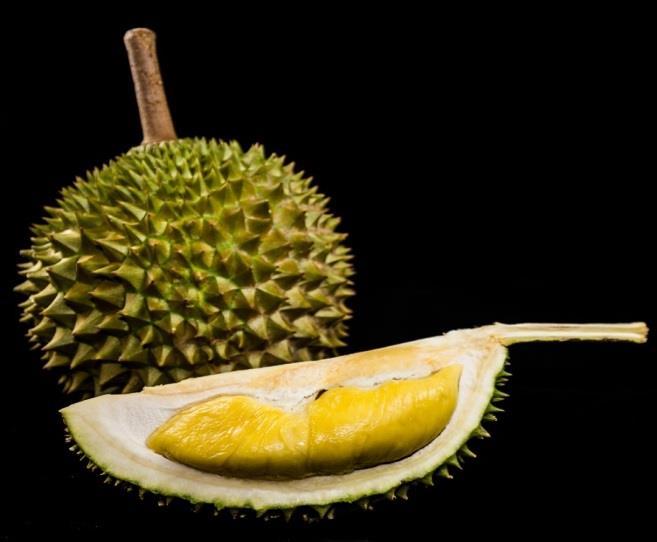
Photo graph of Durian (intact and opened)
Credit: Kevin Lim, Yong Chern Han, Cedric Ng
For more information, please contact:
Ms Rachel Tan
Office: 6236 9535
HP: 9754 0842
[email protected]
Manager, Corporate Communications
National Cancer Centre Singapore
Ms Siti Zawiyah
Office: 6236 9429
HP: 9457 5542
[email protected]
Senior Executive, Corporate Communications
About National Cancer Centre Singapore
National Cancer Centre Singapore (NCCS) provides a holistic and multi-disciplinary approach to cancer treatment and patient care. We treat almost 70 per cent of the public sector oncology cases, and they are benefiting from the sub-specialisation of our clinical oncologists. NCCS is also accredited by the US-based Joint Commission International for its quality patient care and safety. To deliver among the best in cancer treatment and care, our clinicians work closely with our scientists who conduct robust cutting-edge clinical and translational research programmes which are internationally recognised. NCCS strives to be a global leading cancer centre, and shares its expertise and knowledge by offering training to local and overseas medical professionals. http://www.nccs.com.sg
About Duke-NUS Medical School
The Duke-NUS Medical School (Duke-NUS) was established in 2005 as a strategic collaboration between the Duke University School of Medicine, located in North Carolina, USA, and the National University of Singapore (NUS). Duke-NUS offers a graduate-entry, 4-year MD (Doctor of Medicine) training programme based on the unique Duke model of education, with one year dedicated to independent study and research projects of a basic science or clinical nature. Duke-NUS also offers MD/PhD and PhD programmes. Duke-NUS has five Signature Research Programmes: Cancer and Stem Cell Biology, Neuroscience and Behavioural Disorders, Emerging Infectious Diseases, Cardiovascular and Metabolic Disorders, and Health Services and Systems Research.
Duke-NUS and SingHealth have established a strategic partnership in academic medicine that will guide and promote the future of medicine, tapping on and combining the collective strengths of SingHealth's clinical expertise and Duke-NUS' biomedical sciences research and medical education capabilities.
For more information, please visit http://www.duke-nus.edu.sg
Media Contact
Rachel Tan
[email protected]
65-623-69535
http://www.singhealth.com.sg/