An artificial intelligence application designed to score facial skin from ordinary photographs agreed with a human dermatologist on 83 percent of its ratings in a small preliminary study, according to a case series published in Dermatology and Therapy. The software, built on a deep learning neural network, evaluated 14 cosmetic skin parameters on 46 clinical photographs and produced scores that, after conversion to a common scale, fell within one point of the dermatologist’s ratings in the large majority of comparisons.
Evaluation of facial skin parameters matters for accurate diagnosis, the authors note, but human perception is tied to clinical encounters and may vary between them. Computerized systems can reduce that subjectivity and variation, and one approach is deep learning neural networks, a form of artificial intelligence that the authors say may maintain high fidelity across different lighting scenarios, image qualities, and patient postures.
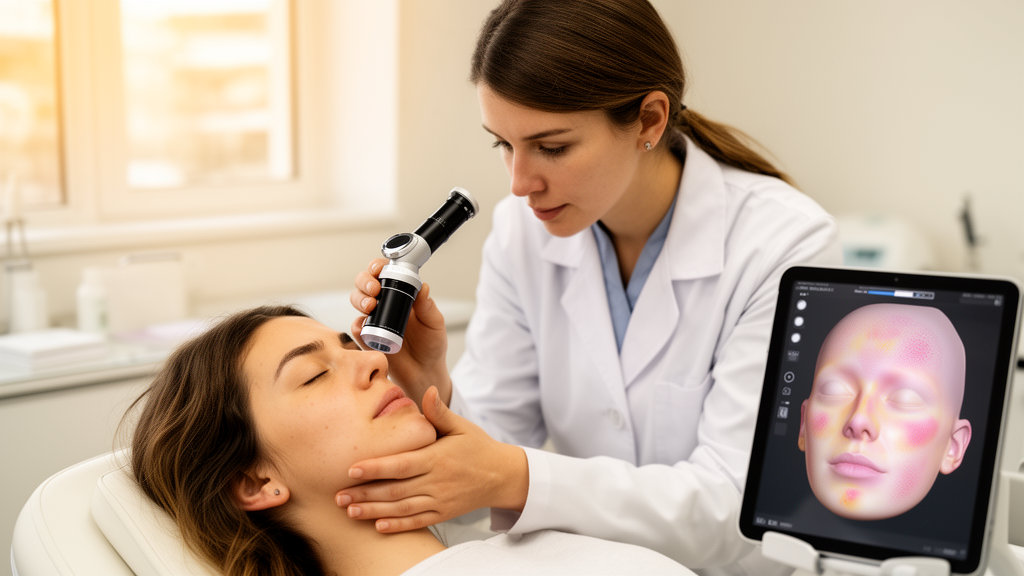
The researchers used an investigator version of a commercially available AI Skincare application, version 1.67, from the company Perfect Corp. The underlying model is a deep learning neural network trained on a database of 70,000 faces. The application captures a JPEG or PNG image, validates image quality, and then assigns raw scores between 0 and 100, where 100 represents flawless skin, to 14 parameters: age spots, eye bags, moisture, oiliness, redness, texture, wrinkles, acne, droopy lower eyelid, droopy upper eyelid, firmness, dark circles, radiance, and pores. The output includes an image with overlays highlighting the regions the AI analyzed. Notably, the patient-facing version of the application displays inflated scores, a design choice the authors say is intended to improve patient self-image.
To create a fair comparison, one expert dermatologist, blinded to the AI scores, rated the same photographs on a five-point scale ranging from 0 for clear skin to 4 for very severe involvement. The raw AI values were then mapped onto that same range based on the standard deviations of each parameter and reversed so that higher numbers indicated greater severity. Differences between the two raters were graded: a zero-point difference counted as complete agreement, one point as good, two points as poor, three points as very poor, and four points as worst. The team also calculated intraclass correlation coefficients using a two-way random-effects, absolute-agreement, single-rater model, with photographs showing the largest discrepancies reviewed qualitatively for possible causes. The study was approved by the Wake Forest University Institutional Review Board, and all participants signed written consent forms.
The 46 photographs came from 13 male and 33 female subjects, taken indoors under fluorescent lighting, some with flash and some without. One investigator assigned Fitzpatrick skin types, spanning types I through V with no type VI subjects, and estimated ages ranging from 10 to 79 years. When the ratings were compared, three parameters stood out for their reliability: redness showed complete or good agreement in 100 percent of comparisons, while eye bags and wrinkles each reached 96 percent. A middle tier of parameters, including radiance at 89 percent, dark circles at 84 percent, droopy lower eyelid at 82 percent, and oiliness, acne, and pores at 80 percent each, fell in the 80 to 90 percent range.
At the lower end, agreement dropped below 80 percent for several parameters. Texture and age spots each reached 78 percent, droopy upper eyelid 77 percent, moisture 72 percent, and firmness only 65 percent. Across all 644 rating comparisons, 37 percent showed complete agreement, 46 percent showed good agreement, 14 percent were poor, 2 percent very poor, and a small fraction showed the worst level of disagreement. Of all ratings made by both raters combined, 18 percent were scored as clear, 39 percent as mild, 28 percent as moderate, 10 percent as severe, and 5 percent as very severe, meaning most ratings fell in the intermediate range where exact matches are hardest to achieve.
The correlation analysis told a more demanding story. No parameter achieved good or excellent intraclass correlation. The strongest were wrinkles at 0.74, eye bags at 0.72, redness at 0.68, and acne at 0.61, all in the moderate range, while parameters such as moisture at 0.05 and droopy lower eyelid at a negative 0.14 showed essentially no correlation. The average across all 14 parameters was 0.41. The authors argue that this exact-match correlation statistic may be overly stringent for their design, because it requires precise agreement and may underestimate correlation when ratings are close but not identical. They also point out that the five-point scale omitted half-points, so a full point difference constituted 20 percent of the entire scale, and the transformation of raw AI scores created a binning effect in which two ratings near a cutoff could yield a one-point difference after conversion.
The qualitative review of the largest disagreements revealed concrete failure modes. The AI sometimes mistook acne for age spots, overestimated a single spot, or failed to identify melasma. In moisture assessments it misinterpreted moisture levels and once mistook pityriasis alba, a common skin condition, for dryness. A single oiliness disagreement arose when the AI interpreted the high reflectance of a topical product as excess oil. Droopy eyelid disagreements stemmed from shadows or an oblique face angle, and several other disagreements involved overestimation without a clear cause. The authors suggest that the AI assesses parameters by isolated facial region, ignoring other possibly relevant areas, whereas human raters may infer information from features elsewhere on the face, for example judging hidden eyelids by laxity in other parts of the face or mentally correcting for head positioning.
The authors are candid about the study’s limitations. There was only a single human rater, the sample of 46 photographs was small and may not support high-confidence conclusions about the AI’s capabilities, the data underwent transformation, and the photographs were heterogeneous in angle and lighting. Moreover, the AI thresholds and ratings were tested on the same set of photographs used to derive them, making the interpretations cohort-dependent and limiting generalizability. The authors note that using bright, balanced lighting and front-facing images gives the AI the best opportunity to evaluate each parameter accurately, and that higher-quality photographs may improve its ratings.
Despite these caveats, the authors see promise in software-based facial analysis. Some computerized systems standardize head position and integrate dedicated cameras and lighting hardware for optimized performance, but they are typically costly and require in-office evaluations. Software-based systems lack that optimization, yet they can run on a variety of hand-held devices without costly hardware, offering low start-up costs, rapid data collection, and ease of use. The authors also draw a comparison with another AI comparison study, which reported exact-match accuracy with a single dermatologist rater of 78 to 95 percent for Fitzpatrick skin type, 69 to 97 percent for hyperpigmentation, 68 to 98 percent for redness, 81 to 97 percent for wrinkles, and a mean of 85 percent overall, with lower accuracy tending to occur at intermediate ratings. In this new study, single-dimensional parameters that leave little to interpretation performed better than multi-dimensional ones such as firmness, moisture, and texture, which integrate many qualities or require inference about lighting, shadows, or gravity.
Subject of Research: Agreement between an AI facial analysis application and a dermatologist in scoring facial skin parameters on clinical photographs
Article Title: Skin Parameter Scoring Using Artificial Intelligence: A Case Series
Article References: Huang, C. A., Buttar, B. A., Moran, S. K., McGrath, L., Taylor, S., & Feldman, S. R. (2026). Skin Parameter Scoring Using Artificial Intelligence: A Case Series. Dermatology and Therapy. https://doi.org/10.1007/s13555-026-01966-w
Image Credits: AI Generated
DOI: 10.1007/s13555-026-01966-w
Keywords: artificial intelligence, dermatology, facial analysis, skin parameters, case series, deep learning, neural network, clinical photographs, intraclass correlation, cosmetic dermatology, AI skincare application, human rater agreement
News Source: Blake Davidson. (October 28, 2026). AI Facial Analysis Matches Dermatologist Ratings on Most Skin Parameters in Small Case Series. Scienmag.