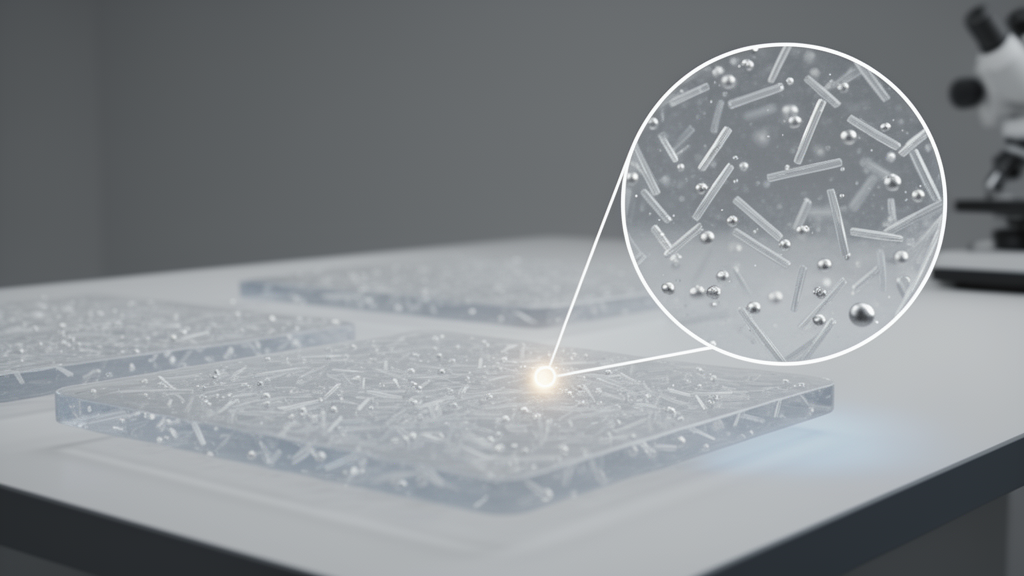
Researchers have fabricated multifunctional bio-nanocomposite films from chitosan reinforced with cellulose nanocrystals and silver nanoparticles, reporting that the type and loading of the nanocrystals strongly influence the films’ mechanical, structural and barrier properties. The work, published in Discover Materials, is described as an open-access, peer-reviewed accepted article that is citable and carries a permanent DOI, with a final version of record to follow.
The team, led by Ahmed Ramdani and Tarik Harit with colleagues including Mounir El Achaby and Fouad Malek, extracted cellulose microfibers from the Moroccan Alfa plant (Stipa tenacissima). These microfibers were then hydrolyzed with three different acids to produce three distinct cellulose nanocrystal variants: sulfated cellulose nanocrystals (S-CNC) from sulfuric acid, phosphorylated cellulose nanocrystals (P-CNC) from phosphoric acid, and hydroxylated cellulose nanocrystals (H-CNC) from hydrochloric acid. X-ray diffraction analysis confirmed that the crystallinity indices of all three modified celluloses were enhanced relative to the original cellulose microfibers.
The three nanocrystal types were incorporated into chitosan matrices at loadings ranging from 5 to 50 percent by weight, and each formulation was additionally reinforced with silver nanoparticles at 5 percent by weight. According to the reported mechanical, structural and barrier analyses, low nanocrystal contents ensured uniform dispersion within the films, whereas higher loadings above 25 percent induced agglomeration and compromised the films’ properties. The study therefore identifies both an optimal working range and a clear upper limit for nanocrystal incorporation in this system.
Several specific formulations stood out in the results. Films containing 5 percent hydroxylated cellulose nanocrystals showed the best reduction in water vapor permeability and displayed the highest hydrophobicity among all tested samples. Films with 25 percent hydroxylated nanocrystals exhibited a remarkable tensile strength of up to 59 megapascals. The 10 percent sulfated nanocrystal formulation provided a synergistic improvement in both tensile strength and barrier resistance, while the addition of phosphorylated nanocrystals contributed to enhanced stiffness and material durability.
The authors state that these results highlight the influence of the nature and percentage of the modified cellulose nanocrystals on the mechanical and barrier properties of chitosan-silver nanoparticle films, and consequently advance the design of sustainable high-performance nanostructured materials. Because the reported findings derive from the abstract of a peer-reviewed accepted manuscript that is subject to further edits before the final version of record, the detailed experimental conditions, statistical treatment and full characterization data will be available in the complete published article. The study’s scope covers film formulations prepared in the laboratory; the reported permeability, hydrophobicity and tensile measurements describe the tested samples rather than demonstrated performance in commercial applications.
Subject of Research: Chitosan bio-nanocomposite films reinforced with cellulose nanocrystals and silver nanoparticles
Article Title: Elaboration and properties study of chitosan bio-nanocomposites strengthened by cellulose nanocrystals and silver nanoparticles
Article References: Ramdani, A., Harit, T., Kasbaji, M., Jaouahar, M., Achaby, M. E., & Malek, F. (2026). Elaboration and properties study of chitosan bio-nanocomposites strengthened by cellulose nanocrystals and silver nanoparticles. Discover Materials. https://doi.org/10.1007/s43939-026-01026-2
Image Credits: AI Generated
DOI: 10.1007/s43939-026-01026-2
Keywords: chitosan, cellulose nanocrystals, silver nanoparticles, bio-nanocomposites, Alfa plant, water vapor permeability, tensile strength, hydrophobicity, sustainable materials, Discover Materials, Elaboration, properties
News Source: Denise Maddox. (October 28, 2026). Chitosan Films Reinforced with Alfa-Derived Cellulose Nanocrystals and Silver Nanoparticles. Scienmag.