Deep beneath the arid plateaus of central Iran, tiny blind crustaceans have been quietly diverging from their relatives in isolated springs, and a new study argues that only molecular tools could have revealed them. Researchers sampling the stygobiont amphipod genus Niphargus from three springs in the Namak lagoon sub-basin of the Central Plateau basin have described two species new to science, Niphargus hamedanensis and Niphargus arakensis, in an open-access paper published in BMC Zoology on 24 October 2026. The finding is less a dramatic discovery of bizarre creatures than a demonstration of how much biodiversity hides in plain sight, morphologically nearly identical to known species yet genetically distinct enough to be considered separate lineages.
The challenge the researchers faced is a classic problem in subterranean biology. Groundwater animals across the world converge on a suite of adaptations collectively called troglomorphy: loss of pigmentation, degeneration of eyes, and shifts in life-history strategy, all responses to permanent darkness and severe energy limitation. Because similar selective pressures act on unrelated or closely related lineages, morphology can be actively misleading. Species that look alike may be genetically far apart, and the amphipod genus Niphargus, widespread in subterranean freshwaters of the Western Palearctic, is a notorious case. All of its members show some degree of troglomorphic traits, and numerous studies have documented species pairs occupying similar microhabitats with very little morphological differentiation. For such groups, DNA-based approaches are not a luxury but a necessity for accurate detection and delimitation of species.
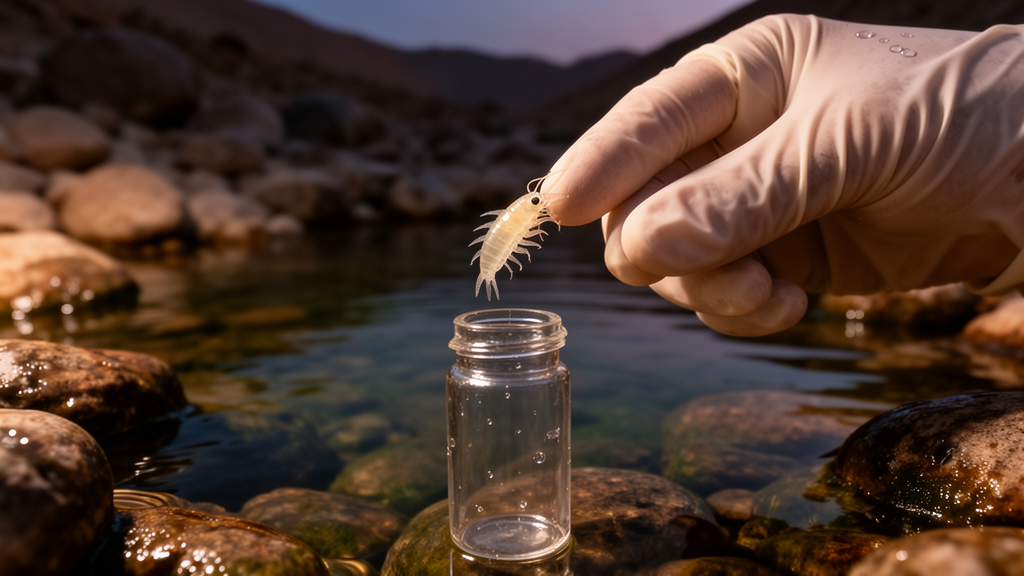
The team, led by Seyyed Ahmad Mirghaffari of Razi University together with Cene Fišer and Somayeh Esmaeili-Rineh, collected amphipods from natural springs using nested sieves with mesh sizes of 1 mm, 0.6 mm and 0.2 mm, preserving specimens in ethanol for laboratory work. Three localities contributed material: Gardan-e-Heyran and Flojerd springs in Markazi Province, and Famenin Spring in Hamedan Province. Nine individuals in total, three from each spring, were sequenced. The researchers targeted two genetic markers standard in Niphargus phylogenetics: a 513-base-pair fragment of the mitochondrial cytochrome c oxidase subunit I gene, COI, and a 902-base-pair fragment of the nuclear 28S ribosomal RNA gene. Sequences were deposited in GenBank under accession numbers PZ403457 to PZ403465 for 28S and PZ404173 to PZ404181 for COI, and voucher specimens were deposited in the Zoological Collection of Razi University.
The molecular results were strikingly asymmetric between the two genomes. The mitochondrial COI fragment, by contrast, exhibited substantially greater divergence. Individuals from Famenin and Flojerd shared identical haplotypes for both markers, while Gardan-e-Heyran specimens carried unique haplotypes for both. Pairwise distances calculated under the Kimura two-parameter model showed that the Gardan-e-Heyran and Flojerd populations constitute a single species, with an intraspecific distance of just 0.02 percent, yet that species sits 5 to 6 percent away from its closest relative, N. alisadri, and 5 percent away from the Famenin population. The Famenin animals were most similar to N. alisadri, at 4 percent divergence.
Phylogenetic reconstruction placed all three populations firmly within the N. alisadri subclade, nested inside a broader Middle Eastern clade. Maximum-likelihood inference in IQ-TREE under the SYM + I + G4 substitution model, selected by the Bayesian Information Criterion, and Bayesian analysis in MrBayes under the TIM3 + I + G model for 28S and GTR + I + G for COI, run for 15 million generations, congruently grouped the new populations with N. zagrosensis and N. alisadri in a well-supported subclade of a tree built from 81 Niphargus specimens. Species delimitation then came from two independent approaches: the distance-based Assemble Species by Automatic Partitioning, run with parameters Pmin 0.001 and Pmax 0.10, and the tree-based Bayesian Poisson Tree Processes run on a COI phylogeny with 100,000 MCMC generations. Both methods agreed that the newly discovered individuals comprise two distinct species, both new to science.
Morphology, examined on dissected and slide-mounted specimens under a stereomicroscope with digital image analysis, confirmed subtle but consistent differences. Niphargus arakensis, whose holotype is an 11.5 mm male from Flojerd Spring near Tafresh City, resembles N. alisadri closely but can be distinguished by a maxilla I outer lobe bearing more numerous pectinate spines, all with more than two subapical denticles, a maxilla I palp extending beyond the tip of the outer lobe, and a more trapezoid propodus on the first gnathopod. Niphargus hamedanensis, with a 10 mm male holotype from Gol-e-Khandan Spring near Famenin, differs from N. alisadri in a less setose distal article of the mandibular palp, a smaller propodus of the first gnathopod, and remarkably broader lobes on the bases of pereopods V to VII. The specific epithets honour Arak city and Hamedan province respectively. Females remain unknown for both species, and the authors note that insights into intraspecific variation are limited by the small number of available individuals.
Why describe species on the basis of such small differences? The authors’ answer lies in how the evidence combines. Despite the absence of nuclear 28S differentiation, only minor morphological distinctions, and relatively low mitochondrial divergence from N. alisadri, the combined signal from mtDNA and functional trait variation points to independent evolutionary histories, likely associated with functional divergence and differential resource exploitation. They are explicit about the limits of their data: the present results cannot exclude the possibility of inter-population fertility or incomplete reproductive isolation, and no study to date has robustly tested reproductive barriers among allopatric groundwater species. The claim is therefore one of diagnosable, independently evolving lineages, not of proven biological isolation.
The genetic distances themselves sit at the low end of what Iranian Niphargus typically show. Previous studies on Iranian species of the genus reported interspecific COI divergences of roughly 3.8 to 25.8 percent, and the 3.8 percent figure corresponds to the lower boundary of genetic differentiation associated with reproductive barriers in cryptic Gammarus amphipods. In the new dataset, only the comparison between N. persicus and N. darvishi falls at that boundary, while most species-pair comparisons substantially exceed it. The new species, at 4 to 6 percent from N. alisadri and 5 percent from each other, occupy the shallow end of this spectrum. The authors suggest that the observed morphological similarity among these lineages may reflect the recency of divergence rather than morphological stasis, though they acknowledge this inference remains indirect in the absence of a time-calibrated phylogeny. The low genetic distances indicate a recent split, while the minor functional differences imply the species may exploit ecological opportunities differently on a local scale, with further morphological divergence potentially accumulating over time.
Geography offers a plausible mechanism. All three populations inhabit springs at higher altitudes, and the authors point to warmer lowland areas as potential barriers to inter-population dispersal. They consider it plausible that climatic oscillations over the past two million years drove the divergence of local Zagros populations, paralleling patterns documented in the European Alps. On this reading, the new species represent an early, allopatric stage of speciation in high-altitude refugia, a snapshot of lineages beginning to separate before morphology has had time to catch up with genetics. This is precisely what makes the system scientifically valuable: the authors propose these species as a model system for evaluating speciation in action, where future studies of physiology, ecology, life histories and behaviour could illuminate the mechanisms driving speciation in groundwater organisms.
The broader lesson extends beyond Iranian amphipods. Groundwater ecosystems harbour a taxonomically and functionally diverse fauna that remains largely undiscovered or formally undescribed, and even described taxa often lack well-resolved geographic distributions, phylogenetic relationships and ecosystem functional roles. The inaccessibility of subterranean habitats, which receive far less systematic exploration than surface environments, makes groundwater biodiversity among the most poorly resolved components of global biodiversity. Formal naming of emerging species, the authors argue, is essential for their protection and for preserving the ongoing processes of speciation and adaptation, citing cases where poor management has led to reverse speciation. In the springs of the Namak lagoon sub-basin, molecular methods have turned what morphology alone would have dismissed as marginal variants of a known species into two diagnosable lineages with their own evolutionary trajectories, a reminder that the census of subterranean life is still in its earliest chapters.
Subject of Research: Cryptic species delimitation in groundwater amphipods of Iran using molecular and morphological evidence
Article Title: Cryptic diversity in groundwater amphipods of Iran: insights from morphological and molecular approaches
Article References: Mirghaffari, S. A., Fišer, C., & Esmaeili-Rineh, S. (2026). Cryptic diversity in groundwater amphipods of Iran: insights from morphological and molecular approaches. BMC Zoology, 11(1), Article 35. https://doi.org/10.1186/s40850-026-00295-x
Image Credits: AI Generated
DOI: 10.1186/s40850-026-00295-x
Keywords: Niphargus, groundwater biodiversity, cryptic species, COI barcoding, species delimitation, Iran, styogfauna, troglomorphy, speciation, amphipods, taxonomy, BMC Zoology
News Source: Drew Townsend. (October 28, 2026). Two New Cryptic Amphipod Species Emerge from Iranian Groundwater Springs. Scienmag.