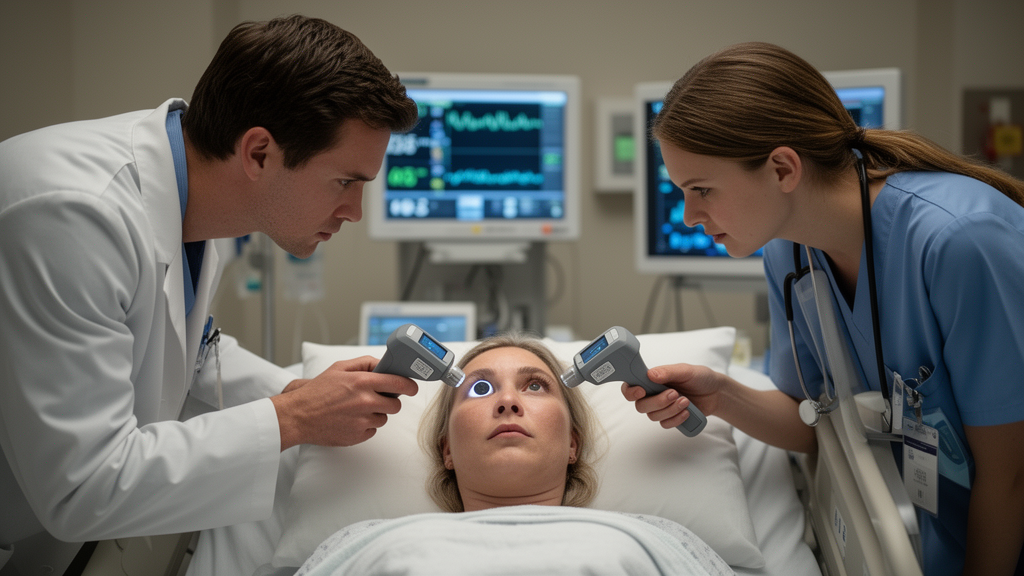
When two bedside pupil measurements disagree in a brain-injured patient, clinicians may wonder whether the mismatch itself carries a warning. A new Matters Arising letter published in Critical Care argues that, in the case of the neurological pupil index (NPi) and the quantitative pupil index (QPi), the discordance is explained mainly by measurement properties rather than by an additional physiological signal, with two dominant contributors: the integer scale of the QPi and its sensitivity to sedation-induced miosis.
The letter, written by Pierre Bouzat, Antoine Vilotitch, Tobias Gauss and Fabio Silvio Taccone, responds to a question raised about the LYNX study, which compared the two indices in brain-injured patients. The question was whether a QPi that reads abnormal while the NPi remains normal carries prognostic information beyond the NPi, or whether the disagreement reflects differences in how the two indices are constructed and measured. The authors conclude that their data point mainly to the second explanation.
The first contributor is arithmetic. The NPi is a continuous variable reported to one decimal place on a scale from 0 to 4.9, whereas the QPi is recorded as an integer from 0 to 5. With a threshold of less than 3, an abnormal QPi means a value of 2 or less, and a single-step change separates a normal from an abnormal reading. The two indices are also not centred at the same position relative to the threshold: in brain-injured patients, the median NPi was 4.3, while the median QPi was exactly 3, sitting on the boundary. A Bland–Altman analysis showed a systematic positive mean difference between the two indices.
Under these conditions, the authors argue, the tenfold difference in the median proportion of abnormal values, 12.7 percent for one index versus 1.2 percent for the other, is what the scale and threshold alone would be expected to produce, without invoking any additional physiological signal. The influence of threshold choice is further illustrated by the median proportion of QPi values below 4, which reached 51.4 percent in the cohort, while healthy volunteers almost exclusively displayed values of 5.
The second contributor is pharmacology. Discordance of the type in which the QPi is abnormal while the NPi is normal matches the pattern the researchers observed under anaesthesia. In sedated patients without brain injury, sufentanil alone lowered the mean QPi below the threshold of 3 while the NPi remained above 4, and propofol reduced the QPi to a median of 1 with an NPi of 4.0. QPi values below 3 occurred almost exclusively at resting pupil diameters below approximately 2.7 millimetres.
The explanation lies in how the QPi is calculated. Because it is derived from percent constriction, it falls as the resting diameter shrinks, regardless of whether the reflex arc itself is intact. In patients without any brain injury, the discordant pattern was produced by opioids and hypnotics alone. The authors also note that the association between abnormal QPi and intracranial hypertension, which the NPi did not share, is consistent with this interpretation: raised intracranial pressure tends to dilate the pupil and should, if anything, increase a percent-based index, whereas escalation of sedation produces miosis and lowers it.
Does discordance nevertheless carry prognostic information? The authors agree it should not be dismissed as pure noise. Patients who receive deeper or prolonged sedation are, on average, those with more severe injuries and higher therapeutic intensity. A QPi lowered by sedation may therefore remain associated with poor outcome, which could contribute to the somewhat larger odds ratio observed for the QPi in the adjusted models. However, the authors caution that such information would reflect treatment burden rather than brainstem function, and it would not be interpretable at the bedside as evidence of neurological deterioration.
Could the existing LYNX dataset answer the question directly? The authors considered a proposed within-patient analysis of discordant episodes but identified limitations that would make the results difficult to interpret. Resting pupil diameter was not recorded in the brain-injured patients, and sedation depth and cumulative drug doses were not collected with enough precision to be used as covariates. Without these variables, a discordant episode attributable to miosis cannot be distinguished from one attributable to neurological dysfunction, which is precisely the question at stake. In addition, because abnormal NPi values were rare, almost all abnormal QPi measurements fell into the discordant category, so such an analysis would largely reproduce the QPi model already reported. Testing the incremental value of the QPi would also require both indices, sedation exposure and pupil size in the same model, which the number of outcome events does not allow without a substantial risk of overfitting.
The authors therefore view the question as the right one for a future study rather than for a secondary analysis of LYNX. Such a study should record resting pupil diameter and sedation exposure at each measurement, use device-specific QPi thresholds validated against outcome, and ideally obtain a continuous or decimal QPi output. Until then, the authors maintain their conclusion: in sedated patients, an abnormal QPi with a normal NPi should first prompt an assessment of pupil size and sedative exposure, rather than being interpreted as an additional sign of brain dysfunction.
Subject of Research: Discordance between the neurological pupil index and quantitative pupil index in critically ill patients
Article Title: Discordance between pupillometry indices: a matter of scale and sedation
Article References: Bouzat, P., Vilotitch, A., Gauss, T., & Taccone, F. S. (2026). Discordance between pupillometry indices: a matter of scale and sedation. Critical Care, 30(1), Article 550. https://doi.org/10.1186/s13054-026-06428-5
Image Credits: AI Generated
DOI: 10.1186/s13054-026-06428-5
Keywords: pupillometry, NPi, QPi, LYNX study, brain injury, sedation, sufentanil, propofol, intracranial hypertension, critical care, miosis, Bland-Altman
News Source: Cassandra Pierce. (October 28, 2026). Pupil index disagreement in brain-injured patients traced to scale and sedation. Scienmag.