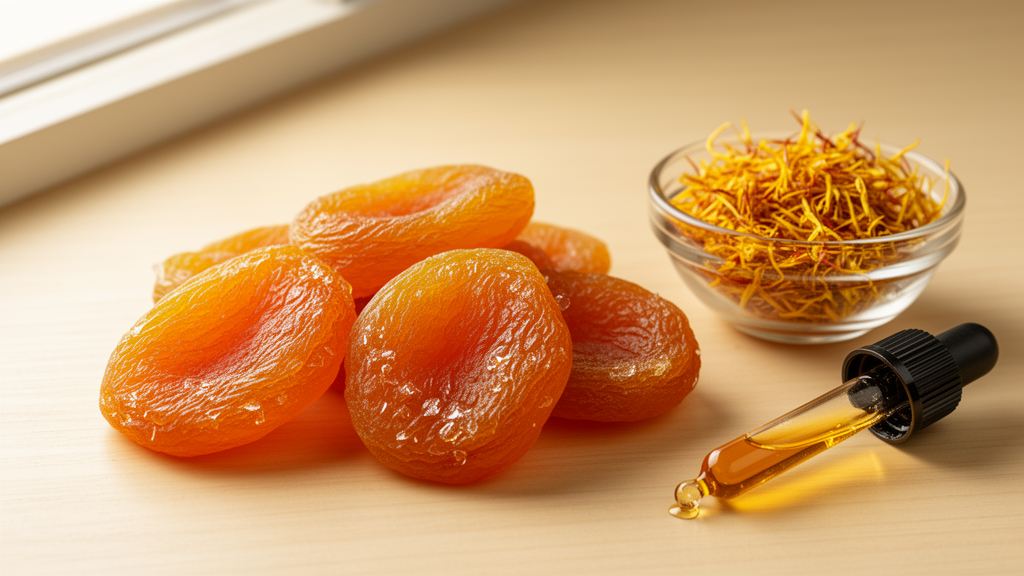
Researchers in Turkey have shown that an edible coating made from whey protein and enriched with safflower flower extract can sharply reduce microbial growth and moisture loss in dried apricots, keeping coated fruit noticeably better preserved than uncoated controls over three weeks of storage. In the study, published in the journal Biotechnology for Food Future, the strongest formulation, called EC4, cut counts of Escherichia coli to 4 × 10⁵ colony-forming units per milliliter and Candida albicans to 8 × 10⁵ cfu/mL after 21 days of refrigerated storage, while uncoated apricots lost more than 10 percent of their weight and coated samples lost only around 4 percent. The work offers a plant-based route to protecting one of Turkey’s most economically important dried fruits without relying on synthetic preservatives.
Edible films and coatings are packaging materials that preserve food while remaining safe to eat, and they can be applied by dipping, spraying, painting, casting, or extrusion. Dipping is the most widely used approach because it is simple and effective: fruit is immersed in the coating solution for a brief period of roughly 5 to 30 seconds, during which a uniform film layer forms on the surface. That thin layer provides protection against both physical damage and microbial deterioration. The new study builds on this established technique but adds a functional ingredient drawn from an underused agricultural crop, turning a passive barrier into an active antimicrobial and antioxidant system.
The functional ingredient in question comes from safflower, an annual oilseed crop of the Compositae family sometimes known as false saffron. The plant is valued for both its seeds and its flowers. Its seeds yield an edible oil rich in essential fatty acids, mainly oleic and linoleic acids, which together make up as much as 75 percent of the oil’s composition, while the by-product pulp contains roughly 40 percent protein and is used as animal feed. The flowers are notable for pigments such as carthamin and carthamidin, present at 0.3 to 0.6 percent, along with vitamins E, B-complex, and C and various minerals, all of which contribute to the flower’s antimicrobial and antioxidant activity. Because of its ecological adaptability, resistance to pests and diseases, and low production costs, safflower is considered a sustainable crop, and its flowers have long been used in traditional medicine and as coloring agents in foods and beverages.
The motivation for seeking natural alternatives is grounded in concerns about the synthetic additives currently in widespread use. Compounds such as butylated hydroxytoluene, butylated hydroxyanisole, and propyl gallate are commonly added to oil-rich foods as antioxidants, but worries over their potential toxicity and carcinogenic effects have limited consumer acceptance. At the same time, apricots are highly perishable because of rapid ripening and high respiration rates, and although methods including canning, freezing, controlled-atmosphere storage, and drying are used to prolong shelf life, sulfurization remains the most common commercial practice for preventing spoilage. Sulfite residues from that treatment have been associated with adverse health effects, including asthmatic reactions, which strengthens the case for plant-based preservation strategies.
The research team, led by Elif Özbey, cultivated the Dinçer variety of safflower from certified seeds in the experimental fields of Malatya Turgut Özal University in Battalgazi, Turkey, during the 2023 growing season under semi-arid conditions. Plants grew under natural daylight with average daytime temperatures of 24 ± 3 °C and moderate soil moisture maintained by drip irrigation. Flowers were harvested at full bloom, shade-dried, powdered, and homogenized. Ten grams of the dried flower powder was then extracted with 150 milliliters of 80 percent methanol in a Soxhlet apparatus, with the process performed in triplicate. After extraction, the methanol was completely evaporated under reduced pressure and the dried extract was re-dissolved in distilled water for use in the coating solutions, which were stored at 4 °C until needed.
The coating base followed a standard film-forming protocol. Whey isolate protein at 10 percent by weight was dissolved in deionized water and stirred for two hours, after which glycerol at 5 percent was added as a plasticizer. The solution was heated in a water bath at 80 ± 2 °C for 20 minutes under continuous stirring, cooled to 45 °C, and supplemented with 0.7 percent guar gum to enhance viscosity. Safflower flower extract was then incorporated at volumes of 0.5, 1.0, 1.5, and 2.0 milliliters, with all dispersions adjusted to a fixed final volume of 10 milliliters so that the extract amount could be evaluated relative to the total solution volume. The mixture was stirred at room temperature for 20 minutes, homogenized at 8000 rpm for 6 minutes, and its pH was adjusted to 7.0 with 0.1 M sodium hydroxide.
For testing, the team used two types of apricot samples of the Kabaaşı variety: sulfurized fruit and sun-dried fruit. Dried fruits were chosen deliberately because they provide a stable matrix suitable for controlled evaluation of coating efficiency and microbial inhibition during storage. Apricot pieces were cut into circular sections of roughly 1-centimeter diameter and 10 ± 2 grams, about 100 fruits in total, using a mushroom drilling apparatus, and uniformly ripened apricots were selected based on color and firmness. The surfaces were inoculated with 0.1 milliliters of liquid cultures of E. coli or C. albicans and held at 37 °C for 15 minutes to allow adhesion before the samples were dipped in the coating solutions. Coated and uncoated samples were then stored under two regimes, refrigerated at 4 °C and ambient conditions at 20 °C with 50 ± 5 percent relative humidity, for up to 21 days, with sampling on days 7, 14, and 21.
Microbial enumeration was carried out by placing apricots in 50-milliliter tubes with 25 milliliters of 0.09 percent physiological saline, vortexing for 3 minutes, preparing serial dilutions, and plating 1-milliliter aliquots on agar using the spread plate method. Bacterial cultures were incubated at 37 °C for 24 hours and yeast cultures at 28 °C. The results showed that in inoculated apricots stored at 4 °C, viable counts of both E. coli and C. albicans were consistently lower in coated samples than in controls, with the effect strengthening as extract concentration rose. The EC4 formulation, containing the highest extract level of 2.0 milliliters, produced the greatest inhibition, and sulfured apricots showed greater reductions in viable cells than sun-dried samples, which the authors attribute to a synergistic inhibitory effect between the sulfur treatment and the plant-based coating. Refrigeration itself slowed proliferation, but the coatings provided additional protection on top of it.
Complementary assays characterized the antimicrobial and antioxidant properties of the extracts and coatings themselves. Disk diffusion tests against a panel of ten microorganisms, including Staphylococcus aureus, Pseudomonas aeruginosa, Bacillus subtilis, Klebsiella pneumoniae, and Streptococcus pyogenes, with cefadroxil antibiotic disks as positive controls, gave a minimum inhibitory concentration of 5000 ppm for both E. coli and C. albicans by macrodilution broth. Pure safflower extract was more antimicrobial than the formulated coatings, with the strongest inhibition zone, 5 millimeters, observed against Bacillus spizizenii, while the coatings showed no inhibition against P. aeruginosa and C. albicans and their highest activity against S. pyogenes. Antioxidant capacity, measured by the DPPH radical scavenging assay at an absorbance of 517 nanometers, increased with extract concentration, and at a 1000-microliter aliquot the EC4 coating achieved the highest scavenging activity of 92.9 percent, significantly higher than the control at p < 0.05.
Weight loss measurements completed the picture of preservation performance. Because weight loss in dried fruit is primarily attributed to water evaporation during storage, the differences between coated and uncoated samples reflect the barrier function of the film. Whey protein isolate acts as an effective film-forming agent owing to its emulsifying and barrier properties, reducing moisture loss and oxygen permeability, and when combined with glycerol and guar gum it forms a semi-permeable layer that limits gas exchange and microbial colonization on the fruit surface. After 21 days, uncoated apricots had lost more than 10 percent of their initial weight while EC4-coated samples lost only about 4 percent. All experiments were performed in triplicate and analyzed by one-way ANOVA with Duncan’s multiple range test. The authors conclude that safflower flower extract, beyond its natural coloring and aromatic features, can serve as a functional additive in edible coatings, and they note that future studies should address scalability, cost-effectiveness, and applicability to other perishable fruits before such coatings can move toward broader use.
Subject of Research: A safflower flower extract-enriched whey protein edible coating that reduces microbial growth, oxidative degradation and weight loss in stored dried apricots.
Article Title: Effect of safflower flower extract-based edıble coatıng on the shelf lıfe and qualıty of aprıcots
Article References: Özbey, E. (2026). Effect of safflower flower extract-based edıble coatıng on the shelf lıfe and qualıty of aprıcots. Biotechnology for Food Future, 1(1), Article 2. https://doi.org/10.1186/s44496-026-00004-8
Image Credits: AI Generated
DOI: 10.1186/s44496-026-00004-8
Keywords: safflower, edible coating, dried apricots, food preservation, antimicrobial, antioxidant, whey protein, shelf life, natural preservatives, Carthamus tinctorius, DPPH, weight loss
News Source: Neil Sanderson. (October 28, 2026). Safflower Flower Extract Edible Coating Extends Dried Apricot Shelf Life. Scienmag.