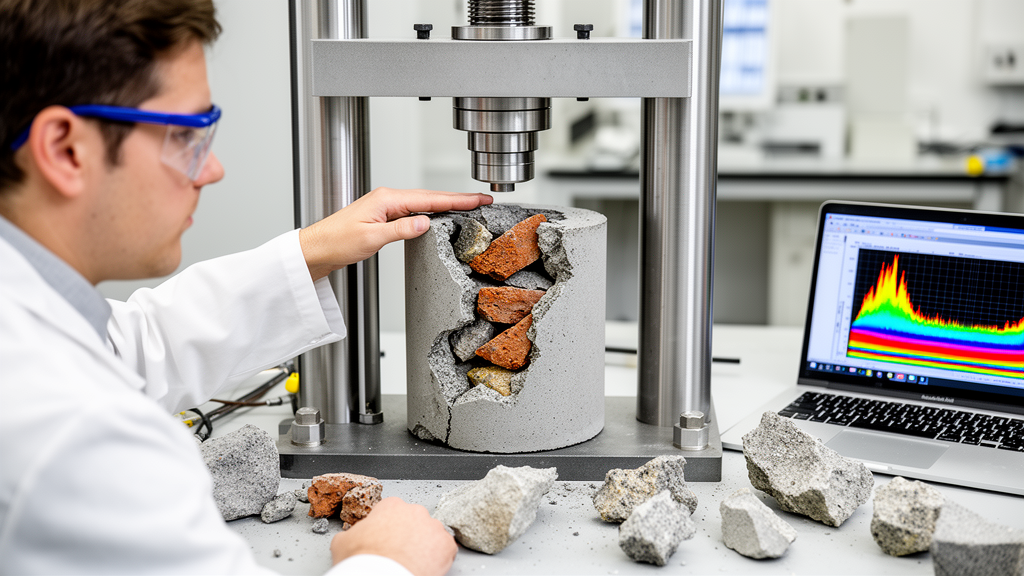
Recycled aggregate concrete has moved a step closer to routine structural use, thanks to a study that pairs laboratory testing with machine learning to predict how strong such concrete will be after 28 days of curing. Researchers prepared twenty-five concrete mixes in which the proportions of recycled fine and coarse aggregates, the water-to-cement ratio, the superplasticizer dosage, and the strength of the parent concrete from which the recycled material came were all varied. The measured 28-day compressive strengths spanned 31.8 to 45.2 megapascals, with the lowest values appearing in mixes made entirely from recycled aggregates and the highest in mixes built purely from natural aggregates.
The central challenge the study addresses is well known to concrete engineers: recycled aggregates carry a burden that natural aggregates do not. When demolished concrete is crushed, screened, and cleaned of contaminants such as steel, wood, and plastics, the resulting particles retain a layer of old adhered mortar along with microcracks introduced during crushing. This makes recycled aggregates more porous and far thirstier than natural ones, absorbing more water and disturbing the effective water-to-cement ratio in a fresh mix. The quality of the parent concrete matters too, because recycled particles cut from low-strength source material carry residual weaknesses into the new concrete. Because these variables interact in nonlinear ways, predicting the outcome of any given mix traditionally demands casting many batches, curing them, and crushing them in destructive tests, a process that is slow and expensive.
To escape that cycle, the researchers turned the problem over to artificial intelligence. Each of the twenty-five experimental mixes was described by thirteen input variables, including cement content, natural and recycled fine and coarse aggregate quantities, water content, water-to-cement ratio, superplasticizer dosage, parent concrete strength, recycled aggregate water absorption, and the Los Angeles abrasion value, a standard measure of aggregate resistance to wear. The 28-day compressive strength served as the target the models had to learn to predict.
Because twenty-five observations are far too few to train reliable machine learning models, the team expanded the dataset through controlled augmentation. Each experimental mix was used to generate forty-five synthetic samples by applying random perturbations of up to ten percent to the measured input variables, while preserving the physical relationships among the mix parameters. That lifted the dataset from twenty-five records to 1,125, of which only the original mixes were actually tested in the laboratory. The authors are explicit about this distinction, and they list it among the study’s limitations, noting that additional real experimental data covering a broader range of material properties would further strengthen the models.
Nine supervised algorithms were then trained and compared on an 80:20 train-test split, with all thirteen input variables standardized using parameters computed exclusively from the training data to prevent information leakage. Hyperparameters were optimized with grid and randomized search together with cross-validation, and early stopping was applied to the boosting algorithms to curb overfitting. The result was a clear hierarchy. Support Vector Regression, using a radial basis function kernel, delivered the best performance with a coefficient of determination of 0.998, a mean absolute error of 0.008 megapascals, and a root mean square error of 0.011 megapascals. Random Forest followed closely at 0.996. K-Nearest Neighbors and XGBoost reached 0.947 and 0.942 respectively, Gradient Boosting managed 0.904, and the linear models trailed behind: Linear Regression at 0.893, Lasso at 0.879, Elastic Net at 0.846, and Ridge at 0.842.
The pattern is unambiguous. Nonlinear and ensemble algorithms captured the complex interactions among recycled aggregate content, water absorption, parent concrete quality, and mix proportions far better than any linear formulation could. A stacking ensemble that combined the strongest individual models pushed performance even higher, achieving a coefficient of determination of 0.999 on the training set and 0.998 on the test set, with errors of roughly 0.0099 megapascals mean absolute and 0.0137 root mean square. In a Taylor diagram comparison against previously published machine learning models for recycled aggregate concrete, including artificial neural networks and adaptive neuro-fuzzy inference systems, the proposed Support Vector Regression model sat closest to the reference observation point, indicating the highest correlation, the lowest error, and the best-matched variability.
The laboratory program itself followed standard practice. One hundred fifty millimeter cubes were cast for each mixture, compacted on a vibrating table, covered with wet burlap during initial curing, and then submerged in water at 23 plus or minus 2 degrees Celsius for 28 days. The strength data confirmed a steady decline as recycled aggregate levels and their water absorption rose, underscoring how aggregate quality, abrasion resistance, and replacement percentage govern mechanical performance. The experimental design deliberately held the water-to-cement ratio within a narrow band, from 0.30 to 0.35, while parent concrete strengths ranged from 25 to 45 megapascals and recycled aggregate replacement ran from zero to one hundred percent for both fine and coarse fractions.
Interpretability came from SHAP analysis, a technique that assigns each input variable a contribution value reflecting its marginal influence on the model’s output. Within this dataset, the recycled coarse aggregate replacement percentage carried the highest average SHAP value at 0.638, followed by recycled aggregate water absorption at 0.584 and the Los Angeles abrasion value at 0.459. Parent concrete strength at 0.351 and superplasticizer dosage at 0.346 contributed moderately, while the water-to-cement ratio registered 0.168. Cement content and water content showed the lowest values, at 0.096 and 0.068 respectively. The authors caution that these rankings reflect the experimental design rather than engineering reality: cement content and water-to-cement ratio were intentionally confined to narrow ranges to isolate the influence of the recycled aggregate characteristics, so their limited statistical variability naturally depressed their SHAP scores. From the standpoint of concrete technology, they remain primary determinants of strength.
The practical message is twofold. First, partial replacement of natural aggregates with recycled material, in the range of roughly 25 to 75 percent, can yield concrete with satisfactory compressive strength when mix design is handled properly, while complete replacement produced the weakest mixes, largely because of higher water absorption and lower aggregate quality. Second, the machine learning framework offers engineers and concrete plant operators a rapid decision-support tool for estimating 28-day strength from readily available material properties, reducing the need for extensive trial-and-error laboratory testing. The authors recommend that practitioners working with recycled aggregates from new geographical sources or production processes carry out a limited number of local tests and use the results to recalibrate or retrain the models.
The study’s boundaries are clearly drawn. The experimental base of twenty-five mixes is small, the models considered only mix composition and selected aggregate characteristics while excluding curing conditions, environmental exposure, chemical composition, microstructure, and long-term durability, and validation relied on the available dataset rather than independent data from other laboratories or regions. The SHAP importance rankings are specific to the statistical distribution of this dataset and should not be generalized to mixes with substantially different variable ranges. Predictions for recycled aggregates falling outside the investigated ranges of replacement ratio, water absorption, parent concrete strength, or abrasion value should be treated with caution, since extrapolation beyond the training domain can erode reliability. With those caveats in place, the work demonstrates that artificial intelligence, anchored to real experimental measurements, can estimate the strength of recycled aggregate concrete accurately enough to streamline sustainable mix design.
Subject of Research: Machine learning prediction of the 28-day compressive strength of recycled aggregate concrete validated by laboratory experiments
Article Title: Predicting compressive strength of recycled aggregate concrete using AI with experimental validation
Article References: Gopal, S., & Kumar, A. (2026). Predicting compressive strength of recycled aggregate concrete using AI with experimental validation. AI in Civil Engineering, 5(1), Article 26. https://doi.org/10.1007/s43503-026-00111-y
Image Credits: AI Generated
DOI: 10.1007/s43503-026-00111-y
Keywords: recycled aggregate concrete, compressive strength, machine learning, Support Vector Regression, SHAP analysis, data augmentation, sustainable construction, construction and demolition waste, Random Forest, XGBoost, mix design, water absorption
News Source: Denise Maddox. (October 28, 2026). AI Predicts Strength of Recycled Aggregate Concrete with Near-Perfect Accuracy. Scienmag.