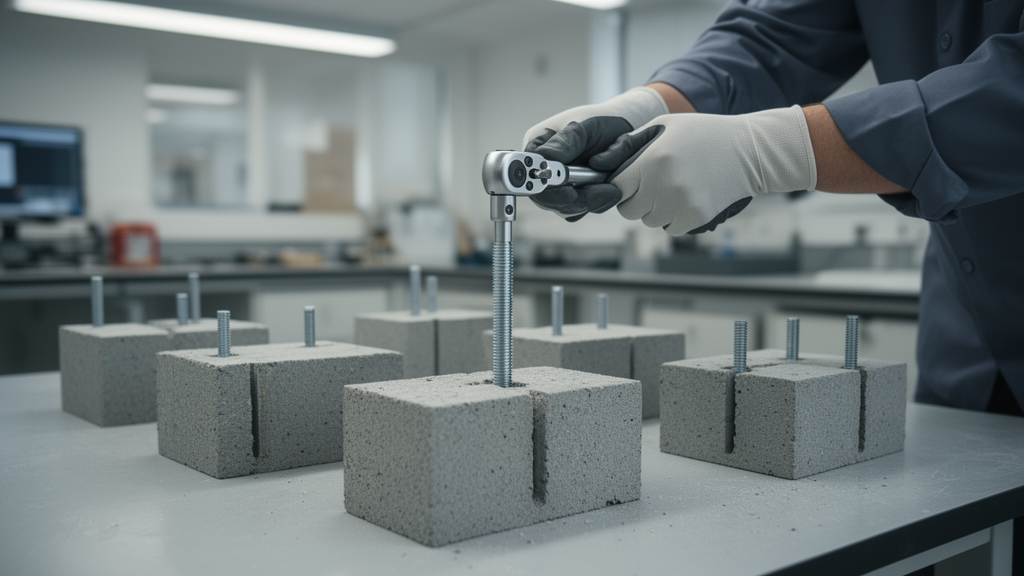
Engineers who strengthen aging bridges with fiber-reinforced polymer sheets face a persistent problem: the bonded sheets can peel away from concrete in a sudden, brittle failure that erases the strengthening benefit entirely. One increasingly popular remedy is the hybrid bonded FRP system, in which steel plates bolted through the FRP strip clamp the composite against the concrete surface. The bolts are chemical anchors embedded in the concrete, and their preload, controlled by the torque applied to the nut, determines how well the system holds. A new numerical study published in Advances in Bridge Engineering examines precisely how anchorage depth and tightening torque govern the failure of these bolt-concrete anchorage systems, and arrives at a concrete recommendation: for the configuration studied, the nut torque should not exceed 13 newton-meters.
The research, conducted by Chunhong Qi, Yixiao Fu and Chao Jiang, addresses two shortcomings the authors identify in prior work on hybrid bonded FRP strengthening. Most earlier investigations concentrated on interfacial bond behavior and the flexural performance of strengthened members, while the failure modes and pull-out behavior of preloaded bolts received less attention. Although some studies had noted that bolt torque matters, they had not clarified how concrete failure modes change with embedment depth, nor had they established a rational method for setting the pre-tightening torque. The new study tackles both questions using three-dimensional finite element simulation built in MSC.Marc software.
The model represents a single 4.8-grade galvanized carbon steel M8 screw, fitted with a Grade 5 machine nut, anchored in a C40 concrete block measuring 100 by 100 by 70 millimeters. Concrete was meshed with eight-node hexahedral solid elements and the bolt with six-node pentahedral solid elements. A full-bond interface assumption with shared nodes connected the two components, meaning no relative slip or separation could occur before concrete cracking. The bottom and peripheral surfaces of the concrete were fully constrained while the top surface retained its degrees of freedom, and the tensile load was applied precisely at the nut position, since the screw above the nut is a stress-free end.
The authors are candid about the limits of this idealization. The perfect-bond assumption inevitably overestimates the actual interfacial bond strength and stiffness of the anchor connection, which may delay the initiation of interfacial debonding, bias the predicted failure mode toward concrete cone failure rather than interfacial bond failure, and yield slightly higher predicted tensile capacity and torque limit. In real service under cyclic loading, interfacial slip and bond degradation are unavoidable, so the simulation deviates somewhat from real mechanical behavior. The team also treated the torque coefficient as a constant, ignoring its variability, and notes that experimental verification and sensitivity analysis of that coefficient remain for future work.
Before running the failure simulations, the study worked through the mechanics of bolt preload. Torque control is the standard way to tighten bolts because a torque wrench measures the applied torque accurately, and the relationship between nut torque and bolt preload depends on thread geometry and two friction coefficients: one at the thread surface and one between nut and washer. Using a torque coefficient of 0.19, derived from Chinese mechanical industry standard JB/T 5000.10-2007, the German standard DIN 267 and a WURTH preload-torque reference table, the researchers calculated that the 15 newton-meters of torque used in earlier experiments produces a preload of roughly 9,868 newtons. Their simulation of that preload showed the screw’s maximum stress, from the concrete cracking model, reached 270.2 megapascals, below the 320 megapascal nominal yield strength of the 4.8-grade steel, so screw yielding did not need to be considered.
The simulated stress and displacement fields matched well-known anchor behavior. Concrete displacement formed an inverted conical distribution, growing toward the anchor center and spreading near the surface, consistent with previously reported displacement fields for tension-loaded anchors. Screw stress decreased gradually from the loading end toward the embedded bottom, mirroring the bond stress distribution familiar from FRP strengthening research. Two major cracks propagated from the middle and lower parts of the anchor toward the concrete surface at roughly 45 degrees, a classic concrete cone failure pattern that agrees with prior experimental and code descriptions, which the authors take as validation of their model.
The core of the study is a systematic sweep of embedment depth and load level. Three depths were examined: 2d (16 millimeters, the shallow case), 6d (48 millimeters, medium) and 10d (80 millimeters, deep), where d is the 8-millimeter bolt diameter. The basic load level F was set at 2,260.5 newtons, the standard tensile bearing capacity for concrete cone failure at 2d according to China’s technical specification for post-installed anchorage, and loads from 1F to 5F were applied. At load level F, the shallow 2d model showed severe cracking forming a typical cone failure, while the 6d and 10d models cracked only mildly. At 2F, the 2d model developed a crack cluster zone, the 6d model produced two distinct cracks, one near mid-embedment and one at the screw bottom, and the 10d model formed a single crack with no cracking at the screw bottom, a sign of transition toward hybrid failure.
As loads rose, the differences sharpened. In the 6d model, the first main crack’s initiation depth moved from 20 millimeters at 2F to 28 millimeters at 3F and 32 millimeters at 4F, then stayed at 32 millimeters at 5F, showing that the concrete cone above the anchor expands with load but not indefinitely. By 5F, lateral cracking in the 6d model reached the model edge, 47 millimeters from the bolt center, close to the reduced critical edge distance of 50 millimeters imposed by the substrate size, meaning concrete cone failure had occurred in the model-sized block. The 10d model behaved more gently throughout: its maximum lateral cracking distance stayed at 41.4 millimeters, below the critical edge distance, and no cone-failure cracks appeared in its deep anchorage layer even at 5F.
Synthesizing these results, the study describes three regimes. Shallow embedment leads to a main crack initiating near the screw bottom and propagating to the surface, producing concrete cone failure. Medium embedment produces two main cracks whose coalescence can yield complete cone failure, or a smaller cone failing first and triggering interfacial bond failure, a hybrid mode. Deep embedment attenuates screw stress before it reaches the bolt bottom, suppressing secondary cracks there, with upper concrete cone failure followed by lower interfacial bond failure. For the 50-millimeter embedment depth typical of HB-FRP steel plate anchors, the simulation identified a mixed failure of upper concrete cone and lower interfacial bond, and the dominant failure mode is difficult to pin down precisely because it depends on the interfacial bond strength.
That ambiguity motivated the torque recommendation. Converting the load range at which the 6d model fails, between 3F and 4F or 6,782 to 9,042 newtons, back through the torque-preload relation gives 10.3 to 13.7 newton-meters. Testing three torque levels of 11, 12 and 13 newton-meters on a 50-millimeter model showed that at 11 and 12 newton-meters the first main crack initiated at 30 millimeters depth, deeper than the maximum lateral cracking distance of 27.3 millimeters, while at 13 newton-meters the lateral distance reached 32.2 millimeters, exceeding the initiation depth. The authors therefore recommend that the applied nut torque not exceed 13 newton-meters to prevent concrete substrate damage from excessive preload. They stress that this limit is specific to 4.8-grade galvanized M8 bolts, C40 concrete, a roughly 50-millimeter embedment depth and their modeling assumptions, and does not extend to high-strength bolts, high-performance concrete or extreme environmental conditions. Within those bounds, the findings offer bridge engineers a quantitative basis for torque control in a strengthening technique whose reliability hinges on getting the preload right.
Subject of Research: Numerical simulation of bolt-concrete anchorage failure modes and torque limits in hybrid bonded FRP strengthening systems
Article Title: Numerical analysis of mechanical anchors in hybrid bonded FRP strengthening system
Article References: Qi, C., Fu, Y., & Jiang, C. (2026). Numerical analysis of mechanical anchors in hybrid bonded FRP strengthening system. Advances in Bridge Engineering, 7(1), Article 37. https://doi.org/10.1186/s43251-026-00225-4
Image Credits: AI Generated
DOI: 10.1186/s43251-026-00225-4
Keywords: hybrid bonded FRP, chemical anchors, finite element analysis, concrete cone failure, bolt preload, torque limit, embedment depth, bridge strengthening, interfacial bond failure, MSC.Marc, C40 concrete, post-installed anchorage
News Source: Denise Maddox. (October 28, 2026). Finite element model reveals how anchorage depth and torque control FRP anchor failure in concrete. Scienmag.