Credit: Courtesy Dr Brett Ferguson
A new Australian study of peptide hormones critical for plant development could result in wide-ranging benefits for agriculture, tissue culture, and related industries, and even improve knowledge of peptides in humans.
The study, involving University of Queensland and University of Sydney researchers, synthesised and examined the function of CLE peptides, a relatively new class of the peptide hormone family in plants.
Dr Brett Ferguson of the Centre for Integrative Legume Research, in the School of Agriculture and Food Sciences at UQ, said the research was exciting because CLE peptides had essential roles in regulating plant growth and development, increasing productivity as well as adaptation to environmental factors.
"The CLE peptides can potentially be used to manipulate plant growth," he said.
"Even a small increase in yield can be massively important to agriculture – increasing food production and food security, whilst enhancing agricultural sustainability.
"Other studies have demonstrated that a variant of one CLE peptide can result in bigger tomato fruit."
"The findings open up new areas of research to study the specificity of function/structure in the CLE peptide signalling system in plants.
"This is a fast-growing research area due to its importance to agriculture, food, and other industries that involve plant growth and development."
Dr Ferguson said as well as relevance to plant development, the findings were relevant to animal peptide signalling.
"CLE peptides are specific to plants, but peptides and associated receptors are also found in animals/humans. Understanding mechanisms in plants can benefit our understanding of similar mechanisms in humans," he said.
Dr Ferguson said CLE peptides were very difficult to detect and extract from plants due to their small size and extremely low concentration. As a result, the peptides need to be chemically synthesised to test their function in biological assays.
"This is sophisticated chemistry with biological relevance," he said.
"Creating the target molecule then testing its biological function is not always done, especially when the molecule, such as the CLE peptide, is complex.
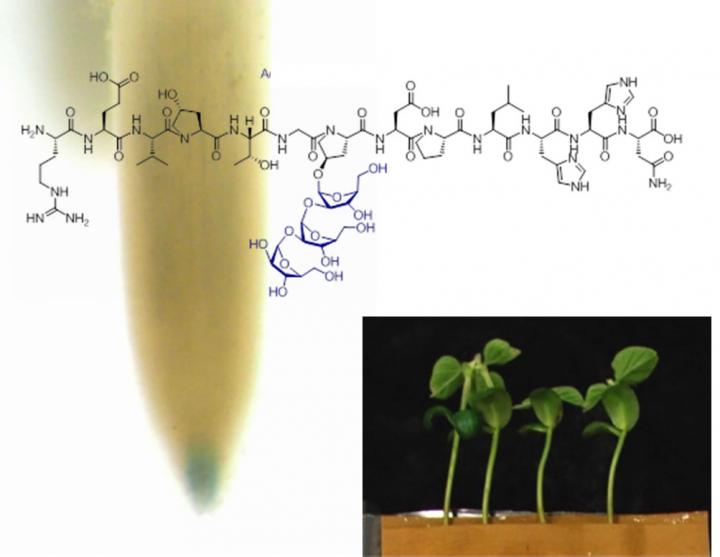
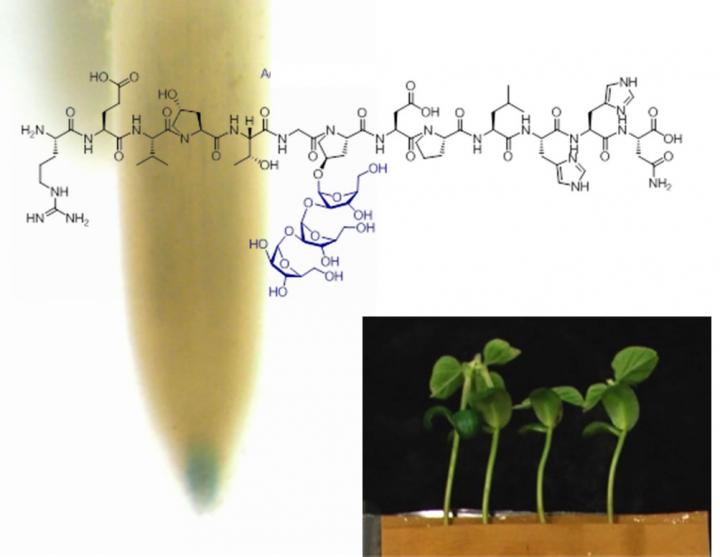
"The few CLE peptides that have been detected have all been modified with three arabinose sugar molecules linked together," he said.
"However, this 'triarabinose building block' is extremely difficult to synthesise. In our study, this important building block was synthesised using cutting-edge chemical synthesis methods.
"The building block that has been produced by the Payne Laboratory (School of Chemistry, the University of Sydney) is now readily available to access synthetic CLE peptide hormones to test their activity in plants using feeding studies."
Dr Ferguson said the study used the building block to chemically synthesise CLE40, which is a CLE peptide that modulates root development (by controlling the stem cell population of the root).
"This is obviously a very important peptide hormone to plant growth," he said.
"We also developed a new assay to feed the CLE40 peptide and monitor root growth.
"Using this assay, we showed that the building block is important to CLE40 activity.
Modifying root architecture via key developmental factors is viewed as a pivotal step in enhancing agricultural sustainability and food security.
"The building block can now be used to synthesise other CLE peptides, which can subsequently be used in feeding studies to establish their activity."
He said CLE peptides found to modify aspects of growth or yield had tremendous potential in agriculture (potential to increase food production), tissue culture (potential to stimulate shoot or root development), floriculture (potential to enhance flowering), and other industries that relied on plant growth. This might be achieved by feeding, or through targeted breeding or genome editing techniques.
###
The study, "Arabinosylation Modulates the Growth-Regulating Activity of the Peptide Hormone CLE40a from Soybean", is published in Cell Chemical Biology (doi: 10.1016/j.chembiol.2017.08.014).
Dr Ferguson's group also recently published the complete CLE peptide family of two legume species in Scientific Reports, in addition to publishing another article in Scientific Reports on a CLE peptide receptor having a role in regulating shoot architecture.
Media Contact
Dr Brett Ferguson
[email protected]
61-733-469-951
@uq_news
http://www.uq.edu.au
Related Journal Article
http://dx.doi.org/10.1016/j.chembiol.2017.08.014