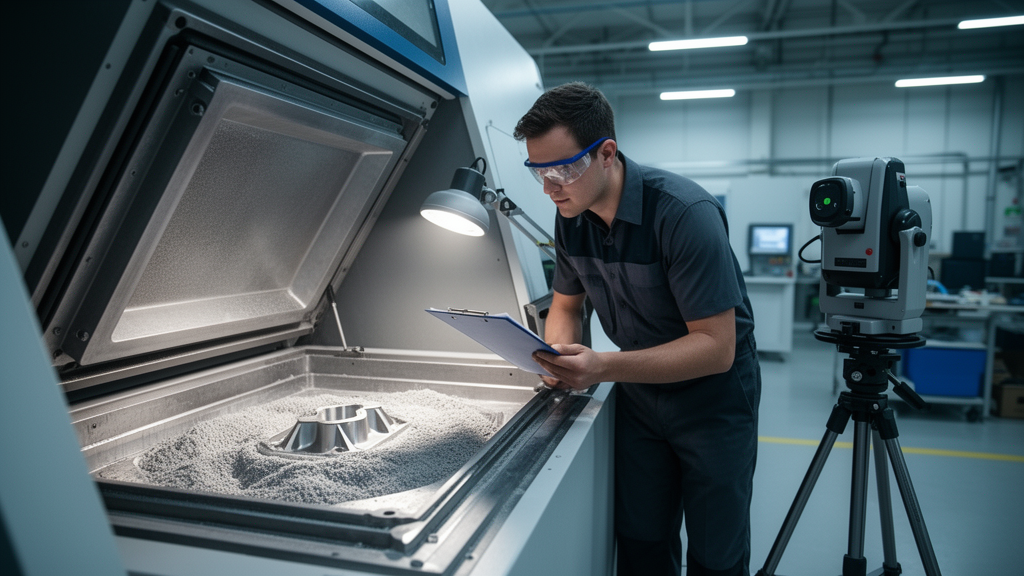
A new literature review concludes that the additive manufacturing industry still lacks a fast, cheap and standardized way to verify that a laser powder bed fusion machine is ready to run a production batch. The review, published in Discover Mechanical Engineering, analyzed 76 scientific articles on machine validation in additive manufacturing and found that only a small fraction of the work done to date can actually be used for the routine, pre-production checks that manufacturers need before committing a build platform to parts destined for aerospace or medical applications.
Laser powder bed fusion, or LPBF, is one of the most important additive manufacturing processes for producing high-performance, complex metallic parts in critical industries such as aerospace and medical engineering. The process builds components layer by layer from metal powder, and its industrial adoption continues to grow. But the authors, Ali Kiass, El Mehdi Kiass and Khalid Zarbane, argue that the industrial use of LPBF still faces persistent constraints related to process stability over time and the consistency of part quality. Defects tied to the process, including internal porosity, residual stresses, geometric distortions and surface irregularities, can influence the mechanical properties and overall functionality of finished parts.
The problem is compounded by the complex relationships between process parameters, material behavior and machine condition, which lead to high variability across production builds even under nominally identical conditions. Because of this variability, the authors argue that ensuring machine readiness before serial production is an essential step for maintaining quality consistency and supporting reliable industrial implementation. Yet the validation approaches that exist in the literature largely fail to meet the practical demands of a factory floor.
To bring order to a scattered field, the review first draws a careful conceptual distinction between three different kinds of validation. Process validation qualifies a process setup to produce parts with defined requirements, typically by selecting and controlling parameters such as laser power, scan speed and hatch distance, and demonstrating through testing that parts achieve acceptable mechanical properties, microstructure and density; this is generally performed once or when parameters change significantly. Machine qualification or acceptance checks that a given machine is installed correctly and operates within nominal specifications, including calibration, optical verification, powder recoating consistency and environmental stability, and is performed when a new machine is installed or after major maintenance.
The third category, which the authors call Production Readiness Validation, or PRV, is the focus of the review. It refers to the routine verification of a machine’s capability to produce quality parts prior to launching a production batch, whether weekly, monthly or per shift. The goal is not to repeat a full qualification of the machine or process, but to ensure that no drift or degradation has occurred that could compromise quality. This kind of validation is pragmatic, often time constrained, and must be cost effective, yet sufficiently informative. The authors are explicit that PRV is not an established industrial or standards-based concept; they introduce it as a definitional lens to analyze the existing literature, and they distinguish it from continuous process control, which relies on real-time monitoring during production rather than a discrete, pre-batch check.
The methodological core of the review is a coding matrix built from full-text analysis of 76 selected scientific articles related to machine validation in LPBF and other additive manufacturing works used for comparison, covering publications dated between 1994 and 2025. The literature search was conducted using Google Scholar and direct browsing of Springer-published journals, with search terms including ‘LPBF qualification’, ‘machine readiness’, ‘benchmark artifact additive manufacturing’ and ‘SLM’. The corpus was finalized in January 2026, and review articles were excluded, with one noted exception retained for its direct relevance, because the study focuses on original experimental or methodological contributions. Each study was assessed against a predefined grid covering the type of validation addressed, the properties measured, the presence of correlation studies, and the estimated cost, time and complexity of the approach.
The classification results are striking. Of the 76 coded studies, 59 were specifically focused on LPBF or the closely related selective laser melting process. Within that LPBF-focused subset, only 15 studies were considered relevant to production readiness validation, meaning they demonstrated through experimental evidence the capability of a process to produce parts meeting predefined quality requirements, typically by manufacturing representative specimens or artifacts and evaluating measurable properties such as density, porosity, mechanical performance, microstructure, surface quality or geometric accuracy. A final filtering step using an operational burden score, calculated as the product of cost and time estimates on ordinal scales, left just 6 studies that were both PRV-relevant and operationally simple enough, with a score of 4 or below, to be compatible with routine industrial use.
The review also documents a pronounced imbalance in what the literature actually measures. Geometric accuracy clearly dominates the field, likely because it is relatively easy to measure using coordinate metrology or 3D scanning and aligns with geometric dimensioning and tolerancing requirements. In contrast, mechanical properties, porosity and density, and surface quality are significantly less represented, even though they are critical for part functionality and directly relevant to machine performance. When the authors excluded geometric accuracy and examined how many functional property categories, density and porosity, mechanical properties, microstructure and surface quality, were evaluated jointly within the same studies, they found that a substantial proportion of studies evaluated none at all, and the majority assessed only one or two. Truly multidimensional validation, combining several property categories in a unified framework, remains comparatively rare.
The operational burden analysis reinforces the picture. Among the 15 direct PRV-relevant LPBF studies, the majority concentrated at the highest end of the burden scale, reflecting methods that are complex, time consuming or costly. Even the most promising contributions fall short of a deployable routine check. One study proposing an artifact whose crack length correlates strongly with notch ductility was explicitly presented as efficient and cost effective, and demonstrated strong measurement repeatability between independent builds, but it still requires printing dedicated artifacts and companion notched specimens, involves partly operator-dependent measurement, and does not define an acceptance threshold or address traceability. Other approaches rely on design of experiments, tomography, micro-computed tomography, tensile or creep testing, or destructive workflows that are far too resource intensive for frequent production validation.
The authors conclude that the literature contains important building blocks for production readiness validation, but that these remain fragmented between scientifically rich yet heavy methods and operationally simple yet functionally incomplete artifacts. They call for future research to focus on simplified, pragmatic validation strategies based on quick and cost-effective measurable indicators, with the goal of a fast assessment method that could serve as a practical decision tool for machine readiness before production, complementing rather than replacing more comprehensive validation frameworks. They also note that once such sensitive, repeatable and operationally simple indicators are established, they could in subsequent research provide the data foundation for machine learning-based quality prediction models and data-driven certification frameworks. The review acknowledges its own limitations, including that the operational burden score, as a product of two ordinal scales, is a coarse relative filtering heuristic rather than a precise quantitative metric, and that the classification of borderline studies was resolved by consensus between two authors rather than independent evaluation.
Subject of Research: A literature review of machine validation and production readiness validation approaches for laser powder bed fusion additive manufacturing
Article Title: Production readiness validation approaches for laser powder bed fusion a literature review
Article References: Kiass, A., Kiass, E. M., & Zarbane, K. (2026). Production readiness validation approaches for laser powder bed fusion a literature review. Discover Mechanical Engineering, 5(1), Article 210. https://doi.org/10.1007/s44245-026-00390-w
Image Credits: AI Generated
DOI: 10.1007/s44245-026-00390-w
Keywords: laser powder bed fusion, additive manufacturing, production readiness validation, machine qualification, process validation, benchmark artifacts, porosity, geometric accuracy, operational burden, aerospace, medical manufacturing, literature review
News Source: Denise Maddox. (October 27, 2026). Most LPBF machine checks are too slow and costly for routine production use. Scienmag.