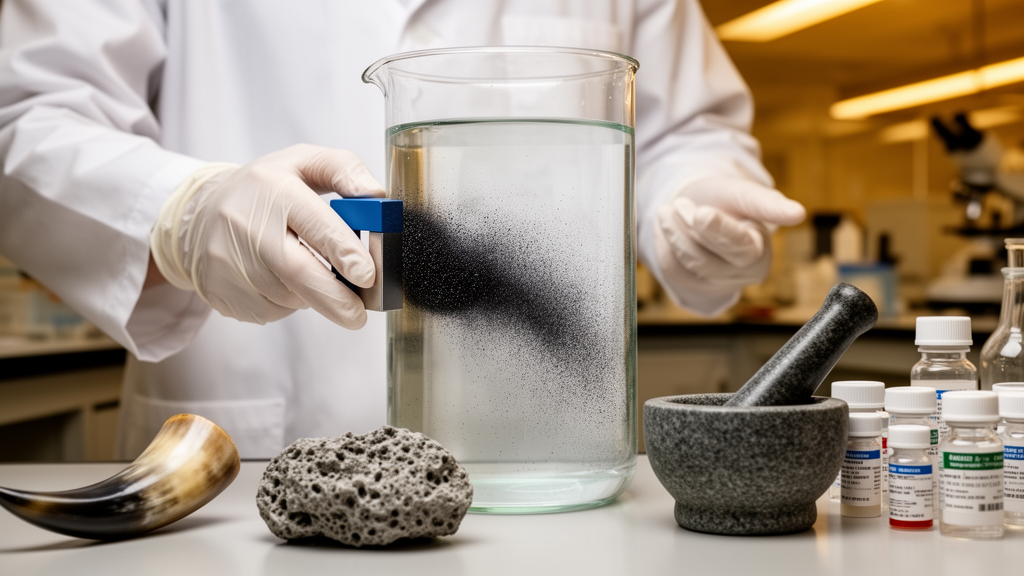
Researchers synthesized a magnetite-functionalized cow horn/pumice biocomposite, abbreviated Fe3O4–CH/P, through in situ co-precipitation and evaluated it for removing hexavalent chromium, or Cr(VI), from aqueous solutions.
The design combines three functional elements in a single material. Cow horn contributes a keratin-rich organic matrix, pumice supplies a highly porous mineral scaffold, and incorporated magnetite particles enhance the composite’s physicochemical properties while making it separable from treated water with a magnet. According to the study, this integration produces a multifunctional adsorbent engineered for both high affinity toward oxyanion species of Cr(VI) and efficient magnetic separation after use.
To characterize the finished biocomposite, the team employed a full analytical toolkit: Fourier-transform infrared spectroscopy (FTIR), X-ray diffraction (XRD), scanning electron microscopy (SEM), and thermogravimetric analysis (TGA).
The performance numbers come from batch adsorption tests run under optimized conditions: a solution pH of 3, a contact time of 120 minutes, and an adsorbent dosage of 2 grams per 100 milliliters of solution, equivalent to 20 grams per liter. Under those conditions the composite achieved a removal efficiency exceeding 99.8 percent for hexavalent chromium — a figure the authors describe as demonstrating the material’s high affinity for the oxyanion forms in which Cr(VI) exists in water.
Kinetic modeling of the adsorption data pointed to a specific mechanism. The pseudo-second-order kinetic model predicted the results well, with a coefficient of determination of 0.99926, indicating that surface-mediated interactions are crucial to the adsorption process.
Isotherm analysis told a complementary story. The Langmuir model provided the better fit, with a coefficient of determination of 0.9994 and a maximum adsorption capacity of 15.34 milligrams per gram. That outcome indicates that homogeneous active sites and monolayer adsorption are the dominant mechanism — the composite’s binding sites behave uniformly, and uptake proceeds as a single molecular layer on the material’s surface until those sites saturate.
The authors conclude that the adsorption process is regulated by three interacting forces: electrostatic attraction, surface complexation, and potential redox interactions.
On the basis of these results, the researchers describe the Fe3O4–CH/P biocomposite as environmentally friendly and a highly effective adsorbent for treating water contaminated with chromium.
The work, published open access in Discover Chemical Engineering on 22 October 2026 by Dargie Haile, Nigus Gabbiye, and Zemene Worku, is currently available as a peer-reviewed accepted version carrying a permanent DOI, subject to further editorial edits before the final Version of Record replaces it.
Subject of Research: A magnetite-functionalized cow horn and pumice biocomposite for removing hexavalent chromium from water
Article Title: Development of a magnetite functionalized cow horn pumice biocomposite for hexavalent chromium removal
Article References: Haile, D., Gabbiye, N., & Worku, Z. (2026). Development of a magnetite functionalized cow horn pumice biocomposite for hexavalent chromium removal. Discover Chemical Engineering. https://doi.org/10.1007/s43938-026-00151-x
Image Credits: AI Generated
DOI: 10.1007/s43938-026-00151-x
Keywords: hexavalent chromium, magnetite, cow horn, pumice, biocomposite, adsorption, water treatment, Langmuir isotherm, pseudo-second-order kinetics, magnetic separation, co-precipitation, keratin
News Source: Bethany Barker. (October 27, 2026). Cow horn and pumice yield magnetic adsorbent that strips chromium from water. Scienmag.