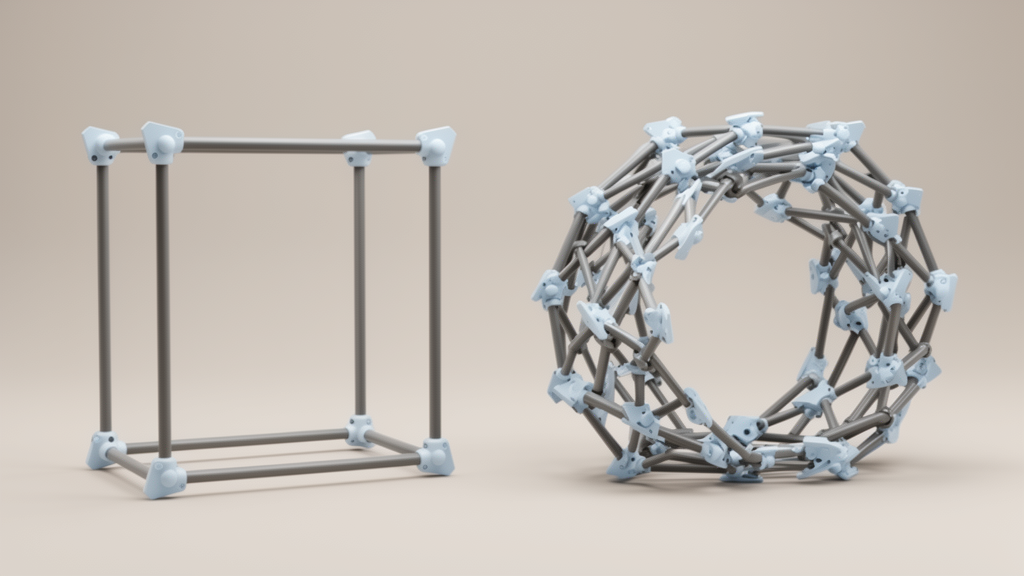
A team of structural designers has demonstrated that a freeform spatial structure does not have to end its life as a pile of customised scrap. In a study published in Architectural Intelligence, Yuqian Liu and Ting Cao present a design-and-optimisation method in which two geometrically distinct freeform structures are co-designed so that one complete set of straight rods and planar connecting nodes can be taken apart from the first structure and rebuilt, piece for piece, into the second. The concept was validated with two furniture-scale table prototypes, each roughly 0.8 metres in every dimension, built from aluminium rods and steel cables at the CAADRIA 2024 workshop.
The core problem the researchers attack is economic as much as environmental. In a freeform structure, almost every member, panel and node may differ in length, angle and curvature, so construction cost is driven less by the total quantity of material than by the number of geometrically distinct, non-repeating parts that must be produced individually. Fabrication-aware research has long tried to reduce this variety, but the resulting repetition is normally pursued within a single structure and chiefly for cladding panels or moulds. That lowers unit cost without making the load-bearing members recoverable for a different structure once the first reaches the end of its life. The new work extends reuse to the structural members themselves, and does so in both directions between two co-designed configurations.
The geometric foundation comes from the hyperbolic paraboloid, or hypar, a doubly curved surface that is also doubly ruled. Because a hypar contains two families of straight lines, it can be built entirely from straight, standardised components, and its saddle-like form keeps structural behaviour efficient under varying loads. Felix Candela systematically exploited these properties in the 1950s and 1960s. The catch, in previous hypar construction, was that modules were typically joined through reinforced beams, producing creases that broke the continuity of the surface. Building on earlier work by Cao and colleagues, the present method smoothly combines hypar modules into a continuous freeform surface, achieving tangent-plane, or G1, continuity across module boundaries.
The key enabling device is what the authors call the coplanarity principle. In a smooth poly-hypar surface, all the rulings and edges intersecting at a given node must lie in one common plane. This condition is not merely aesthetic: it guarantees that interactions between adjacent hypars are transmitted within the plane without inducing bending moments, so the surface carries load primarily through axial forces. Because every line meeting at a node is coplanar, the connection itself can be a flat, planar node rather than a complex three-dimensional joint that gathers many members at awkward angles. Planar nodes are easier to fabricate, cheaper, simpler to standardise, and, the authors note, visually cleaner than the large spherical joints that often disfigure spatial structures.
To make the rods genuinely interchangeable between the two table structures, S1 and S2, the team developed a grouped optimisation strategy. Components are grouped according to their position in the force transmission path: rods removed at the same step of the disassembly sequence of S1 are paired with rods installed at the corresponding step of the assembly sequence of S2. This pairing means that when a group of rods is dismantled from one table, it can be installed directly into the other at the matching stage, preserving a one-to-one removal-and-installation correspondence that guarantees constructability, even at the cost of some global optimality.
Within each group, a genetic algorithm implemented in the Galapagos plugin for Rhino Grasshopper adjusts the geometric control parameters that generate the two surfaces, minimising the deviation of each rod length from its group average. Crucially, the optimisation operates only within the smooth poly-hypar parametric family, so the coplanarity of all rods meeting at each node, and therefore the validity of the planar joints, is preserved throughout. The number of length groups is not fixed in advance; instead, any group whose rods violate the deviation threshold is split in two, and the search continues over a narrowed parameter interval. The solver, run with an initial population of 50, converged within about 110 generations to a total residual length deviation of roughly 17 centimetres across all rods, with a further 50 stagnant generations confirming termination at about 160 generations in total.
The outcome is striking. The original two structures comprised 120 rods in total; after optimisation, the shared component set contains only 60 rods, divided into five colour-coded groups of 12, each group sharing a common target length. Every rod used in S1 can be reused in S2 after a length adjustment of no more than 2 centimetres, the total travel of the threaded twist connection at the rod ends, about 1 centimetre per side. Measured across the 24 lengths in each group, the largest deviation was 1.35 centimetres, in the green group, comfortably within tolerance. The authors define this as a 100 percent component reuse rate, meaning full rod-length compatibility within the 2 centimetre assembly tolerance between the two co-designed configurations.
The 2 centimetre threshold itself was chosen deliberately. It was the smallest value at which the grouped genetic algorithm reliably converged to a full-reuse solution at this scale, where rod lengths range from 0.33 to 0.39 metres. It also respects mechanical practicality: keeping the adjustment well below half of the engaged thread length preserves joint stiffness, since excessive loosening reduces thread engagement and makes connected rods prone to wobble. During the physical transformation, the team did encounter such issues at rods pushed near the limit, resolving them by re-twisting from the opposite end or exchanging rods within a group, and a second round of thread adjustment was needed at some four-rod nodes after the diagonal cables were tensioned.
The authors are careful about what the prototypes do and do not prove. The contribution, they emphasise, is geometric and constructive rather than a structural-performance study; the furniture-scale tables serve as a proof of concept, and a full structural evaluation lies beyond the present scope. In the table configuration, loads applied at the top are carried along the rulings and edges of the surface down to the supports, with forces transmitted essentially in plane because every node remains coplanar, and small residual length differences are absorbed by the threaded adjustment and the in-plane rotation of the flattened rotating heads, which are about 1 millimetre thick. Detailed structural analysis of smooth poly-hypar surfaces is reserved for the authors’ earlier work.
The limitations are equally explicit. The method has so far been validated only at furniture scale, and extending it to pavilions or roof shells would require target-surface selection, grouping at much larger member counts, control of node-thickness accumulation, and finite-element verification under service and asymmetric loads. The genetic algorithm may settle in local optima as member numbers grow, a risk the authors suggest could be mitigated with multi-start or island-model strategies and hybrid local search. Future work also aims to diversify the approach to reticulated shells and trusses, extend component variety beyond rods and nodes to panels, cables and membranes, and develop multi-objective optimisation balancing structural efficiency, material use, construction convenience and compatibility. Even in its current form, the demonstration shows that freeform architecture, often the epitome of wasteful bespoke fabrication, can be designed from the outset so that its entire skeleton lives again in a different shape.
Subject of Research: A circular construction method for freeform structures using smooth poly-hypar surfaces, planar nodes and grouped genetic-algorithm optimisation, demonstrated with reusable furniture-scale prototypes.
Article Title: Circular construction strategies of freeform structures based on smooth poly-hypar surfaces: design and fabrication of furniture-scale prototypes
Article References: Liu, Y., & Cao, T. (2026). Circular construction strategies of freeform structures based on smooth poly-hypar surfaces: design and fabrication of furniture-scale prototypes. Architectural Intelligence, 5(1), Article 30. https://doi.org/10.1007/s44223-026-00136-4
Image Credits: AI Generated
DOI: 10.1007/s44223-026-00136-4
Keywords: circular construction, smooth poly-hypar surfaces, freeform structures, component reuse, genetic algorithm, planar nodes, design for disassembly, gridshell, sustainable architecture, furniture-scale prototype, parametric design, embodied carbon
News Source: Denise Maddox. (October 27, 2026). Reusable freeform structures: straight rods and planar nodes rebuilt into new forms. Scienmag.