• HOME
  • NEWS
  • EXPLORE
    • CAREER
      • Companies
      • Jobs
    • EVENTS
    • iGEM
      • News
      • Team
    • PHOTOS
    • VIDEO
    • WIKI
  • BLOG
  • COMMUNITY
    • FACEBOOK
    • INSTAGRAM
    • TWITTER
Wednesday, October 28, 2026
BIOENGINEER.ORG
No Result
View All Result
  • Login
  • HOME
  • NEWS
  • EXPLORE
    • CAREER
      • Companies
      • Jobs
        • Lecturer
        • PhD Studentship
        • Postdoc
        • Research Assistant
    • EVENTS
    • iGEM
      • News
      • Team
    • PHOTOS
    • VIDEO
    • WIKI
  • BLOG
  • COMMUNITY
    • FACEBOOK
    • INSTAGRAM
    • TWITTER
No Result
View All Result
Bioengineer.org
No Result
View All Result
Home NEWS Science News Technology

Review Maps How Machine Learning Estimates Electric Vehicle Remaining Range

by
October 28, 2026
in Technology
Reading Time: 2 mins read
0
Review Maps How Machine Learning Estimates Electric Vehicle Remaining Range

Review Maps How Machine Learning Estimates Electric Vehicle Remaining Range

Share on FacebookShare on TwitterShare on LinkedinShare on RedditShare on Telegram

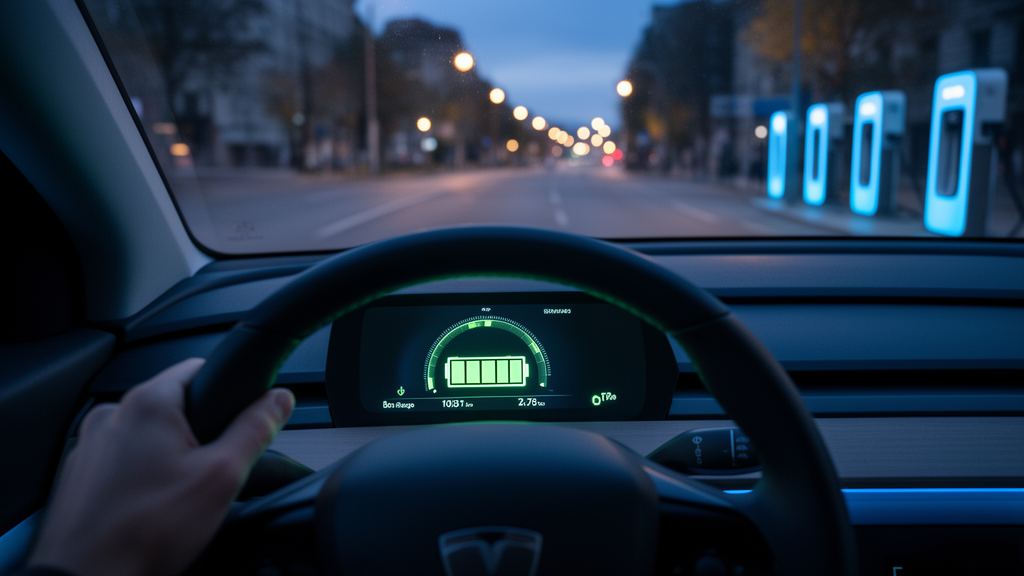
A newly published review in Energy Informatics examines how researchers estimate the remaining driving range of electric vehicles, a figure that sits at the center of what drivers call range anxiety. The paper, authored by Mrugank Gandhi and Archana Y. Chaudhari and published on 20 October 2026, surveys the data, features, and modeling approaches used to predict how far an EV can travel before its battery runs down.

The review traces a shift in the field. Earlier systems relied on conventional rule-based methods, while recent data-driven modeling allows intelligent systems to learn complex relationships among driving styles, battery dynamics, and interactions with the external environment. According to the authors, this transition has transformed how remaining driving range is calculated, moving estimation away from fixed rules toward models that adapt to how a vehicle is actually being driven.

A central finding of the review is that combining real-time sensor data with machine learning and deep learning models improves the accuracy of range estimation. These approaches capture multifaceted relationships among driving speed, acceleration, temperature, road topology, and the battery’s state of charge, the variable that describes how much energy remains in the pack. Because range depends on all of these factors at once, models that can learn their interactions have an advantage over simpler calculations.

The authors frame accurate range estimation as more than a convenience for drivers. They describe it as essential for alleviating range anxiety, improving energy management, and supporting sustainable mobility in public spaces.

Accuracy is not the review’s only concern. The authors identify interpretability and trustworthiness as significant challenges that remain unresolved in current approaches.

Looking forward, the review argues that causal inference and uncertainty quantification should become essential components of future predictive systems.

The article is published open access, and the version released on 20 October 2026 is an early-release copy of the peer-reviewed, accepted research. It carries a permanent DOI and is citable, but the publisher notes that this version is subject to further edits and will be replaced automatically by the final Version of Record.

By organizing the field’s data sources, input features, and modeling techniques in one place, the authors provide a reference point for researchers working on the next generation of range predictors, and they make the case that the field’s future lies in models that are not only accurate but also interpretable and honest about their own uncertainty.

Subject of Research: A review of data, features, and modeling approaches for estimating the remaining driving range of electric vehicles.

Article Title: A comprehensive review of data, features, and modeling approaches for estimating remaining driving range in electric vehicle

Article References: Gandhi, M., & Chaudhari, A. Y. (2026). A comprehensive review of data, features, and modeling approaches for estimating remaining driving range in electric vehicle. Energy Informatics. https://doi.org/10.1186/s42162-026-00698-7

Image Credits: AI Generated

DOI: 10.1186/s42162-026-00698-7

Keywords: electric vehicles, remaining driving range, range anxiety, machine learning, deep learning, state of charge, battery dynamics, sensor data, interpretability, uncertainty quantification, energy management, review

News Source: Blake Davidson. (October 27, 2026). Review Maps How Machine Learning Estimates Electric Vehicle Remaining Range. Scienmag.


Tags: battery dynamicsdeep learningelectric vehiclesenergy managementinterpretabilityMachine Learningrange anxietyremaining driving rangeReviewsensor datastate of chargeuncertainty quantification
Share12Tweet7Share2ShareShareShare1

Related Posts

How an industrial apparel brand stitches narrative into fabric, thread and label

How an industrial apparel brand stitches narrative into fabric, thread and label

October 28, 2026
New Open-Access Journal Biomedical Materials Science Launches to Link Materials Innovation with Patient Care

New Open-Access Journal Biomedical Materials Science Launches to Link Materials Innovation with Patient Care

October 28, 2026

Smart Nanocarriers Promise Sustained Delivery of Biostimulants for Sustainable Crops

October 28, 2026

New Traffic Model Tames Wild Speed Swings by Letting Gaps Drive the Math

October 28, 2026

POPULAR NEWS

  • How an industrial apparel brand stitches narrative into fabric, thread and label

    How an industrial apparel brand stitches narrative into fabric, thread and label

    29 shares
    Share 12 Tweet 7
  • New Open-Access Journal Biomedical Materials Science Launches to Link Materials Innovation with Patient Care

    29 shares
    Share 12 Tweet 7
  • Berberine Eases Diabetic Kidney Damage by Tuning a Renal Sugar-Transport Switch

    29 shares
    Share 12 Tweet 7
  • Palmitoylation Enzyme ZDHHC5 Emerges as Driver of Neutrophil Inflammation in COPD

    29 shares
    Share 12 Tweet 7

About

We bring you the latest biotechnology news from best research centers and universities around the world. Check our website.

Follow us

Recent News

How an industrial apparel brand stitches narrative into fabric, thread and label

New Open-Access Journal Biomedical Materials Science Launches to Link Materials Innovation with Patient Care

Berberine Eases Diabetic Kidney Damage by Tuning a Renal Sugar-Transport Switch

Subscribe to Blog via Email

Enter your email address to subscribe to this blog and receive notifications of new posts by email.

Join 85 other subscribers
  • Contact Us

Bioengineer.org © Copyright 2023 All Rights Reserved.

Welcome Back!

Login to your account below

Forgotten Password?

Retrieve your password

Please enter your username or email address to reset your password.

Log In
No Result
View All Result
  • Homepages
    • Home Page 1
    • Home Page 2
  • News
  • National
  • Business
  • Health
  • Lifestyle
  • Science

Bioengineer.org © Copyright 2023 All Rights Reserved.