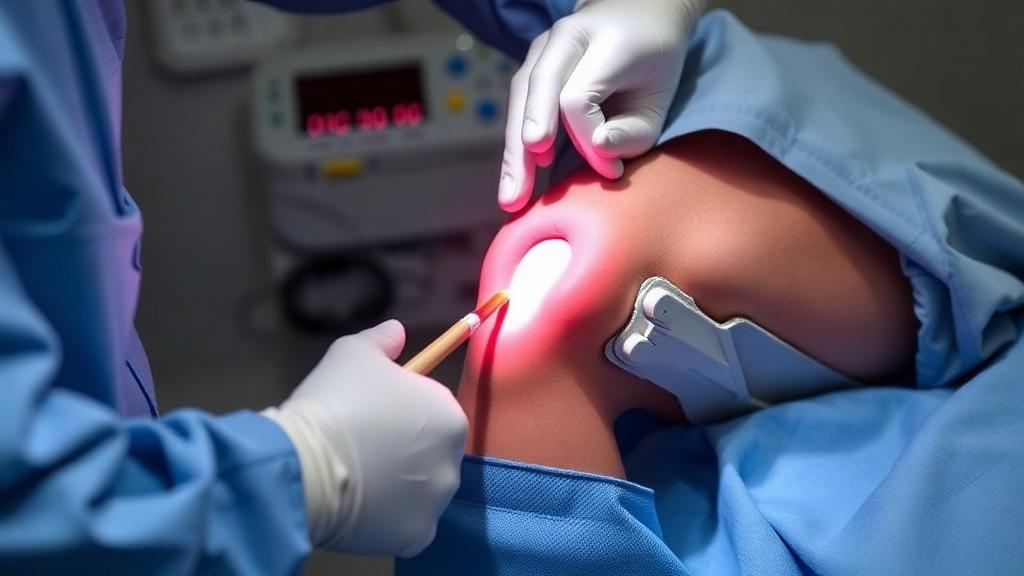
A randomized controlled trial has found that injecting the antibiotic cefuroxime directly into bone before robotic-assisted total knee replacement produces far higher concentrations of the drug in the tissues around the joint than the same drug given intravenously. The study, published in the journal Arthroplasty, also showed that a lower intraosseous dose of 750 milligrams achieved tissue concentrations nearly as high as a 1,500 milligram bone injection while keeping systemic drug levels in the blood lower after the tourniquet was released. The researchers describe 750 milligrams as a candidate dose for further clinical evaluation, while emphasizing that the trial was not designed to prove that the technique actually reduces infections.
Periprosthetic joint infection remains one of the most serious complications after knee replacement, and preventing it depends heavily on prophylactic antibiotics. For prophylaxis to work, tissue concentrations of the drug must exceed the minimum inhibitory concentration of the target pathogens from the moment the skin is incised until the wound is closed. Coagulase-negative staphylococci and Staphylococcus aureus account for roughly two-thirds of these infections worldwide. Although cephalosporins such as cefazolin and cefuroxime remain the standard prophylactic agents recommended by the 2018 International Consensus on Musculoskeletal Infection, rising antimicrobial resistance complicates the picture, with data suggesting that cephalosporin resistance in coagulase-negative staphylococci may have increased nearly one hundred-fold in terms of minimum inhibitory concentration values.
Intraosseous regional antibiotic administration, in which the drug is injected into the medullary cavity of the bone, has previously been validated with vancomycin in conventional knee replacement. This route delivers higher local tissue concentrations while reducing systemic exposure, because the tourniquet isolates the operative limb and the drug is distributed through the highly vascular, non-collapsible microvenous network of the medullary cavity, which operates at a pressure of roughly 20 to 30 millimeters of mercury. However, most prior studies paired the intraosseous antibiotic with an additional intravenous dose, which increases total antibiotic consumption and undermines the time and labor savings that make the intraosseous approach attractive. In an earlier randomized trial of conventional manual knee replacement, the same research team showed that stand-alone preoperative intraosseous cefuroxime produced higher periarticular tissue concentrations than intravenous administration, and that the 750 milligram regimen was associated with lower systemic concentrations than the 1,500 milligram regimen.
Whether those findings would carry over to robotic-assisted surgery was uncertain. Robotic-assisted total knee arthroplasty has been increasingly adopted for its precision in bone resection, implant matching and gap balancing, but it introduces workflow features that could disrupt regional drug delivery. The procedure requires multiple fixation pins that penetrate the intramedullary canal, generally takes longer than conventional surgery, and carries its own infection risks, including pin tract infections. Reported data indicate that the incidence of periprosthetic joint infection is higher in robotic-assisted arthroplasty than in conventional arthroplasty. Tibial tracker pins are inserted near the intraosseous access site after drug administration and removed after implant placement, potentially creating additional pathways for fluid egress. Robotic technique also avoids the femoral intramedullary alignment rod used in conventional surgery, preserving the central femoral canal, and differences in medullary integrity, bleeding and fluid dilution could alter drug distribution. Longer operative and tourniquet times raised a further question of whether high tissue concentrations could be sustained throughout the procedure.
To address these uncertainties, the researchers conducted a prospective, randomized, single-blind controlled study of 39 patients undergoing MAKO robotic-assisted total knee replacement between July and August 2024, all operated on for knee osteoarthritis. Patients were allocated in a 1:1:1 ratio to receive either 750 milligrams of cefuroxime injected into the proximal tibial metaphysis before skin incision, 1,500 milligrams by the same intraosseous route, or 1,500 milligrams infused intravenously through the antecubital vein. No additional intravenous antibiotics were given before incision or during surgery, making the intraosseous regimens truly stand-alone. One participant in the intravenous group was lost to follow-up, leaving 38 patients in the final analysis: 13 in each intraosseous group and 12 in the intravenous group. The trial was registered with the Chinese Clinical Trial Registry before recruitment and formed part of the same registered research programme as the team’s earlier conventional-TKA cohort, recruited separately with no overlap in participants or specimens.
During each operation the surgeons collected nine tissue samples, including cancellous bone from the femur or tibia, synovium and fat from the surgical area, along with two blood samples, one after skin incision and one after tourniquet release. All specimens were analyzed for cefuroxime concentrations using liquid chromatography-tandem mass spectrometry. The team also prespecified an exploratory tissue-concentration benchmark of 16 micrograms per gram, numerically four times the epidemiological cutoff value of 4 micrograms per milliliter for Staphylococcus aureus in the EUCAST database. Because the reference value is a fluid concentration while tissue measurements are expressed per gram of tissue, the researchers stressed that the benchmark should be regarded as an operational yardstick rather than a strict pharmacokinetic equivalence.
The results were striking. Cefuroxime concentrations in all fat, synovium and bone samples were significantly higher in both intraosseous groups than in the intravenous group. In the intravenous group, 59.3 percent of tissue samples, 64 of 108, fell below the 16 microgram per gram benchmark, whereas 95.7 percent of samples in the 750 milligram intraosseous group and 99.1 percent in the 1,500 milligram intraosseous group reached that level. Compared with intravenous administration, the 750 milligram intraosseous regimen produced fat concentrations 9 to 13 times higher, synovial concentrations 4 to 8 times higher, and bone concentrations 9 to 41 times higher, with the 1,500 milligram intraosseous dose producing even higher tissue levels. The two earliest tissue specimens, collected within minutes of injection, already exceeded the benchmark, indicating rapid regional distribution within the isolated limb. High concentrations persisted at all prespecified sampling points, including later operative stages and after tourniquet release.
The systemic concentration profile differed by route and dose. Initial blood concentrations after skin incision were significantly lower in both intraosseous groups than in the intravenous group, consistent with the drug being retained within the tourniquet-isolated limb while intravenously infused cefuroxime circulates systemically from the outset. After tourniquet release, the 1,500 milligram intraosseous group showed a higher mean blood concentration than the other two groups, with the difference between the two intraosseous doses reaching statistical significance at p equals 0.005. The authors caution that interpretation must account for differences in administration route, infusion duration and sampling timing, since the intravenous infusion was given over a substantially longer period and the intervals between administration and the first blood draw were not identical across groups.
Notably, tissue concentrations in the robotic cohort were higher than in the team’s previous conventional-TKA study at seven of nine matched sampling points. After the 750 milligram intraosseous dose, the mean concentration in the first distal femoral cancellous bone specimen was 146.0 micrograms per gram in robotic surgery compared with 25.3 micrograms per gram in the conventional cohort; after 1,500 milligrams, the corresponding values were 272.0 and 77.7 micrograms per gram. The authors suggest that preserving the femoral medullary canal, avoiding canal-related bleeding and dilution, and a longer interval for drug distribution before that specimen was collected may partly explain the pattern. They emphasize, however, that the two cohorts were recruited in different periods and were not randomized against each other, so this cross-cohort comparison is descriptive rather than evidence of a causal effect of the robotic workflow.
On safety and tolerability, all intraosseous administrations were completed successfully, vital signs remained stable, and no visible leakage occurred from the injection site or the tracker-pin sites. There were no significant differences among the three groups in postoperative inflammatory markers such as C-reactive protein, interleukin-6 and erythrocyte sedimentation rate on days one and three, and no complications occurred within three months, including wound or infection-related events or adverse drug reactions. The authors are careful to note that these secondary outcomes were exploratory and underpowered, that the sample of 13 patients per group was calculated only for the primary tissue-concentration endpoint, and that high-risk infection patients were not enrolled. Because total drug concentrations were measured in tissue homogenates at discrete time points rather than through continuous monitoring of unbound interstitial drug, the proportion of samples above the benchmark is a descriptive pharmacokinetic outcome, not direct evidence of continuous free-drug target attainment. Whether the observed pharmacokinetic advantages translate into lower rates of periprosthetic joint infection will require larger, adequately powered trials, but the study establishes that stand-alone intraosseous cefuroxime is technically feasible within the robotic workflow and identifies 750 milligrams as a reasonable dose for that next stage of evaluation.
Subject of Research: Pharmacokinetics of intraosseous versus intravenous cefuroxime prophylaxis in robotic-assisted total knee arthroplasty
Article Title: Higher tissue concentrations of cefuroxime achieved with preoperative stand-alone intraosseous regional prophylaxis in robotic-assisted total knee arthroplasty: a randomized controlled trial
Article References: Liu, T., Zhang, H., Guo, M., Zhao, R., Tao, Y., Zhang, Z., Zhang, G., Fu, J., & Ni, M. (2026). Higher tissue concentrations of cefuroxime achieved with preoperative stand-alone intraosseous regional prophylaxis in robotic-assisted total knee arthroplasty: a randomized controlled trial. Arthroplasty, 8(1), Article 81. https://doi.org/10.1186/s42836-026-00436-0
Image Credits: AI Generated
DOI: 10.1186/s42836-026-00436-0
Keywords: total knee arthroplasty, robotic surgery, cefuroxime, intraosseous antibiotic administration, periprosthetic joint infection, surgical prophylaxis, randomized controlled trial, pharmacokinetics, tissue concentrations, orthopedic surgery, antimicrobial resistance, MAKO robotic system
News Source: Ophelia Keating. (October 27, 2026). Intraosseous Cefuroxime Outperforms IV Dosing in Robotic Knee Surgery Trial. Scienmag.