Credit: Mary Ann Liebert, Inc., publishers
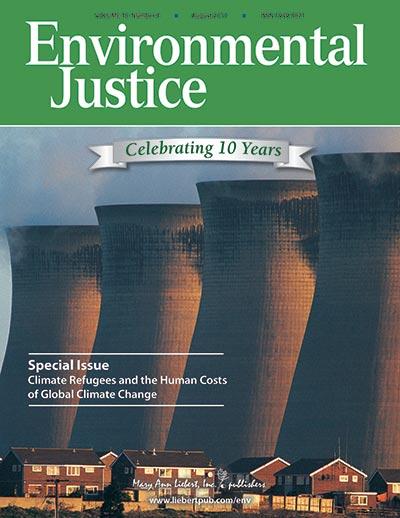
New Rochelle, NY, Oct. 4, 2017–Researchers have developed a computational model based on available childhood blood-lead level records and nationwide census data to predict the risk of lead exposure for children in the U.S. The predictive power of this model can help target high-risk areas for interventions, government support, enforcement measures, and screening, as proposed in an article published in Environmental Justice, a peer-reviewed journal published by Mary Ann Liebert, Inc. publishers. The article is available free on the Environmental Justice website until November 4, 2017.
The article entitled "Predicting Lead Exposure Among U.S. Children at the Census Tract Level ," presents a validated regression model that identified several key predictive factors for childhood lead exposure: pre-1960 housing, percent of population below poverty level, and percent of population that is non-Hispanic black. Coauthors Bradley Schultz, U.S. Environmental Protection Agency (ret.) (Research Triangle Park, NC), Michele Morara, Google (Mountain View, CA), Bruce Buxton, Battelle Memorial Institute (Columbus, OH), and Max Weintraub, U.S. Environmental Protection Agency (San Francisco, CA) applied the model to 1- and 2-year-olds across the U.S.
"In the wake of Flint, MI, the need for predictive lead models is needed to ensure environmental equity, particularly for children. The research results for this new computational model for lead prediction advance the field of environmental justice," says Environmental Justice Editor-in-Chief Sylvia Hood Washington, PhD, MSE, MPH, a LEED AP and Sustainability Director, Environmental Health Research Associates, LLC.
###
About the Journal
Environmental Justice is an authoritative peer-reviewed journal published bimonthly online with Open Access options and in print. The Journal encompasses study and debate on a broad range of environmental inequalities at the local, national, and global level tied to social, health, and economic equity. The Journal features studies that demonstrate the adverse effects on populations that are already at risk for health and environmental hazards, as well as the complicated issues inherent in remediation, funding, relocation of facilities that pose hazardous risk to health. Complete tables of contents and a sample issue may be viewed on the Environmental Justice website.
About the Publisher
Mary Ann Liebert, Inc., publishers is a privately held, fully integrated media company known for establishing authoritative peer-reviewed journals in many promising areas of science, medicine, biomedical research, and law, including Sustainability: The Journal of Record, Environmental Engineering Science, and Ecopsychology. Its biotechnology trade magazine, GEN (Genetic Engineering & Biotechnology News), was the first in its field and is today the industry's most widely read publication worldwide. A complete list of the firm's 80 journals, books, and newsmagazines is available on the Mary Ann Liebert, Inc., publishers (http://www.liebertpub.com/) website.
Mary Ann Liebert, Inc.140 Huguenot St., New Rochelle, NY 10801-5215
Phone: 914-740-2100 800-M-LIEBERT Fax: 914-740-2101
http://www.liebertpub.com
Media Contact
Kathryn Ryan
[email protected]
914-740-2250
@LiebertPub
http://www.liebertpub.com
Original Source
http://www.liebertpub.com/global/pressrelease/can-census-data-better-predict-lead-exposure-in-children/2266/ http://dx.doi.org/10.1089/env.2017.0005