

• HOME
  • NEWS
  • EXPLORE
    • CAREER
      • Companies
      • Jobs
    • EVENTS
    • iGEM
      • News
      • Team
    • PHOTOS
    • VIDEO
    • WIKI
  • BLOG
  • COMMUNITY
    • FACEBOOK
    • INSTAGRAM
    • TWITTER
Monday, November 2, 2026
BIOENGINEER.ORG
No Result
View All Result
  • Login
  • HOME
  • NEWS
  • EXPLORE
    • CAREER
      • Companies
      • Jobs
        • Lecturer
        • PhD Studentship
        • Postdoc
        • Research Assistant
    • EVENTS
    • iGEM
      • News
      • Team
    • PHOTOS
    • VIDEO
    • WIKI
  • BLOG
  • COMMUNITY
    • FACEBOOK
    • INSTAGRAM
    • TWITTER
No Result
View All Result
Bioengineer.org
No Result
View All Result
Home NEWS Science News Technology

Lightweight hybrid transformer model detects plant diseases with over 99% accuracy

by
October 28, 2026
in Technology
Reading Time: 2 mins read
0
Lightweight hybrid transformer model detects plant diseases with over 99% accuracy

Lightweight hybrid transformer model detects plant diseases with over 99% accuracy

Share on FacebookShare on TwitterShare on LinkedinShare on RedditShare on Telegram

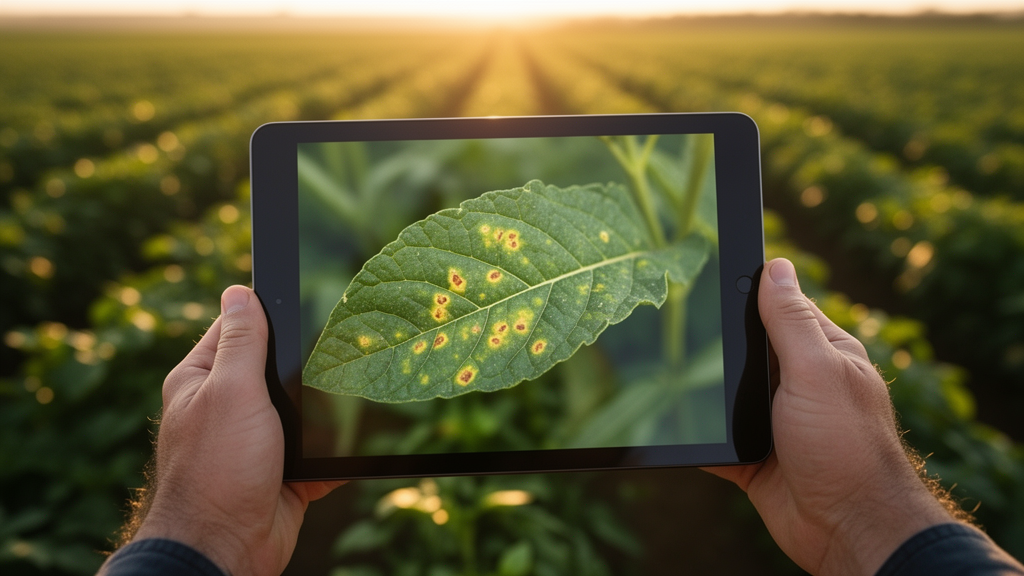
Researchers have developed a lightweight hybrid deep learning model, called WT-MobileViT, that classifies plant diseases from images with accuracy rates above 99% across four datasets, including a newly created collection of tea leaf disease photographs taken in field conditions.

The model, described in an open access paper published in Discover Applied Sciences on 27 October 2026, integrates frequency domain information into the MobileViT transformer framework. The method first applies a one-level Haar Discrete Wavelet Transform to decompose each input image into low-frequency and high-frequency sub-bands. This step preserves complementary structural and texture information, which is then concatenated with the original RGB image to build a multi-frequency feature representation that the network can learn from.

In experiments reported in the paper, the proposed model achieved an accuracy of 99.44% on the tea leaf dataset, 99.68% on a rice dataset, 99.17% on a bean dataset, and 99.21% on the PlantVillage dataset. According to the authors, the experimental results show that the proposed model outperforms several state-of-the-art deep learning models with fewer parameters.

The work addresses a practical agricultural problem. The authors note that the rapid spread of plant diseases significantly threatens global food security, and that early and accurate detection is crucial for effective disease management and crop protection. Manual identification of diseases requires expert knowledge in the field, and finding people with that domain knowledge is challenging, which has motivated researchers in recent years to propose computer vision-based machine learning techniques to overcome the challenge.

A distinctive contribution of the study is the tea leaf disease dataset itself, which the authors created using RGB images captured in field conditions.

The reported results come from the authors’ own experiments on four datasets, and the paper is being shared early as a peer-reviewed, accepted manuscript that is citable and carries a permanent DOI, subject to further edits before the final version of record. As with any classification study, the headline accuracy figures reflect performance on the datasets tested, and independent validation on other crops, regions, and imaging conditions would be needed to establish broader applicability.

The study was conducted by Sk Mahmudul Hassan, Tanvir Habib Sardar, Ruhul Amin Hazarika, and Kumar Sekhar Roy. By combining wavelet-based frequency analysis with a hybrid transformer architecture, the approach pairs signal-processing techniques with modern vision models, motivated by the challenge that manual disease identification requires expert knowledge that can be difficult to find.

Subject of Research: A lightweight hybrid deep learning model for classifying plant diseases from leaf images

Article Title: Lightweight transformer based WT-MobileViT framework for plant disease detection

Article References: Hassan, S. M., Sardar, T. H., Hazarika, R. A., & Roy, K. S. (2026). Lightweight transformer based WT-MobileViT framework for plant disease detection. Discover Applied Sciences. https://doi.org/10.1007/s42452-026-09719-2

Image Credits: AI Generated

DOI: 10.1007/s42452-026-09719-2

Keywords: plant disease detection, WT-MobileViT, deep learning, transformer, Haar wavelet transform, MobileViT, tea leaf disease, computer vision, agriculture, image classification, food security, lightweight model

News Source: Alan Morgan. (October 27, 2026). Lightweight hybrid transformer model detects plant diseases with over 99% accuracy. Scienmag.


Tags: AgricultureComputer Visiondeep learningfood securityHaar wavelet transformimage classificationlightweight modelMobileViTplant disease detectiontea leaf diseaseTransformerWT-MobileViT
Share12Tweet7Share2ShareShareShare1

Related Posts

Systematic review maps sustainability tensions in offshore wind development

Systematic review maps sustainability tensions in offshore wind development

October 30, 2026
Amateur maps and sketches helped put Hong Kong's wartime pillboxes on official charts

Amateur maps and sketches helped put Hong Kong’s wartime pillboxes on official charts

October 30, 2026

Heavier logging trucks only pay off when the road network lets them work

October 30, 2026

Supersulfated cement outperforms Portland cement in curbing concrete’s alkali-silica reaction

October 30, 2026

POPULAR NEWS

  • Microbial Sources and Stress Shape the Hidden Endophytes of an Invasive Plant

    Microbial Sources and Stress Shape the Hidden Endophytes of an Invasive Plant

    29 shares
    Share 12 Tweet 7
  • Firebreaks Leave Lasting Scars in Grasslands While Wildfire Heals Fast

    29 shares
    Share 12 Tweet 7
  • ZNF207 shields glutamine transporter ASCT2 from degradation to fuel liver cancer growth

    29 shares
    Share 12 Tweet 7
  • Systematic review maps sustainability tensions in offshore wind development

    29 shares
    Share 12 Tweet 7

About

We bring you the latest biotechnology news from best research centers and universities around the world. Check our website.

Follow us

Recent News

Microbial Sources and Stress Shape the Hidden Endophytes of an Invasive Plant

Firebreaks Leave Lasting Scars in Grasslands While Wildfire Heals Fast

ZNF207 shields glutamine transporter ASCT2 from degradation to fuel liver cancer growth

Subscribe to Blog via Email

Enter your email address to subscribe to this blog and receive notifications of new posts by email.

Join 86 other subscribers
  • Contact Us

Bioengineer.org © Copyright 2023 All Rights Reserved.

Welcome Back!

Login to your account below

Forgotten Password?

Retrieve your password

Please enter your username or email address to reset your password.

Log In
No Result
View All Result
  • Homepages
    • Home Page 1
    • Home Page 2
  • News
  • National
  • Business
  • Health
  • Lifestyle
  • Science

Bioengineer.org © Copyright 2023 All Rights Reserved.
