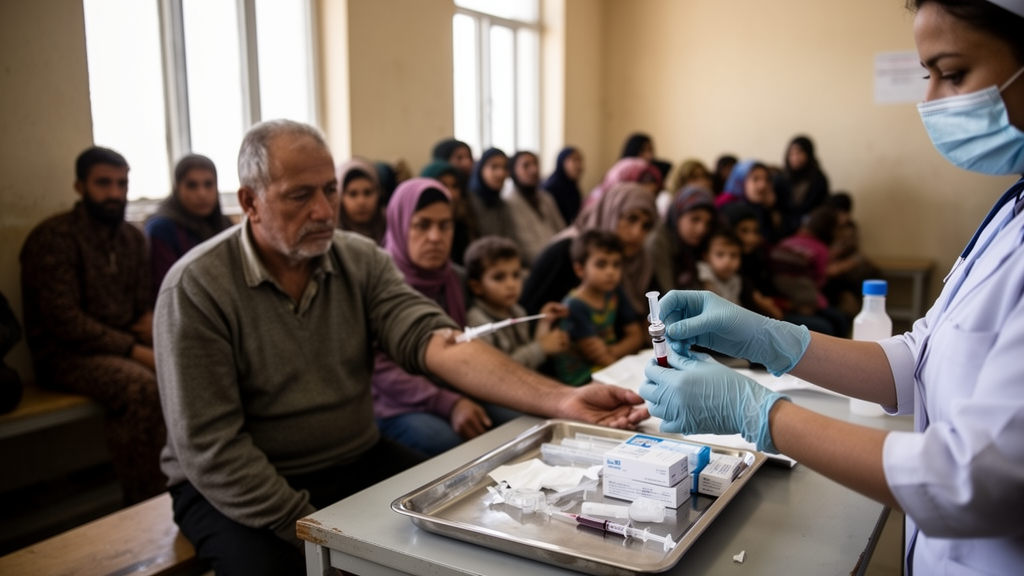
Displaced people worldwide carry a substantially heavier burden of hepatitis B than the general population, according to a systematic review and meta-analysis published in BMC Public Health. Pooling data from 117 studies identified through searches of eight academic databases covering 2016 to 2026, researchers led by Efosa Ekhator and colleagues estimated that 3.86 percent of internally displaced persons, refugees and asylum seekers are living with the viral infection, with a 95 percent confidence interval of 3.45 to 4.29 percent. The analysis followed the PRISMA 2020 reporting guideline and was registered as CRD420261361168.
The pooled figure masks considerable variation across groups. Prevalence was markedly higher among men, at 5.98 percent (95 percent CI: 4.61 to 7.50 percent), than among women, at 3.82 percent (95 percent CI: 2.96 to 4.78 percent). Displaced people from Eastern Asia recorded the highest pooled prevalence, 11.62 percent (95 percent CI: 7.61 to 16.32 percent), followed by those from South-eastern Asia at 7.18 percent (95 percent CI: 5.70 to 8.80 percent) and Sub-Saharan Africa at 6.62 percent (95 percent CI: 5.44 to 7.90 percent).
Displacement status itself appeared to matter. Internally displaced persons showed a pooled prevalence of 9.99 percent (95 percent CI: 6.82 to 13.67 percent), significantly higher than other subgroups at the p ≤ 0.05 threshold. People hosted in African countries had a pooled prevalence of 7.74 percent (95 percent CI: 5.02 to 10.97 percent), and those living in displacement camps recorded 7.19 percent (95 percent CI: 5.47 to 9.11 percent).
The authors suggest that governments and non-governmental organisations should prioritise displaced populations in hepatitis B control efforts on the basis of these findings. Methodologically, the review screened 4,673 records and extracted data from each included study, assessing methodological quality with the Joanna Briggs Institute checklist. That heterogeneity proved substantial.
Even after subgroup analyses, considerable variability remained across the included studies, and multivariate meta-regression linked it to several study-level characteristics: displacement status, the percentage of male participants, the temporal design of the studies and the settings in which they were conducted. This means the pooled estimates should be read as averages across widely differing populations, sampling strategies and screening approaches rather than as a single uniform prevalence figure applicable everywhere. The authors took several steps to probe the reliability of their results.
A leave-one-out sensitivity analysis, which re-estimates the pooled prevalence while excluding each study in turn, demonstrated the robustness of the findings, indicating that no single study was driving the overall result. Publication bias, the tendency for smaller or less striking results to go unpublished, was assessed with Egger's regression test and funnel plot visualisation. The authors note that their estimates are subject to the limitations inherent in meta-analysis of observational prevalence studies, including the residual heterogeneity and the small-study effect detected by Egger's test.
Even so, the consistency of the elevated burden across sensitivity analyses supports the paper's central conclusion that displaced populations represent a group with a high prevalence of hepatitis B and a corresponding claim on public health resources.
Subject of Research: Global prevalence of hepatitis B virus infection among refugees, asylum seekers and internally displaced persons
Article Title: Global prevalence of hepatitis B among displaced populations (internally-displaced persons, refugees, and asylum seekers): a systematic review and meta-analysis
Article References: Ekhator, E., Afolabi, O. E., Okundaye, M. I., Essien, V. G., Amodu, M. A., & Omolumen, J. I. (2026). Global prevalence of hepatitis B among displaced populations (internally-displaced persons, refugees, and asylum seekers): a systematic review and meta-analysis. BMC Public Health. https://doi.org/10.1186/s12889-026-29716-9
Image Credits: AI Generated
DOI: 10.1186/s12889-026-29716-9
Keywords: hepatitis B, displaced populations, refugees, internally displaced persons, asylum seekers, systematic review, meta-analysis, global health, public health, viral hepatitis, prevalence, BMC Public Health
News Source: Kristina Jarvis. (October 27, 2026). Hepatitis B Burden Runs High Among Displaced Populations, Review Finds. Scienmag.