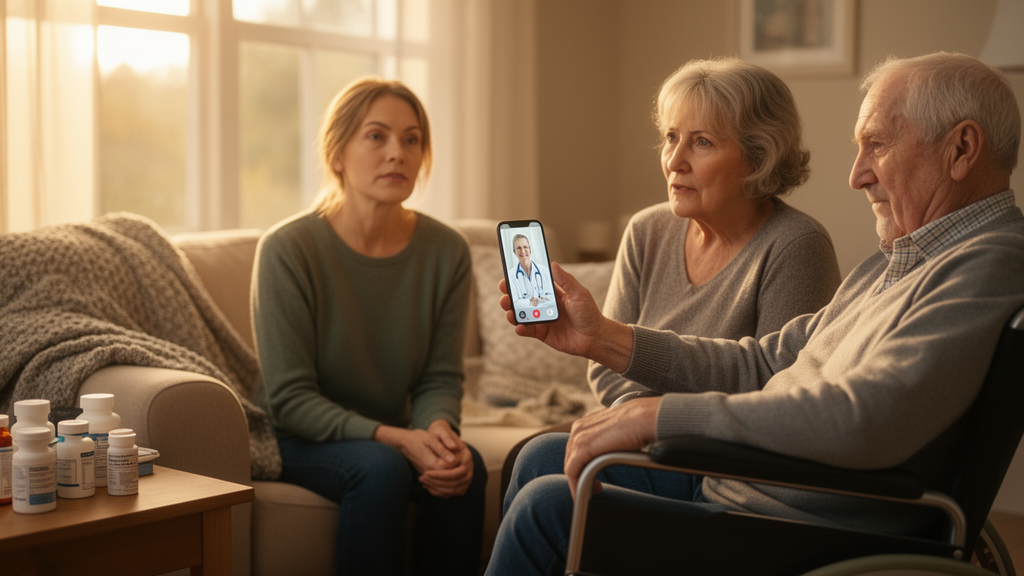
Informal caregivers—the family members and friends who provide unpaid care for sick or aging loved ones—are frequently invisible in research on virtual healthcare, according to a scoping review published in BMC Health Services Research. The review, led by Sevde Okudan and colleagues including Julia Smith, analyzed 69 studies published in English between January 2013 and July 2025 to map what is known about caregivers’ experiences and perceptions of remote care. The researchers followed the Joanna Briggs Institute methodology for their search strategy and reported the work according to the PRISMA-ScR protocol.
They systematically searched PubMed, Web of Science, CINAHL, and Scopus, then applied content analysis to synthesize the findings. As a scoping review, the study maps the breadth of existing literature rather than pooling effect sizes, and its conclusions reflect the scope of studies available in these databases during the search window.
The evidence shows a distinctly mixed picture. On the positive side, caregivers valued virtual healthcare for its ability to overcome geographical barriers, save time, and offer flexibility—benefits that matter greatly to people juggling care duties with work and family life.
Caregivers also reported wellbeing gains, including reduced anxiety and increased connectivity, particularly through virtual support and training initiatives designed for them. But the same technologies introduced new strains.
Negative perceptions centered on concerns about quality of care, privacy and security, and difficulties adapting to unfamiliar tools. Notably, virtual care created new and additional tasks for caregivers, adding to their existing burden rather than relieving it—a finding that challenges the assumption that remote care simply lightens the load for families.
The review also documented diverse perspectives on how virtual healthcare affects caregivers’ relationships with clinicians, without a consistent direction across studies. Experiences varied further among caregivers of specific population groups, suggesting that the benefits and drawbacks of remote care are not distributed evenly across patient populations or caregiving situations.
The authors conclude that policymakers and clinicians need to consider how to enhance the aspects of virtual healthcare that recognize and support caregivers’ essential work, while mitigating negative effects on caregiver workload and wellbeing. They also call for further research on caregivers’ role in virtual healthcare delivery, particularly research that accounts for the socio-economic effects of caregiving and the diverse needs of caregiver populations.
Because the review is a scoping synthesis of published studies, it identifies patterns in the literature rather than measuring outcomes directly, and the included studies span more than a decade of rapidly evolving telehealth technology. The authors note that the evidence base itself has gaps: caregivers’ perspectives are often overlooked in virtual care research, which is precisely the problem the review set out to document.
Subject of Research: Informal caregivers' experiences and perceptions of virtual healthcare
Article Title: Centering caregivers in virtual healthcare research: a scoping review of informal caregivers’ experiences and perceptions
Article References: Okudan, S., Buekens, A., Tiwana, M. H., Hedden, L., & Smith, J. (2026). Centering caregivers in virtual healthcare research: a scoping review of informal caregivers’ experiences and perceptions. BMC Health Services Research. https://doi.org/10.1186/s12913-026-15467-1
Image Credits: AI Generated
DOI: 10.1186/s12913-026-15467-1
Keywords: virtual healthcare, informal caregivers, scoping review, telehealth, caregiver burden, caregiver wellbeing, health services research, remote care, PRISMA-ScR, BMC Health Services Research, Centering, caregivers
News Source: Ophelia Keating. (October 27, 2026). Virtual Healthcare Often Overlooks Informal Caregivers, Scoping Review Finds. Scienmag.