Two commercial South African herbal teas marketed for lowering blood pressure and blood sugar have shown measurable enzyme-inhibiting activity in laboratory tests, and — more strikingly — appear to amplify the effects of standard prescription drugs when the two are combined in vitro. The study, published in Clinical Phytoscience, tested Sela Tea-High Blood and Sela Tea-Blood Sugar, blends sold as traditional remedies, against key enzymes involved in hypertension and type 2 diabetes. The findings offer the first systematic laboratory evidence bearing on the therapeutic claims attached to these products, while stopping well short of clinical proof.
The research team, led by Motlalepula Gilbert Matsabisa at the University of the Free State in South Africa, set out to address a gap that has practical consequences for millions of patients. Sela teas are widely available commercial blends, yet no published evidence had supported their advertised effects, and nothing was known about what happens when they are consumed alongside antihypertensive or antidiabetic medications. This matters because many people who use herbal medicine do not abandon their prescriptions; they take both at once. Depending on how the ingredients interact, that concomitant use could weaken a drug, intensify its side effects, or — as the new results suggest may be possible here — enhance its effectiveness.
The two teas have distinct compositions. Sela Tea-High Blood, abbreviated SHB in the study, combines black tea from Camellia sinensis, rooibos from Aspalathus linearis, and hibiscus flowers. Sela Tea-Blood Sugar, or SBS, pairs rooibos and black tea with Aloe ferox Mill. Previous research has provided hints of relevant activity in the individual plants: C. sinensis and A. linearis have been reported to lower plasma angiotensin II and endothelin 1 while raising nitric oxide, promoting vasodilation, and both have shown antidiabetic properties through inhibition of carbohydrate-digesting enzymes or improved insulin sensitivity and glucose uptake. Aloe ferox has been linked to a potential hypoglycemic effect. But a blend of ingredients is not the sum of its parts, and the commercial products themselves had never been rigorously profiled.
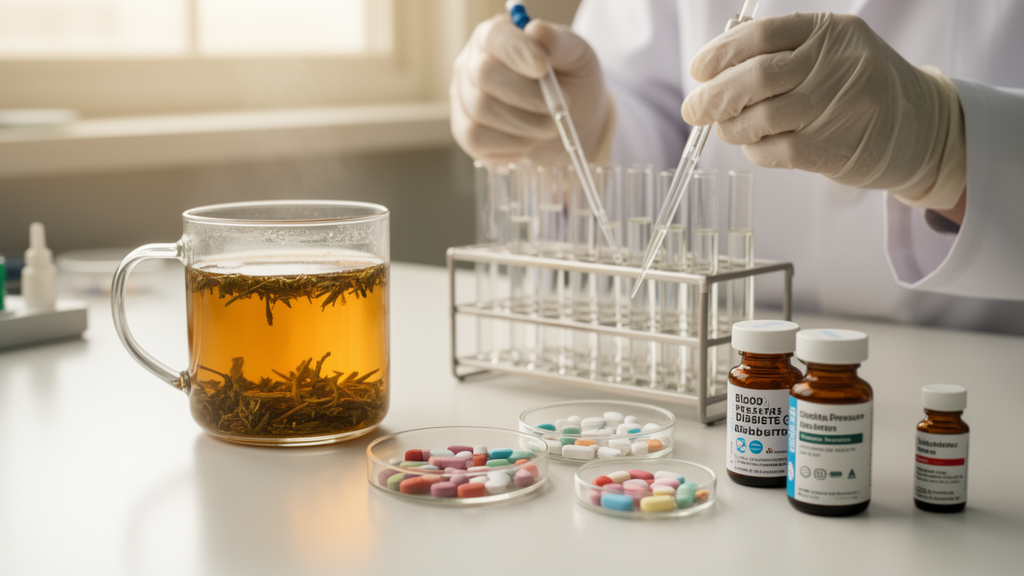
The preparation method deliberately mirrored everyday practice. Six teabags, each weighing 1.7 grams, were steeped in 1,500 millilitres of boiling water for 15 minutes, the way a consumer might brew a large pot. The extract was then filtered, frozen, and freeze-dried over three days into a powder, with the extraction performed in triplicate to ensure consistency. This choice matters for interpretation: the concentrations tested in the assays derive from a water extraction at typical brewing strength, not from aggressive solvent extraction of raw plant material, so the starting point reflects what a tea drinker might actually ingest.
Safety screening came first. The researchers exposed HEK-293 human embryonic kidney cells to SHB and Chang liver cells to SBS, chosen because the kidney is central to blood pressure regulation and the liver to glucose homeostasis. Using the MTT viability assay over a 48-hour treatment period, they found that at the lowest concentrations cell viability actually exceeded 100 percent, and even at the highest tested doses — 300 micrograms per millilitre for SHB and 480 micrograms per millilitre for SBS — viability remained above 75 percent. Doxorubicin served as the positive control. The authors characterise this as limited cytotoxicity, though they are careful to note it is a preliminary assessment in cell lines, not a verdict on safety in humans.
The enzyme inhibition results form the core of the study. SHB inhibited angiotensin-converting enzyme, or ACE, with a half-maximal inhibitory concentration (IC50) of 247.60 micrograms per millilitre, and inhibited renin with an IC50 of 28.38 micrograms per millilitre — both key enzymes in the renin-angiotensin-aldosterone system that governs blood pressure. At the highest concentration tested, 1,500 micrograms per millilitre, SHB reduced ACE activity by 80 percent; at 486 micrograms per millilitre it suppressed renin activity by 90 percent, both in a dose-dependent fashion. SBS, meanwhile, inhibited alpha-glucosidase potently with an IC50 of 4.59 micrograms per millilitre, but was far weaker against alpha-amylase, needing 1,974 micrograms per millilitre for the same effect. That asymmetry echoes patterns reported for green tea extracts, which show similarly lopsided profiles against the two digestive enzymes.
The combination experiments used a two-way fixed-dose design intended to probe interaction from both directions. The IC50 of each tea extract was held fixed while the concentration of the matching drug varied, and then the roles were reversed, with the drug’s IC50 fixed and the tea concentration varied. Lisinopril, an ACE inhibitor with an IC50 of 0.142 micrograms per millilitre, and aliskiren, the only direct renin inhibitor approved for clinical use, with an IC50 of 0.52 nanograms per millilitre, represented antihypertensive therapy. Acarbose, an alpha-glucosidase inhibitor, stood in for conventional antidiabetic treatment. Across the board, the combinations produced significantly greater enzyme inhibition than either the drug or the tea alone.
The statistical comparisons sharpen the picture. The IC50 of SHB in the presence of lisinopril was significantly lower than SHB alone at inhibiting ACE (p = 0.0076), and the IC50 of SHB with aliskiren was significantly lower for renin inhibition (p = 0.0037). For the diabetes side, the IC50 of SBS with acarbose fell significantly below SBS alone for alpha-amylase inhibition (p = 0.0014), and for alpha-glucosidase the combination IC50 values were significantly lower than those of both SBS alone (p < 0.0001) and acarbose alone (p = 0.0037). Notably, when drugs were tested in the presence of the tea extracts, the researchers could not determine IC50 values at all for ACE, renin, alpha-amylase, or alpha-glucosidase, because the combinations exceeded 50 percent inhibition even at the lowest concentrations tested — a result the authors interpret as reflecting strong combined inhibitory activity. All estimates were derived from three independent biological experiments, each run in triplicate wells, with IC50 values fitted by nonlinear regression and compared using Welch’s t-test.
Context helps explain why these findings resonate locally. Hypertension affects roughly 25 percent of the global population, and South Africa carries the highest hypertension prevalence in Sub-Saharan Africa, estimated between 27.58 and 58 percent, along with the region’s second-highest prevalence of type 2 diabetes at 5.1 percent. Conventional drug classes — ACE inhibitors, angiotensin II receptor blockers, biguanides, alpha-glucosidase inhibitors — are effective but often require combinations of two or more agents to reach therapeutic goals, and such combinations can raise the risk of adverse cardiovascular outcomes including myocardial infarction, stroke, and heart failure. In urban South Africa, 83.9 percent of herbal medicine is consumed as tea, which makes the commercial tea format a particularly relevant vehicle for any real-world interaction between traditional remedies and prescription drugs.
The authors themselves frame the conclusions cautiously. The study demonstrates, in vitro, that the two teas inhibit their target enzymes and enhance the inhibitory effects of lisinopril, aliskiren, and acarbose at the concentrations tested, suggesting the teas could provide complementary effects alongside these drugs. But the researchers explicitly state that further studies are needed to confirm this hypothesis, and their conclusion calls for more comprehensive investigation of the antidiabetic and antihypertensive effects, safety profiles, and potential interactions with standard medications. An enzyme assay in a cell culture plate cannot capture absorption, metabolism, dosing in a real cup, or the physiology of a patient taking lisinopril with breakfast tea. What the work does establish is a reproducible laboratory signal — dose-dependent enzyme inhibition, limited cytotoxicity in two cell lines, and statistically significant enhancement of three established drugs — that now justifies the clinical and pharmacological follow-up the therapeutic claims of these popular blends have long lacked.
Subject of Research: In vitro evaluation of two commercial Sela herbal teas for enzyme inhibition and interaction with antihypertensive and antidiabetic drugs
Article Title: Evaluating the efficacy of commercial Sela tea- high blood and Sela tea-blood sugar in combination with antihypertensive and anti-diabetic drugs: an in vitro study
Article References: Matsabisa, M. G., Mthethwa, S. I., Hadebe, N. V., Ngoungoure Ndam, V. L., & Ngoumen Ngassa, D. J. (2026). Evaluating the efficacy of commercial Sela tea- high blood and Sela tea-blood sugar in combination with antihypertensive and anti-diabetic drugs: an in vitro study. Clinical Phytoscience, 12(1), Article 31. https://doi.org/10.1186/s40816-026-00446-0
Image Credits: AI Generated
DOI: 10.1186/s40816-026-00446-0
Keywords: Sela tea, hypertension, type 2 diabetes, ACE inhibition, renin, alpha-glucosidase, alpha-amylase, lisinopril, aliskiren, acarbose, in vitro study, herbal medicine
News Source: Ophelia Keating. (October 27, 2026). Herbal Sela teas boost blood pressure and diabetes drugs in lab tests. Scienmag.