Transparent ceramics have spent nearly three decades trying to catch up with the single crystals that dominate high-power solid-state lasers, and a new measurement technique may finally give engineers the precision tool they need to judge how close the ceramics have come. Researchers report in Applied Physics B a method that combines an integrating sphere with a multipass optical cell, allowing the scattering and absorption losses of laser materials to be separated and quantified with markedly improved precision. Applied to pure YAG and ytterbium-doped YAG ceramics, and compared directly against single crystals of identical composition and doping, the technique delivered numbers that both validate the ceramics and expose the subtle optical penalties they still carry.
The motivation is straightforward. In a laser gain material, the attenuation coefficient — the total rate at which light is drained from a beam as it travels through the medium — is the sum of two components: absorption, in which photons are genuinely consumed, and scattering, in which photons are deflected out of the beam but the energy remains in the material. Conventional transmission measurements cannot cleanly distinguish the two, because both processes conspire to reduce the light that emerges from the far face of a sample. Cavity ring-down spectroscopy offers exquisite sensitivity to weak losses, but teasing apart the scattering and absorption contributions demands additional modeling and a high-finesse cavity with demanding alignment. Laser calorimetry measures absorption directly but says little about scattering on its own. Specialized methods such as photothermal common-path interferometry and angle-resolved scattering each target only one loss channel.
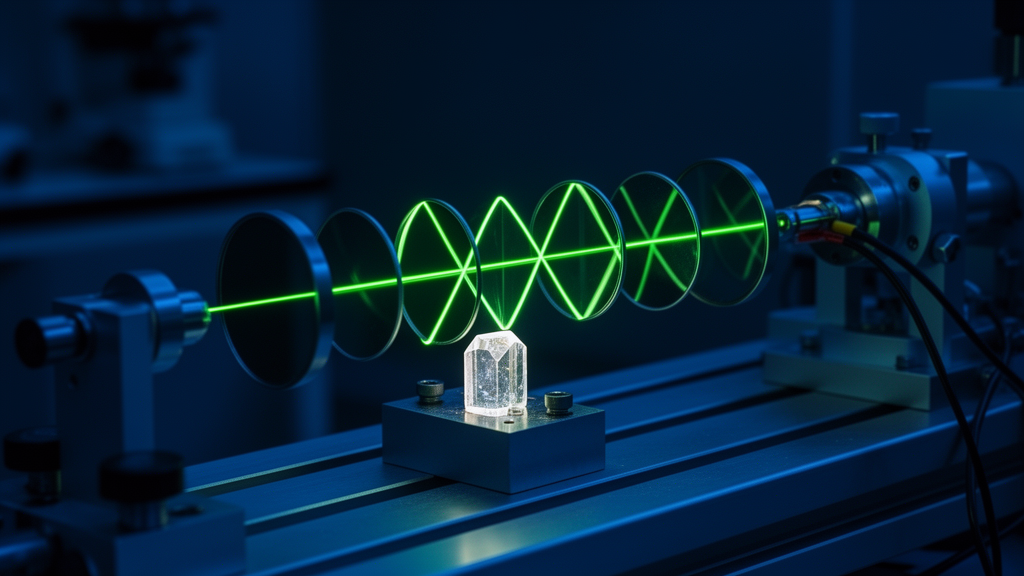
The integrating sphere has long been the workhorse for separating the two: by collecting both the light that passes through a sample and the light that is diffusely scattered out of the beam, it can, in principle, yield independent values for the scattering and absorption coefficients. Its weakness is that the optical interaction length is limited to a single pass through the sample. For low-loss materials — precisely the ones that matter for high-power lasers — the signal is so small that measurement precision suffers. The Chinese research team, led by Ya-Jie Zheng, Bing-Tian Lang, Yan-Jie Song, Duo Zhu and Yong Bo, attacked this limitation by folding the light path. They placed each sample at the center of a multipass cell inside the integrating sphere, where two slightly tilted mirrors coated for high reflectivity at 1064 nanometers bounced the beam back and forth seven times through the material before letting it exit.
Seven passes through the sample means seven times the optical interaction length, seven times the accumulated loss signal, and — as the team demonstrates both theoretically and experimentally — a sevenfold reduction in the relative uncertainty of the attenuation coefficient compared with a single-pass measurement. The light source was a Q-switched pulsed laser at 1064 nanometers, running at 5 kilohertz with 120-nanosecond pulses, with a beam diameter of roughly 3 millimeters at the sample position. That beam size matters for interpretation: the reported coefficients are averages over the beam-sample interaction volume, not spatially resolved local measurements. The scattering signal was recorded with a high-speed photodiode by comparing the sphere’s output with and without the sample in place, while transmitted and input powers were measured with a calibrated power meter.
Four samples were tested, all 15 by 5 by 10 cubic millimeters and all purchased commercially from the 11th Research Institute of China Electronics Technology Group Corporation. Two were ceramics — a pure YAG labeled A1 and a Yb:YAG doped with 0.35 atomic percent ytterbium labeled A2 — and two were single crystals of the same dimensions and doping concentration, labeled B1 and B2. The low doping level is deliberate: it represents the class of lightly doped Yb:YAG materials sought for high-energy laser amplifiers, where gain, suppression of amplified spontaneous emission, and effective pump absorption must be balanced through the choice of doping and interaction length. All optical surfaces carried antireflection coatings at 1064 nanometers to suppress surface reflection losses, which were assumed at 0.2 percent in the analysis.
The headline numbers: at 1064 nanometers, the scattering coefficient of the pure YAG ceramic measured 0.0046 per centimeter, while the Yb:YAG ceramic came in at 0.0093 per centimeter — roughly double. The corresponding absorption coefficients were 0.0267 and 0.0221 per centimeter, respectively, values the authors describe as close to those of the single-crystal counterparts. Notably, the absorption and scattering coefficients proved to be of comparable magnitude, a finding with practical consequences: it means absorption losses cannot be neglected when evaluating the overall attenuation properties of laser materials, even though scattering tends to attract more attention in ceramics.
Where does the residual absorption come from, given that 0.35 atomic percent ytterbium should absorb only weakly at 1064 nanometers? The team estimated the intrinsic ytterbium contribution using the known ion concentration — approximately 4.9 times 10 to the 19th per cubic centimeter — and the reported absorption cross-section spectrum of Yb:YAG, which shows the cross-section at 1064 nanometers is far weaker than at the main pump band near 940 nanometers. The intrinsic absorption therefore accounts for only a limited fraction of the measured value, and the remainder is attributed to extrinsic losses in the host: structural defects, residual pores, scattering centers and residual impurities. The scattering itself likely originates from grain boundaries and residual pores in the ceramic matrix, whose porosity depends sensitively on processing parameters such as composition, sintering temperature and holding time.
To validate the multipass approach, the researchers removed the two mirrors and repeated the measurements in a conventional single-pass configuration. The attenuation coefficients from the two schemes followed a generally consistent trend across all four samples, but the relative uncertainties of the absorption, scattering and attenuation coefficients were all larger in the single-pass case — with the attenuation coefficient’s uncertainty roughly seven times higher, exactly as the multipass theory predicts. The uncertainty analysis was based on the specified instrument uncertainties of the power meter and photodetector rather than on statistical scatter from repeated measurements, and the transmitted and scattered powers were measured repeatedly for each sample under identical conditions, with averaged values used in the calculations.
Beyond the loss coefficients, the team probed how scattering degrades beam quality. Using a Shack-Hartmann wavefront sensor illuminated by a 20-times-expanded helium-neon laser beam at 632.8 nanometers, they measured wavefront distortion through each sample, taking 20 measurements per sample and comparing against the bare beam as a reference. The reference beam had a root-mean-square wavefront error of 0.020 micrometers and a peak-to-valley value of 0.151 micrometers. The ceramics measured 0.028 and 0.037 micrometers RMS (A1 and A2) with peak-to-valley values of 0.211 and 0.228 micrometers, while the crystals measured 0.020 and 0.026 micrometers RMS with peak-to-valley values of 0.181 and 0.196 micrometers. The Yb:YAG ceramic A2 showed the largest deviation and the most pronounced beam-shape change, consistent with its higher scattering coefficient, and the crystals generally outperformed the ceramics in wavefront quality. The authors caution that the Shack-Hartmann sensor captures the integrated wavefront of the transmitted probe beam, so the measured aberrations reflect a combination of localized scattering centers and macroscopic refractive-index inhomogeneities — an indicator of overall optical quality rather than purely scattering-induced degradation. Transmitted beam-profile measurements reinforced the same picture: crystal samples showed relatively uniform intensity distributions, while the ceramics, especially A2, showed clear degradation.
Finally, the measured attenuation coefficients were fed into a classical cavity-loss analysis to estimate what these material losses would mean for actual laser performance. For a 10-millimeter laser rod, the material-related parasitic loss was estimated at 0.0314 for the Yb:YAG ceramic and 0.0108 for the Yb:YAG crystal — the crystal’s parasitic loss is roughly one third of the ceramic’s. Assuming an identical output-coupler transmission of 40 percent, the corresponding loss factors work out to 0.927 for the ceramic and 0.974 for the crystal. Although the crystal retains an edge, the two figures remain close under identical cavity parameters, which the authors interpret as evidence that high-quality, low-loss Yb:YAG ceramics can still provide favorable cavity-loss conditions and genuine potential for high-performance laser applications. The method itself — longer effective path, stronger signal, lower uncertainty, and independent separation of scattering from absorption in a single configuration — offers the laser-ceramics community a practical yardstick for the continued push to close the gap with single crystals.
Subject of Research: A multipass-cell integrating-sphere technique for measuring scattering and absorption losses in YAG and Yb:YAG laser ceramics
Article Title: High-precision characterization of scattering losses in YAG and Yb:YAG ceramics with an integrating sphere and multipass-cell
Article References: Zheng, Y.-J., Lang, B.-T., Song, Y.-J., Zhu, D., & Bo, Y. (2026). High-precision characterization of scattering losses in YAG and Yb:YAG ceramics with an integrating sphere and multipass-cell. Applied Physics B, 132(11), Article 115. https://doi.org/10.1007/s00340-026-08728-8
Image Credits: AI Generated
DOI: 10.1007/s00340-026-08728-8
Keywords: YAG ceramics, Yb:YAG, scattering loss, absorption coefficient, integrating sphere, multipass cell, solid-state lasers, wavefront distortion, Shack-Hartmann sensor, optical loss measurement, cavity-loss analysis, transparent ceramics
News Source: Denise Maddox. (October 27, 2026). Seven-Pass Light Trap Pinpoints Hidden Losses in Ceramic Laser Materials. Scienmag.