Researchers in China have built a dissolving microneedle patch that packs a defect-engineered iron-tin oxide nanozyme together with gallic acid, and in a mouse model of breast cancer the combined patch plus near-infrared laser irradiation held mean tumor volume to 101.2 cubic millimeters on day 14, compared with 871.7 cubic millimeters in untreated controls, a tumor-inhibition rate of 88.4 percent. The work, published in Frontiers in Chemistry, describes a platform that couples photothermal heating, light-driven reactive oxygen species generation, glutathione depletion, and iron-associated lipid peroxidation within a single locally applied formulation.
The core of the system is a hollow, oxygen-vacancy-rich nanoparticle the authors call HFC, an Fe3O4@SnO2 heterostructure. It was made by first coprecipitating a FeSnO(OH)5 precursor from tin chloride, sodium citrate, and ferrous chloride, then etching the particles with concentrated sodium hydroxide to hollow them out, and finally applying a two-step calcination under argon: heating to 600 degrees Celsius, holding, then cooling to 450 degrees Celsius without removing the sample. Screening of temperature combinations showed that the 600-plus-450 protocol gave the best particle dispersion while avoiding the severe sintering seen at harsher conditions, and it produced the characteristic diffraction peaks of Fe3O4, confirming coexisting Fe2+ and Fe3+ species.
Defect engineering was central to the design rationale. Electron spin resonance spectra showed oxygen-vacancy signals at g = 2.003 for the precursor, the hollow intermediate, and the final calcined material, but the signal for HFC was substantially stronger than for the other two, indicating a marked increase in vacancy concentration after etching and calcination. X-ray photoelectron spectroscopy resolved iron in both the 2+ and 3+ states and deconvoluted the oxygen 1s spectrum into three components, including one assigned to oxygen-deficient sites. Electrochemical impedance measurements gave HFC the smallest semicircle diameter among the tested samples, indicating the lowest interfacial charge-transfer resistance, and ultraviolet-visible diffuse reflectance showed markedly enhanced absorption across the visible and near-infrared regions compared with the precursor and hollow intermediate.
Those materials properties translated into strong light-driven activity. Under 655-nanometer irradiation at 1.0 watt per square centimeter, a 1.0 milligram per milliliter dispersion of HFC reached approximately 62 degrees Celsius within 10 minutes. Fitting the heating and cooling curves to a standard photothermal model gave a system time constant of 194.25 seconds and a photothermal conversion efficiency of roughly 46 percent, with an R-squared of 0.997. Heating and cooling profiles stayed nearly unchanged over five consecutive laser on-off cycles, and raising the power density from 0.5 to 2.0 watts per square centimeter lifted the final temperature from 39.1 to 66.2 degrees Celsius, confirming controllable, power-dependent heating.
The nanoparticles also generated reactive oxygen species under light. Singlet oxygen production, tracked by bleaching of the probe 1,3-diphenylisobenzofuran and by TEMP-trapped electron spin resonance, was fastest and strongest for HFC compared with the precursor, hollow intermediate, and a non-optimized reference sample, and it increased with both nanoparticle concentration and laser power. Hydroxyl radical formation, assessed through oxidation of the chromogenic probe TMB, methylene blue degradation, and DMPO-trapped electron spin resonance, likewise rose with irradiation time, laser power, and HFC concentration, and was consistently higher at pH 5.4 than at pH 7.4, indicating Fenton-like activity favored by acidic conditions. In a separate assay, HFC consumed approximately half of the available glutathione within 120 minutes, with stronger depletion under acidic conditions, a combination the authors describe as a light-enhanced oxidative-stress amplification process.
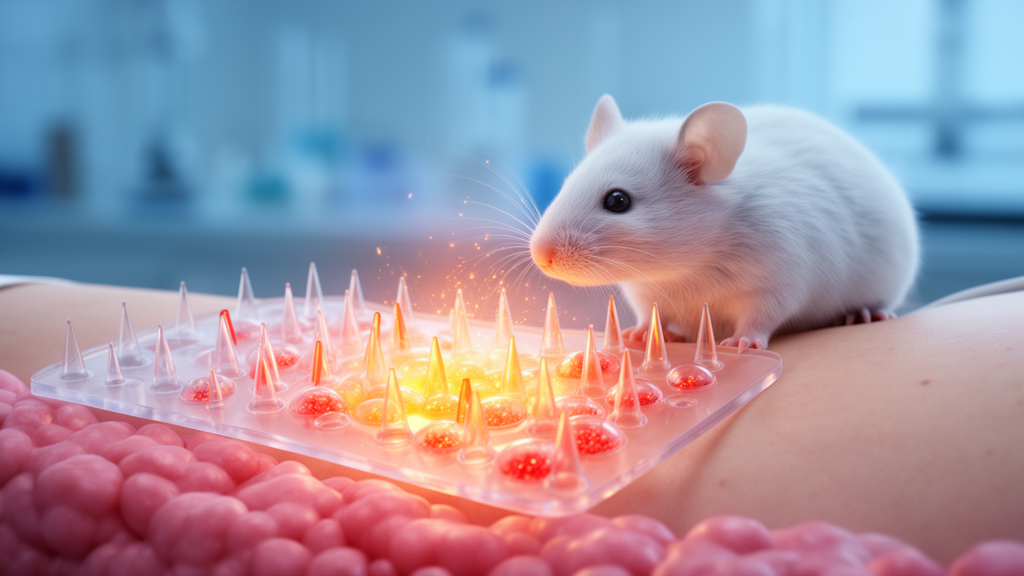
Delivery relies on a dissolving microneedle array of 10 by 10 needles molded from poly(sodium acrylate), poly(vinyl alcohol), and poly(vinylpyrrolidone), with the nanozyme loaded at 0.02 grams per milliliter and gallic acid at 0.01 grams per milliliter. Formulation optimization showed that 0.1 grams of the sodium acrylate polymer and 1.0 gram of PVA gave sharp, well-organized tips without the deformation seen at lower polymer content or the adhesion and void formation seen at higher loads. The finished needles measured roughly 800 micrometers tall with tips spaced about 650 micrometers apart, survived repeated penetration through 10-micrometer foil, and dissolved almost completely in an agar tissue model within roughly 240 seconds under laser irradiation.
Gallic acid release from the patch was both pH-dependent and light-regulated. Cumulative release was markedly enhanced at pH 5.4, a strongly acidified condition chosen to represent endosomal and lysosomal compartments rather than typical bulk tumor extracellular pH, compared with neutral pH 7.4, and laser irradiation further accelerated release while switching the laser off slowed it. The authors are careful about gallic acid’s role: the molecule has reported antioxidant and context-dependent pro-oxidant activities, and they treat it as a combination payload whose contribution is assessed experimentally rather than assigning it a single molecular function, noting that the extent to which it chelates iron or perturbs glutathione metabolism remains an open mechanistic question.
In 4T1 mouse breast cancer cells, the combined treatment produced the strongest effects across a panel of probes. Dichlorodihydrofluorescein staining showed the highest intracellular reactive oxygen signal in the group receiving the full formulation plus laser, exceeding the nanozyme-plus-laser group. FerroOrange staining revealed elevated intracellular Fe2+, BODIPY 581/591 C11 indicated extensive lipid peroxidation, acridine orange staining pointed to lysosomal membrane destabilization, and JC-1 showed the most pronounced red-to-green transition, signifying mitochondrial membrane depolarization, in the full-treatment group. Calcein and propidium iodide staining confirmed the greatest loss of cell viability under the combined treatment. Cytocompatibility testing showed that at the highest tested nanozyme concentration of 500 micrograms per milliliter, viability remained about 96 percent in normal L929 fibroblasts while falling to 78 percent in 4T1 cells, and free gallic acid alone left both cell types largely viable, supporting its use only within the combined system.
In female BALB/c mice bearing subcutaneous 4T1 tumors of roughly 100 cubic millimeters, microneedles were pressed onto the tumor surface and irradiated groups received 655-nanometer light at 1.0 watt per square centimeter for about 10 minutes. Infrared thermography showed tumor temperature climbing to approximately 55 degrees Celsius within 10 minutes in the treated groups, with the high-temperature region mainly confined to the tumor site, while laser alone produced only slight warming. Tumors in the control, laser-only, and nanozyme-patch groups grew rapidly throughout the 14-day period, whereas the full formulation plus laser produced the strongest suppression, reflected in both tumor volume and significantly lower average tumor weight on day 14. Skin microchannels created by insertion closed almost completely within 20 minutes without redness or swelling.
Safety readouts were limited but consistent. No obvious decrease in body weight occurred in any treatment group over the 14 days, and hematoxylin and eosin staining showed no pathological abnormalities in the heart, liver, spleen, lung, or kidney, while tumor sections from the treated group showed extensive cell destruction and necrotic regions. The authors frame the cell-death mechanism cautiously: elevated Fe2+ and lipid peroxidation are consistent with, but do not alone prove, ferroptosis, so they describe the response as ferroptosis-associated damage, and they note that ferroptosis-rescue experiments, pathway protein measurements, pharmacokinetics, and long-term recurrence studies will be needed to define the mechanism and translational window more rigorously. Within those limits, the study demonstrates how defect engineering, microneedle confinement, and external light can be combined into a spatially restricted redox cascade for local tumor therapy.
Subject of Research: A defect-engineered Fe3O4@SnO2 nanozyme delivered by dissolving microneedles for laser-triggered local photothermal, photodynamic, and ferroptosis-associated tumor therapy
Article Title: Defect-engineered Fe3O4@SnO2 nanozyme microneedles couple local photothermal-photodynamic therapy with redox-amplified ferroptosis
Article References: Guo, W., Wang, W., Yang, Z., & Jing, L. (2026). Defect-engineered Fe3O4@SnO2 nanozyme microneedles couple local photothermal-photodynamic therapy with redox-amplified ferroptosis. Frontiers in Chemistry, 14, Article 1991252. https://doi.org/10.3389/fchem.2026.1991252
Image Credits: AI Generated
DOI: 10.3389/fchem.2026.1991252
Keywords: nanozyme, oxygen vacancies, microneedles, photothermal therapy, photodynamic therapy, ferroptosis, reactive oxygen species, glutathione depletion, gallic acid, 4T1 tumor model, Fe3O4@SnO2, local drug delivery
News Source: Nathaniel Bowman. (October 27, 2026). Defect-Rich Nanozyme Microneedles Heat Tumors and Amplify Oxidative Damage in Mice. Scienmag.