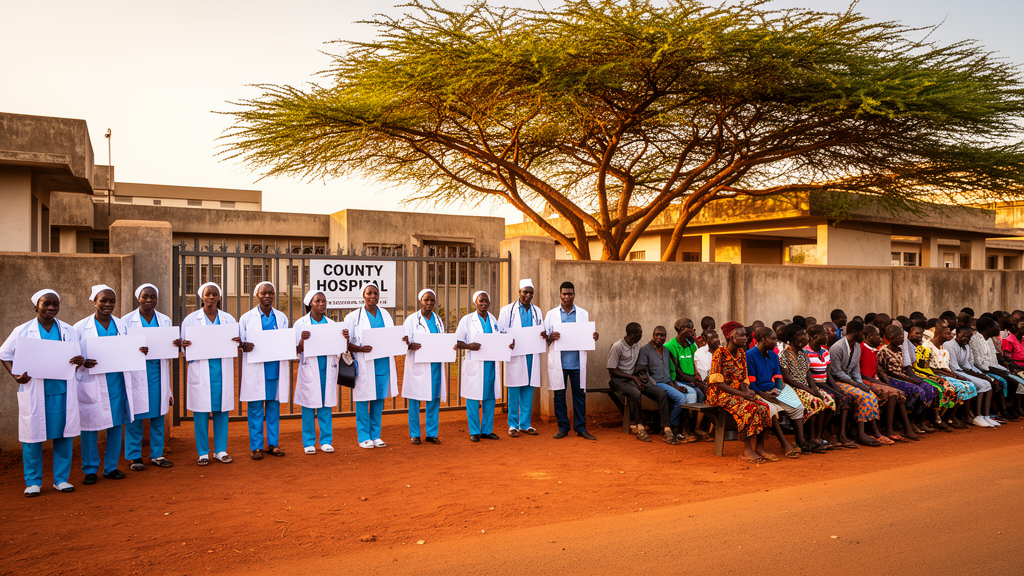
Recurrent health worker strikes in Kenya are not simply episodes of labour unrest, according to a qualitative policy analysis published in PLOS Global Public Health. The study argues that the persistent disputes since the country’s 2013 devolution reforms signal broader governance challenges that may be especially pronounced in decentralised, resource-constrained health systems.
Researchers led by Benjamin Tsofa and colleagues analysed health worker strikes in Kenya between 2010 and 2025. They drew their data from legal statutes, policy documents, government reports, peer-reviewed literature and grey sources, applying Walt and Gilson’s policy triangle alongside complex adaptive systems and health governance frameworks to examine how institutional arrangements, stakeholder dynamics and policy processes shape labour relations in a devolved system.
The analysis identified several interrelated drivers of the recurring strikes. These include tensions between the constitutional right to strike and the constitutional right to health, fragmented governance and weak intergovernmental coordination under devolution, persistent workforce challenges, and repeated failures to implement Collective Bargaining Agreements and Return-to-Work Formulae.
The authors also point to ineffective dispute-resolution mechanisms and the absence of enforceable minimum service arrangements during industrial action. Through their interaction, these factors generate recurring cycles of non-compliance, labour unrest and institutional mistrust, the study reports.
A central conclusion of the analysis is that the core problem lies not in the absence of legal protections or negotiated settlements, but in translating commitments into sustained action. Recurrent disputes over the implementation of Collective Bargaining Agreements and Return-to-Work Formulae suggest that agreements are repeatedly reached but not reliably honoured.
To address the problem, the researchers argue that reform must go beyond short-term dispute settlement and tackle underlying governance, accountability and implementation challenges. They identify priorities including strengthening independent dispute-resolution mechanisms, clarifying responsibilities across levels of government, improving accountability for negotiated commitments, harmonising human resource management systems, and institutionalising minimum service protections during industrial action.
The study is a qualitative policy analysis rather than an evaluation of specific interventions, so it does not test the effectiveness of any proposed reform. Its findings are based on documentary and legal sources covering Kenya between 2010 and 2025, interpreted through established policy analysis frameworks.
Even so, the authors argue that Kenya’s experience offers lessons for other decentralised health systems. Aligning authority, accountability and implementation capacity, they conclude, is essential to strengthening resilience and advancing universal health coverage in settings where health services have been devolved across multiple levels of government.
Subject of Research: Governance drivers of recurrent health worker strikes in Kenya's devolved health system
Article Title: Health worker strikes in Kenya: A symptom of governance inadequacies in a devolved health system
Article References: Tsofa, B., Nyanchoka, M., Munywoki, J., Guleid, F., Kagwanja, N., Kanya, L., Wafula, F., & Nzinga, J. (2026). Health worker strikes in Kenya: A symptom of governance inadequacies in a devolved health system. PLOS Global Public Health, 6(10), e0006412. https://doi.org/10.1371/journal.pgph.0006412
Image Credits: AI Generated
DOI: 10.1371/journal.pgph.0006412
Keywords: Kenya, health worker strikes, devolution, health governance, Collective Bargaining Agreements, Return-to-Work Formulae, dispute resolution, health policy, universal health coverage, PLOS Global Public Health, Health, worker
News Source: Courtney Benton. (October 27, 2026). Recurring health worker strikes in Kenya expose deep governance gaps in devolved health system. Scienmag.