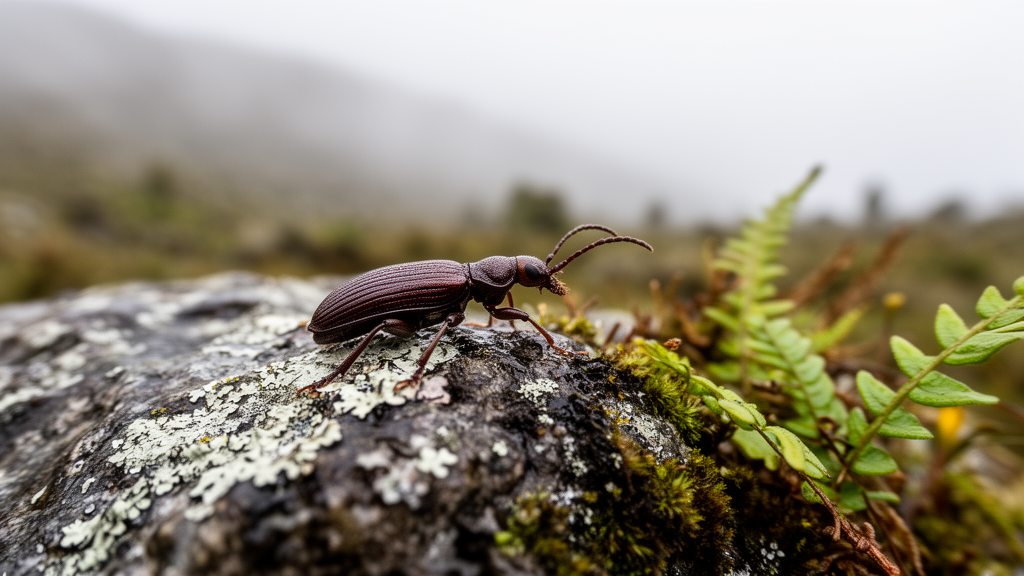
A new species of flightless rove beetle has been described from the high mountains of Colombia, adding a fourth member to a small and enigmatic genus that lives only in the páramo grasslands of the northern Andes. The species, named Ikaros navarretei, belongs to the rove beetle subfamily Staphylininae and was identified from a single male specimen collected more than fifty years ago near the town of Silvia in the Cauca Department, at an elevation of 3400 meters above sea level. The description includes photographs of the habitus and genital structures, a formal diagnosis, and an updated identification key covering all four species now known in the genus.
The genus Ikaros was established only in 2021 by Chatzimanolis and Brunke, originally to accommodate three species, and it is placed in the staphylinidine subtribe Xanthopygina. What makes these beetles unusual among their relatives is a suite of body features tied to the loss of flight. Ikaros can be distinguished from other genera of the subtribe by the reduction of the elytra, which expose the second abdominal tergum, by the complete absence of hind wings, and by an abdomen that is constricted at the front and expanded toward the rear. The new species fully matches this generic diagnosis, according to the authors of the description, who placed it in Ikaros on the basis of these and other characters.
Wing loss in rove beetles is not confined to one kind of environment. The apterous condition appears in different settings, including isolated islands, hypogean habitats such as caves and crevices of talus, and, as in Ikaros, high elevations. A significant portion of alpine insect communities, especially among the beetles, shows various degrees of wing reduction. Because the loss of wings lowers dispersal capacity, it tends to lead to higher levels of endemism, and it is combined with high specialization to adapt to the harsh environmental conditions of high mountains. Against that background, the discovery of a new species in an apterous genus from the Andes, where rove beetle biodiversity remains little known, was anticipated by the research team.
The single specimen that became the holotype had been resting in an institutional collection since its original capture. The label data record that it was collected on 16 June 1970, twenty kilometers east of Silvia in Cauca, Colombia, by J. M. Campbell, and it is now housed in the Canadian National Collection of Insects, Arachnids and Nematodes in Ottawa, Ontario. The specimen is a male, point mounted, with its genitalia preserved in a separate microvial. It was designated the holotype of Ikaros navarretei by Reyes-Hernández, Hansen and Solodovnikov in 2022, and the species epithet honors José Luis Navarrete Heredia in recognition of his contribution to knowledge of the family Staphylinidae and his training of many coleopterologists in Latin America.
The morphological description is detailed and precise. The total body length of the holotype measures 10.06 millimeters, measured from the anterior margin of the frons to the posterior margin of the eighth segment, with the forebody 5.25 millimeters long. The body is reddish-brown, with the abdomen carrying undertones of metallic green-brown. The head is subrectangular and slightly wider than long, with a width-to-length ratio of 1.1, and its epicranium bears numerous large punctures except for an impunctate center, with transversely meshed to isodiametric microsculpture. The antennomeres carry crown-like macrosetae that are shorter than the length of the antennomere itself, one of the characters used in the identification key to distinguish the new species from Ikaros polygonos.
Further diagnostic characters appear on the thorax and abdomen. The pronotum is longer than wide, with a width-to-length ratio of 0.9, and its surface shows a median impunctate area as wide as three to five punctures, multiple irregular rows of punctures, and meshed to isodiametric microsculpture. The elytra are shorter than the pronotum, with a length ratio of 0.83, and bear large, deep punctures. The abdominal terga III through V carry an arch-like carina, which on terga IV and V is nearly straight. The male secondary sexual structures include a very shallow emargination on sternum VII and a deep, broad V-shaped emargination on sternum VIII, with the borders of these emarginations appearing shaved, without setae. The aedeagus shows a paramere of violin-like shape, broadest at the middle of its length and converging to a rounded tip, with peg setae arranged in two sublateral rows of four to five setae plus a single additional seta closer to the apex, and the median lobe in lateral view carries one subapical tooth.
That combination of traits forms the formal diagnosis of the species. Ikaros navarretei can be distinguished from all other species in the genus by the presence of an arch-like carina on terga III through V, the meshed to isodiametric microsculpture on the dorsal surface of the head, thorax and mesoscutellum, and antennomeres with crown-like macrosetae shorter than the length of the antennomere. The updated key separates the four species on these grounds: species with an arch-like carina divide according to whether the crown-like macrosetae of the antennae are long, at least twice as long as the antennomeres, as in Ikaros polygonos, or short, not even as long as the antennomeres, as in the new species. Among species lacking the carina, the disc of the pronotum distinguishes Ikaros apteros, with only a short dorsal row of a few punctures, from Ikaros paramo, with multiple long rows of punctures.
The authors also note a subtlety in the anatomy of the new species. The structure they call the arch-like carina on the abdominal terga, a term chosen for compatibility with other literature on Xanthopygina, appears somewhat similar to a structure usually called the posterior basal tergal carina in the Staphylinini literature. However, this is a very different condition from that seen in other species of Ikaros and, as far as the authors are aware, in all other Xanthopygina, where the arch-like carina is more of a curved fragment that does not reach the spiracles as the posterior basal tergal carina does.
Geographically, the new species is known only from its type locality near Silvia in the Cauca Department of Colombia. According to the georeferencing carried out from the collection data of all Ikaros species, the genus occupies an altitude range from 3000 to 3600 meters above sea level, in ecoregions characterized by shrubby páramo within the Montane Grasslands and Shrublands biome. The environmental profiles compiled for the four species show the conditions of these high-elevation sites: Ikaros apteros at 3230 meters with an annual mean temperature of 9.2 degrees Celsius and 1543 millimeters of annual precipitation; Ikaros navarretei at 3400 meters with 8.3 degrees Celsius and 1623 millimeters; Ikaros paramo at 3500 meters with 8.4 degrees Celsius and 971 millimeters; and Ikaros polygonos at 3400 meters with 9.4 degrees Celsius and 921 millimeters, in the Cordillera de Merida páramo.
Much about these beetles remains unknown. Because species of the genus are rarely collected and poorly represented in collections, their biology, systematic position and conservation status are still poorly understood. Even after the comprehensive phylogenetic analysis that accompanied the original description of the genus, the sister group relationships of Ikaros remain unclear. The authors argue that a better understanding of the diversity of this peculiar xanthopygine genus will facilitate understanding of its affinities and of the diversification process related to wing loss in rove beetles at high elevations. Since the Andes are one of the most important conservation hotspots due to their high species richness and endemism, efforts to discover new endemic apterous species in sites such as these are described as a high priority. In the case of the rather enigmatic genus Ikaros, a complete species inventory is also an opportunity to resolve its phylogenetic position and to study the evolution of morphological characters in Xanthopygina associated with adaptations to alpine habitats.
Subject of Research: Taxonomic description of a new apterous rove beetle species, Ikaros navarretei, from high elevations in Colombia
Article Title: Ikaros navarretei ( Coleoptera , Staphylinidae , Staphylininae ), a new apterous rove beetle species from high elevations in Colombia
Article References: Reyes-Hernández, J. L., Hansen, A. K., & Solodovnikov, A. (2022). Ikaros navarretei (Coleoptera, Staphylinidae, Staphylininae), a new apterous rove beetle species from high elevations in Colombia. Alpine Entomology, 6, 13-18. https://doi.org/10.3897/alpento.6.80349
Image Credits: AI Generated
Keywords: Ikaros navarretei, rove beetles, Staphylinidae, new species, Colombia, Andes, páramo, high elevation, wing loss, taxonomy, endemism, Xanthopygina
News Source: Gavin Prescott. (October 27, 2026). New Wingless Rove Beetle Species Described from High Elevations in the Colombian Andes. Scienmag.