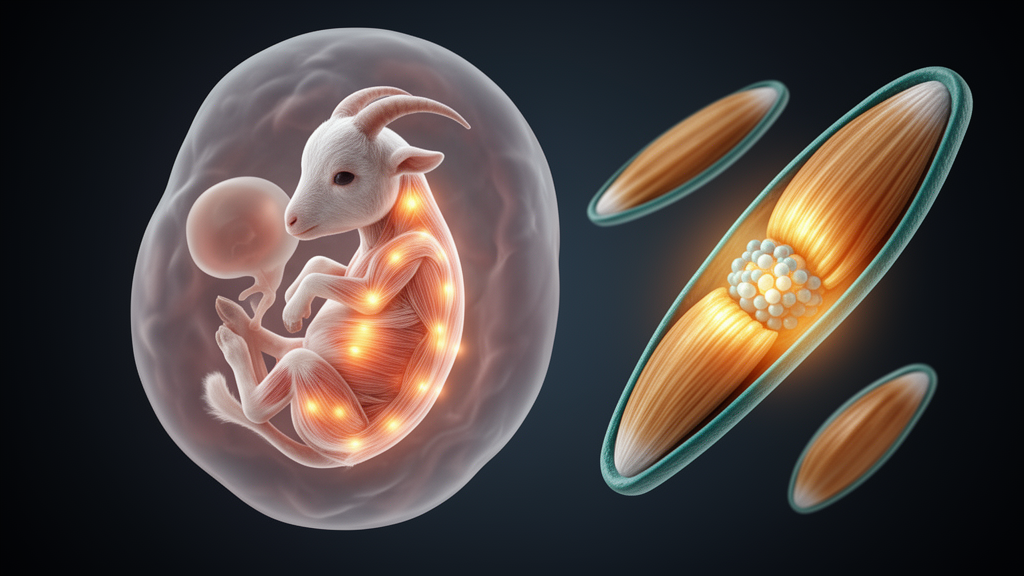
Researchers studying goat embryogenesis have identified the cell-cycle gene CDK1 as a hub regulator of skeletal muscle development, with its effects depending sharply on both timing and expression level. The finding, published in BMC Genomics, maps a critical proliferative window in the embryonic goat longissimus dorsi muscle and suggests that CDK1 must be held in balance for myogenic cells to multiply properly.
The team applied weighted gene co-expression network analysis to RNA-seq data collected across 11 developmental stages of the longissimus dorsi. One module, labelled the orange module, was specifically activated during embryonic days 65 to 90 and was enriched for genes involved in cell cycle and DNA replication pathways. Within that module, cyclin-dependent kinase 1, or CDK1, showed the highest intramodular connectivity, marking it as the hub gene of this developmental phase.
When CDK1 was moderately upregulated, cell viability and proliferation increased. When expression was pushed to excessive levels, however, the effect reversed: cells underwent cell cycle arrest and proliferation was inhibited. The dose-dependent switch suggests that CDK1 is not simply a growth promoter but a sensitive regulator whose activity must remain within a narrow range.
Integrated transcriptomic and proteomic analyses helped explain the inhibitory effect of high CDK1. Elevated CDK1 levels suppressed DNA replication and cell cycle programs while activating checkpoint-associated pathways. The authors note that these changes are consistent with a feedback response involving replication stress-associated checkpoint signalling, although replication stress itself was not directly measured in the study, leaving that mechanism as an interpretation to be confirmed by future work.
Based on these results, the researchers propose a time- and expression level-dependent regulatory model in which CDK1 maintains a balance between myogenic proliferation and checkpoint control. They define embryonic days 65 to 90 as a critical proliferative window in goat muscle development and position CDK1 as a key sensitive regulator of myogenesis. Because skeletal muscle development is a key determinant of growth and meat production traits in ruminants, the work offers new insight into a process that had remained poorly characterised in goats, while the regulatory mechanisms of embryonic myogenesis in this species remain an open area of investigation.
Subject of Research: CDK1 regulation of embryonic skeletal muscle satellite cell proliferation in goats
Article Title: Regulation of embryonic skeletal muscle satellite cell proliferation by CDK1 expression levels in goats
Article References: Tang, J., Liu, C., E, G., Zhang, Y., Liu, M., & Guo, Z. (2026). Regulation of embryonic skeletal muscle satellite cell proliferation by CDK1 expression levels in goats. BMC Genomics. https://doi.org/10.1186/s12864-026-13464-6
Image Credits: AI Generated
DOI: 10.1186/s12864-026-13464-6
Keywords: goats, CDK1, embryonic myogenesis, skeletal muscle, satellite cells, WGCNA, cell cycle, DNA replication, longissimus dorsi, checkpoint signalling, BMC Genomics, Regulation
News Source: Juliet Wilcox. (October 27, 2026). CDK1 acts as a sensitive regulator of embryonic muscle growth in goats. Scienmag.