Chemists have synthesized three new copper(II) complexes that display striking antibacterial and anti-inflammatory activity in laboratory tests, with one member of the series outperforming the reference antibiotic gentamicin against every bacterial strain examined. The compounds, described in the journal Results in Chemistry, belong to a family of heteroleptic copper complexes with the general formula [CuX(O∩O)phen], where X is chloride, bromide or nitrate, phen is the chelating nitrogen ligand 1,10-phenanthroline, and O∩O is the bidentate oxygen-donor ligand ethyl 3-oxo-3-phenylpropanoate. Beyond their biological performance, the complexes were engineered and characterized as a coherent crystal-engineering series, with structural, spectroscopic, thermal and computational analyses woven into a single study.
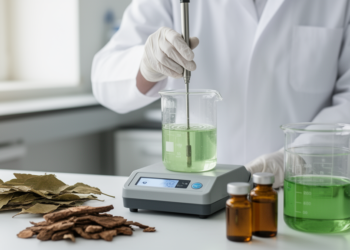
The synthetic route is one of the more practical aspects of the work. Rather than combining copper halides directly with both ligands, the team started from the isolated precursor complexes [Cu(phen)2X]X and treated them in water with ethyl 3-oxo-3-phenylpropanoate. Within one to two minutes of shaking, the light blue starting material turned deep green, a change visible to the naked eye that signaled the substitution of one phenanthroline ligand by the O∩O ligand. Dichloromethane extraction removed excess ligand and the liberated free phen, and evaporation of the aqueous layer delivered the products in yields of 64 to 90 percent. The authors report that the complexes remained color-stable in solution for more than a week and dissolved readily in water, methanol, DMSO and DMF, a solubility profile that matters for any compound intended for further biological testing.
Single-crystal X-ray diffraction on the bromide complex, complex 2, revealed the structural heart of the series. The crystal data show a triclinic unit cell in space group P-1 with two formula units per cell. The copper(II) center is five-coordinate in a distorted square-pyramidal geometry: two oxygen atoms from the chelating O∩O ligand and two nitrogen donors from phenanthroline form the basal plane, while a bromide ion occupies the axial position. The Cu-Br bond measures 2.684 Å, an elongation of about 4.5 percent that the authors attribute to the Jahn-Teller distortion expected for a d9 copper(II) center, in which the singly occupied dz2 orbital weakens the axial bond. Within the basal plane, the O1-Cu-O2 angle of 93.2 degrees closes a six-membered chelate ring, and the N1-Cu-N2 angle of 81.4 degrees defines the five-membered phenanthroline ring, features the authors link to the stability of the coordination environment.
The crystal packing analysis highlights how a single water molecule organizes the lattice. Sitting at a bridging center, it connects three complex molecules through classical O-H…Br hydrogen bonds of 2.659 Å and non-classical C-H…OH2 contacts measuring 2.658, 2.675 and 2.668 Å. Additional C-H…Br, C-H…π and π-π stacking interactions, the latter with an average separation of 3.393 Å, knit the molecules into a three-dimensional network. Hirshfeld surface analysis corroborated the diffraction results, with ten red spots on the dnorm surface marking the short contacts, and fingerprint plots quantifying the contributions: H…H interactions dominate at 49.0 percent, followed by H…C at 8.1 percent, H…Br at 3.8 percent, H…O at 3.3 percent and H…N at 0.8 percent. The authors frame this as a hierarchical crystal-engineering picture in which the programmed copper coordination environment dictates the molecular geometry, while supramolecular synthons govern the crystal assembly.
Spectroscopy added a dynamic dimension to the static crystal picture. All three complexes show a π-π* band near 260 to 280 nm and a broad d-d band in the visible region. When polar, electron-donating solvents were added, the visible absorption shifted to longer wavelengths in a classic solvatochromic response: the donor solvent acts as a Lewis base that coordinates the copper(II) Lewis acid, displacing the halide or nitrate ligand. For complex 2, the maximum moved from 698 nm in water to 710 nm in methanol, 736 nm in DMF and 748 nm in DMSO; complex 3 shifted even further, from 660 nm in water to 770 nm in DMSO. Plotting the shifts against the solvent donor number gave linear Guttmann correlations with R2 values of 0.9743 and 0.9794, and the slope for complex 3, 8.2544 versus 3.9495 for complex 2, identifies the nitrate complex as the more sensitive Lewis acid, consistent with the easier displacement of nitrate. This behavior suggests the complexes could serve as colorimetric sensors for solvent polarity.
Thermal analysis of the nitrate complex showed stability up to 275 °C with no lattice solvent or water. Decomposition then proceeded in two steps: the organic ligands burned off between 280 and 305 °C, leaving a copper nitrate fragment with a 71.5 percent weight loss against a theoretical 72.1 percent, and a second stage from 410 to 505 °C converted the residue to copper oxide with a 14.5 percent yield. Mass spectrometry, elemental analysis, infrared spectroscopy and energy-dispersive X-ray analysis confirmed the compositions, including the diagnostic fragment at m/z 432.6 for complex 2 corresponding to loss of bromide from the molecular ion.
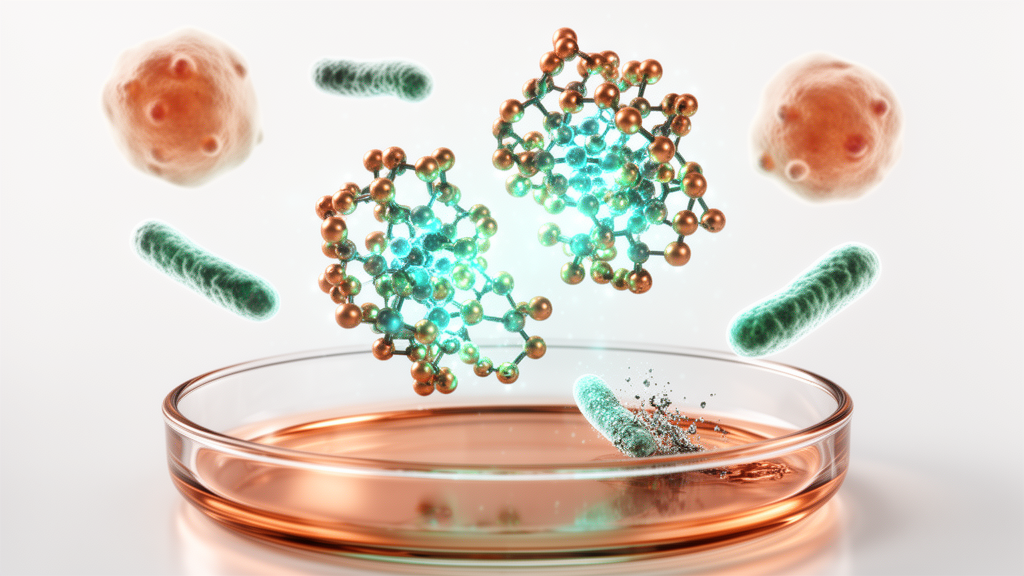
The biological results are where the study becomes most eye-catching. In agar disk diffusion tests against five bacterial strains, complex 3 produced inhibition zones of 18 to 29 mm, the largest of the series, including 29 mm against Staphylococcus aureus and 20 mm against Escherichia coli. Micro-broth dilution assays then quantified the effect: complex 3 showed minimum inhibitory concentrations of 1.95 to 7.8 µg/mL and minimum bactericidal concentrations of 3.9 to 31.25 µg/mL across the tested organisms. Against every strain, complex 3 significantly outperformed gentamicin, with P values below 0.05. The contrast within the series is sharp: complex 2 required 1000 µg/mL across the board, and complex 1 was intermediate, so the nitrate ligand appears to be the decisive variable, a pattern the authors connect to the added polarity and hydrogen-bonding capacity of the nitrate group.
The anti-inflammatory data follow the same ordering. In enzyme inhibition assays, complex 3 inhibited COX-1 with an IC50 of 2.94 ± 0.08 µM, COX-2 with 4.09 ± 0.25 µM and 15-LOX with 5.51 ± 0.04 µM, each measured as the mean of three independent replicates. Complexes 1 and 2 were consistently less potent, with IC50 values ranging up to 6.15 µM. The widely used drug indomethacin remained far more potent, at 0.72, 0.90 and 0.52 µM respectively, so the complexes are best described as promising lead-like enzyme inhibitors rather than competitors to existing therapy. Molecular docking against the crystal structures of COX-1, COX-2 and 15-LOX supported the experimental trend: complex 3 bound COX-1 with the strongest calculated energy of the series, −9.91 kcal/mol, through three hydrogen bonds to ARG374, ASN375 and ARG376, and the docking-derived potency ordering of COX-1 over COX-2 over 15-LOX mirrored the measured IC50 ordering.
Computational pharmacokinetics rounded out the profile. SwissADME analysis showed that all three complexes satisfy Lipinski’s rule of five, with only a slight deviation in the degree-of-saturation parameter on the bioavailability radar. In the BOILED-Egg model, complexes 1 and 2 fell in the yolk region, predicting possible blood-brain barrier penetration, while complex 3 sat in the white region, indicating good gastrointestinal absorption; all three were predicted to evade P-glycoprotein efflux. SwissTargetPrediction placed all three among the top enzyme inhibitor classes. The authors are careful about the limits of these findings: the biological evaluation was confined to in vitro antibacterial and enzyme-inhibition assays, the docking results are supportive computational evidence rather than experimental validation, and nothing in the study establishes in vivo efficacy, pharmacokinetics or safety. Molecular dynamics simulations and animal or clinical work would be needed before any therapeutic claim. Within those limits, the study delivers a tightly integrated package: a fast, high-yield aqueous synthesis, a crystallographically defined Jahn-Teller-distorted copper center, solvent-responsive optical behavior, and a nitrate-driven biological activity spike that gives medicinal chemists a clear structural handle for the next round of design.
Subject of Research: Synthesis, crystal structures and in vitro antibacterial and anti-inflammatory activity of three novel heteroleptic copper(II) complexes
Article Title: Novel Heteroleptic [CuX(O∩O)phen] complexes: Crystal engineering, Jahn–Teller distortion, solvatochromism, thermal, XRD/HSA-interaction, bioinformatic and pharmaceutical potential
Article References: Omar, B., AlAli, A., Qrareya, H., Abdallah, L., Zarrouk, A., & Warad, I. (2026). Novel Heteroleptic [CuX(O∩O)phen] complexes: Crystal engineering, Jahn–Teller distortion, solvatochromism, thermal, XRD/HSA-interaction, bioinformatic and pharmaceutical potential. Results in Chemistry, 32, Article 103992. https://doi.org/10.1016/j.rechem.2026.103992
Image Credits: AI Generated
DOI: 10.1016/j.rechem.2026.103992
Keywords: copper complexes, Jahn-Teller distortion, X-ray crystallography, solvatochromism, antibacterial activity, COX inhibition, 15-LOX, molecular docking, crystal engineering, Hirshfeld surface analysis, phenanthroline, drug design
News Source: Bethany Barker. (October 27, 2026). Copper Complexes Show Antibacterial and Anti-Inflammatory Power in New Study. Scienmag.