Cement is responsible for roughly 8 percent of global carbon dioxide emissions, and the search for low-carbon replacements has long been hampered by a stubborn practical problem: alkali-activated binders tend to shrink as they dry, sometimes cracking badly enough to undermine their durability. A new laboratory study now reports that a manufacturing trick borrowed from mechanochemistry—grinding the raw ingredients together in a ball mill before any water is added—can simultaneously ease that shrinkage, improve workability and raise strength in a one-part geopolymer made from fly ash and slag. The work, published in Case Studies in Construction Materials, systematically maps how milling conditions and mix proportions interact, and identifies a recipe the authors say balances all three performance criteria.
According to the study’s introduction, producing geopolymer binder cuts carbon dioxide emissions by 81 percent per unit mass compared with cement, while its precursors—industrial by-products such as fly ash and ground granulated blast-furnace slag—are inexpensive and widely available. Slag-fly ash geopolymers hold considerable industrial promise, but their drying shrinkage has been reported in the range of 400 to 2000 microstrain, and alkali-activated slag mortar can show drying shrinkage up to three times that of Portland-cement mortar depending on the activator used. That liability, the authors argue, has limited wider adoption.
Conventional geopolymers are
Conventional geopolymers are typically made in two steps: a liquid alkali activator is prepared first, then mixed with the solid precursors. That liquid activator is caustic and awkward to handle on site, which is why the one-part approach—where the activator is supplied as a dry powder blended into the binder, so that only water needs to be added—has attracted growing interest. The catch, as the study’s authors note, is that one-part geopolymers produced by simple mixing have long suffered from excessively rapid setting and poor fluidity, and shrinkage problems have remained unresolved. The new work set out to test whether mechanochemical activation, in which the dry ingredients are milled together so that chemical activation occurs during grinding itself, could overcome those drawbacks.
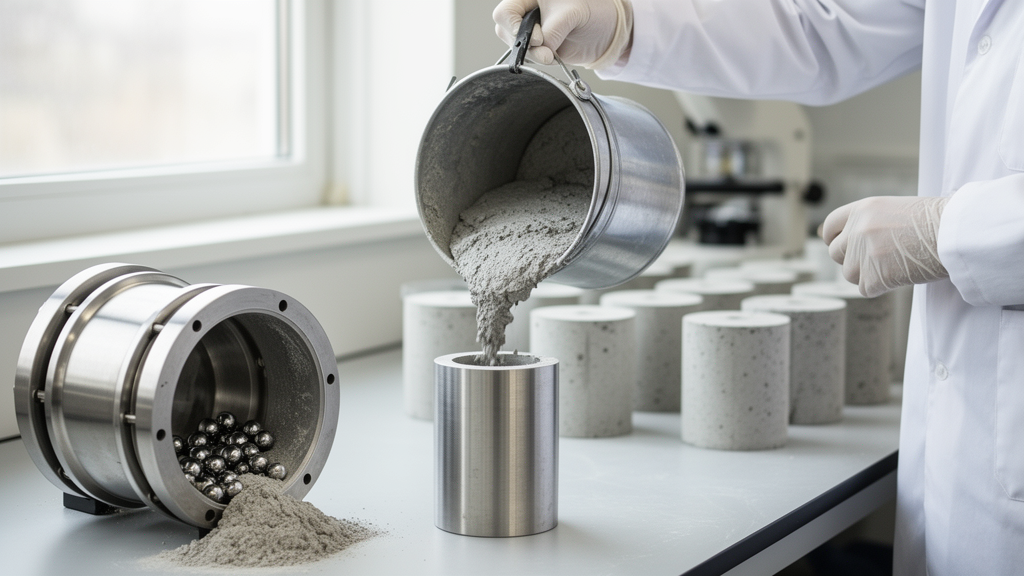
The experiments used Class F fly ash from Fuzhou, China, with a mean particle size of 62.52 micrometres, and ground granulated blast-furnace slag from Hebei with a mean particle size of 15.6 micrometres and a reactivity index above 96. The solid activator combined sodium hydroxide powder with anhydrous sodium silicate powder of modulus 2.85. A small dose of barium chloride, one percent of binder mass, was added as a setting retarder, a dosage chosen in preliminary trials. The mixes used a water-to-binder ratio of 0.4 and a binder-to-sand ratio of 1:3, with mortar specimens of 40 by 40 by 160 millimetres cured under standard conditions. Milling was carried out in a ball mill with 15-litre steel chambers running at 145 revolutions per minute, using steel balls of 30, 20 and 10 millimetre diameter combined in equal masses. The researchers varied five factors in separate series: milling time, ball-to-powder ratio, fly ash content, activator modulus and sodium oxide equivalent, with a simply mixed batch and ordinary Portland cement included as controls.
The workability results illustrate how sensitive these binders are to preparation. As the ball-to-powder ratio rose from 10:1 to 20:1, fluidity improved from 210 to 230 millimetres, a gain of 9.5 percent, though the difference between 15:1 and 20:1 was only 2.2 percent and the setting time shortened slightly. Milling duration mattered far more. Fluidity peaked at 240 millimetres after 60 minutes of milling, compared with 225 millimetres at 30 minutes and 238 at 90 minutes, the slight dip at 90 minutes being attributed to particle agglomeration. Setting times stretched dramatically with milling: initial setting went from 31 minutes at 30 minutes of milling to 74 minutes at 60 and 97 minutes at 90, while final setting extended from 45 to 167 and then 191 minutes. Water demand for standard consistency rose by 5.7 percent at 60 minutes relative to 30 minutes, which the authors link to mechanochemical alteration of hydroxyl groups and hydration kinetics.
Against the simply mixed control, the optimised milling was striking. The 60-minute milled binder showed fluidity 23.1 percent higher than simple mixing and 71.4 percent higher than a two-part geopolymer, and about 5.3 percent above Portland cement. Initial setting extended from 26 minutes for simple mixing to 74 minutes, and final setting from 52 to 167 minutes, far closer to the cement reference of 140 and 189 minutes. The authors attribute this partly to increased specific surface area, with BET measurements rising from 382 to 451 square metres per kilogram, but they also point to chemical changes beyond physical refinement: a shift in the hydroxyl stretching band in the infrared spectra and a weakening of the gypsum peak in X-ray diffraction, which they say confirm genuine mechanochemical activation rather than mere particle-size reduction.
Mix proportions mattered too. Fluidity rose steadily with fly ash content, from 200 millimetres for pure slag to 247 millimetres at 70 percent fly ash, thanks to the ball-bearing effect of fly ash microspheres, but setting times lengthened in parallel, from 22.5 minutes initial setting for pure slag to 233 minutes at 70 percent fly ash, because the less reactive fly ash dilutes the reactive components. On the activator, fluidity peaked at modulus 1 and setting was longest there, while higher sodium oxide equivalents slightly reduced fluidity but markedly shortened setting, with final setting halving between 6 and 8 percent sodium oxide.
Strength followed its own optimum. Compressive and flexural strengths peaked at 30 percent fly ash across all ages, reaching 47.5 megapascals compressive and 8.6 megapascals flexural at 28 days, 8.4 and 10.3 percent above the pure slag system. The authors credit optimised particle packing and the promotion of aluminosilicate and calcium silicate hydrate gels. Beyond that point strength declined, falling to 22.8 megapascals compressive at 70 percent fly ash. Strength increased monotonically with both modulus and sodium oxide equivalent: compressive strength climbed from 38.6 megapascals at modulus 0 to 58.9 at modulus 1.5, and rose a further 15.2 percent when sodium oxide went from 4 to 8 percent, as higher alkalinity dissolves more of the aluminosilicate glass phases and forms more N-C-S-H and C-A-S-H gel.
The microstructural analysis backed these patterns up. X-ray diffraction showed quartz, mullite and calcite as the main crystalline phases, with mullite and quartz peaks intensifying as fly ash content rose, indicating more unreacted particles, while the gel hump was strongest at 30 percent fly ash. Raising the modulus weakened the crystalline peaks and intensified the gel peak, and increasing sodium oxide to 8 percent broadened the amorphous hump between 20 and 35 degrees two-theta, evidence of more amorphous gel. Infrared spectroscopy told a complementary story: the band associated with chemically bound water tracked the reaction degree, and its behaviour helped explain the shrinkage results, since bound water resides in the gel network rather than as free water in the pores.
Mercury intrusion porosimetry revealed why the shrinkage behaved as it did. Pure slag had the lowest total porosity of the fly ash series at 15.34 percent but the highest proportion of pores larger than 200 nanometres, 28.54 percent, and shrank the most, at 1593 microstrain. At 30 percent fly ash, total porosity rose to 18.99 percent, yet the most probable pore diameter dropped to 11.75 nanometres, harmless pores below 20 nanometres rose to 65.77 percent, and multi-harmful pores fell to 19.12 percent, matching the lowest shrinkage in that series, 1169 microstrain. At 50 percent fly ash the distribution broadened again and shrinkage climbed to 1223 microstrain. The authors stress that shrinkage is governed by pore size distribution rather than total water lost, because capillary pressure varies inversely with pore radius: even modest evaporation from fine capillaries can generate substantial tensile stress.
The activator parameters produced a non-monotonic shrinkage response with respect to modulus. Shrinkage was lowest at modulus 0, at 780 microstrain, peaked at modulus 1 at 1169, and fell back to 1073 at modulus 1.5, a pattern the authors connect to which reaction type dominates and to the corresponding pore structures. Sodium oxide equivalent, by contrast, showed a clear direction: 56-day shrinkage fell from 1169 microstrain at 4 percent to 825 at 6 percent and 770 at 8 percent, a 34.1 percent reduction, accompanied by a sharp drop in total porosity to 9.53 percent and a refinement of the main pore peak to below 8 nanometres. Mass loss moved in the opposite direction with respect to sodium oxide, falling from 1.90 to 1.34 percent at 35 days, while it increased with both fly ash content, reaching 4.87 percent at 70 percent fly ash, and modulus. Notably, the 70 percent fly ash sample lost the most mass yet shrank less than pure slag, which lost only 1.42 percent, underscoring the decoupling of mass loss and shrinkage.
On the basis of these results the authors recommend ball milling for 60 minutes at a ball-to-powder ratio of 15:1, 30 percent fly ash, a modulus between 1.0 and 1.5, and 6 to 8 percent sodium oxide equivalent as a recipe balancing workability, strength and shrinkage. They suggest this could facilitate practical use of low-carbon geopolymer materials in civil engineering. The findings come from laboratory mortar specimens tested over periods of up to 56 days for shrinkage and 35 days for mass loss, with pore structure characterised at 28 days, so longer-term durability and full-scale construction performance remain to be demonstrated. The authors also note that their shrinkage values are substantially lower than those previously reported in the literature, which they attribute to the improved particle characteristics of the milled fly ash and slag and the resulting optimisation of porosity, and they caution that fixed pore-size classification thresholds cannot fully capture shrinkage behaviour, recommending continuous pore-size curves as a complement.
Subject of Research: Mechanochemical ball-mill preparation of one-part fly ash-slag geopolymers and its effects on workability, mechanical properties and drying shrinkage
Article Title: Mechanochemical preparation of one-part geopolymer: Effects on workability, mechanical properties and drying shrinkage
Article References: Wang, J., Lee, J. C., Aslam, M., Wang, Q., Ng, J. L., & Yew, M. K. (2026). Mechanochemical preparation of one-part geopolymer: Effects on workability, mechanical properties and drying shrinkage. Case Studies in Construction Materials, 25, Article e06600. https://doi.org/10.1016/j.cscm.2026.e06600
Image Credits: AI Generated
DOI: 10.1016/j.cscm.2026.e06600
Keywords: geopolymer, one-part binder, mechanochemistry, ball milling, fly ash, slag, drying shrinkage, workability, compressive strength, mercury intrusion porosimetry, low-carbon cement, alkali activation
News Source: Denise Maddox. (October 27, 2026). Ball-Milled One-Part Geopolymer Cuts Shrinkage While Boosting Workability and Strength. Scienmag.