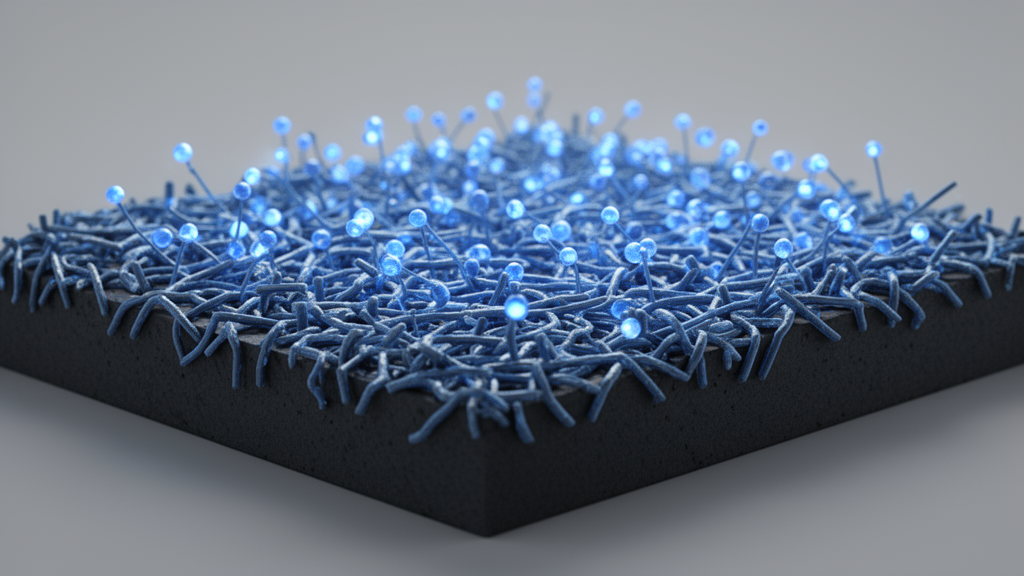
Researchers have synthesized a hierarchical PANI/MnO2 nanocomposite in which the redox-active mediator methylene blue assists stabilization of the material, and they report that electrodes made from it show both high capacitance and exceptional cycling durability. According to the study, published in the journal Ionics, the composite—labeled MB@P/M—was produced by in-situ polymerization and was designed for supercapacitor applications, where long-term electrochemical stability is a persistent challenge.
The team characterized the material with a battery of analytical techniques. UV–Vis spectroscopy indicated direct and indirect band gaps of 2.0 and 1.5 eV respectively, which the authors describe as indicative of good electronic transitions. FTIR and XRD measurements revealed characteristic chemical interactions and a semicrystalline structure, with an average crystallite size of 21.53 nm. FESEM imaging showed the surface morphology and hierarchical architecture of the composite, while XPS was used to determine the surface elemental composition and chemical states.
Porosity and transport properties also came in for detailed scrutiny. BET analysis gave a specific surface area of 17.725 m2 g−1 and an average pore size of 25 nm, features the authors say are beneficial for electrolyte-ion transport and electroactive-site accessibility. AC conductivity and electrochemical impedance spectroscopy studies confirmed, in their words, that good charge-transport properties were obtained.
The electrochemical performance of the MB@P/M electrode was the headline result. The electrode demonstrated specific capacitances of 245 F g−1 at a scan rate of 10 mV s−1 and 335 F g−1 at a current density of 1 A g−1. In terms of device-level metrics, the electrode delivered an energy density of 12 Wh kg−1 and a power density of 250 W kg−1. Most strikingly, it retained 99.3% of its capacitance after 3000 cycles at 3 A g−1, a retention figure that underscores the durability the methylene blue-assisted approach is intended to provide.
The researchers did not stop at the three-electrode level. They assembled a symmetric supercapacitor device from the composite, and that device delivered 145 F g−1 at 1 A g−1, an energy density of 5 Wh kg−1, and 97% capacitance retention after 6000 cycles, with 100% coulombic efficiency. The authors state that the results highlight the potential of MB-assisted PANI/MnO2 for long-term electrochemical power storage.
The reported work uses a redox-active mediator, methylene blue, in the PANI/MnO2 composite, and the reported performance figures—particularly the 99.3% capacitance retention after 3000 cycles at the electrode level and 97% retention after 6000 cycles at the device level—are presented as support for the durability of this approach. The characterization data, from the nanometre-scale crystallite size to the measured pore dimensions, are presented as the structural basis for the observed ion-transport and charge-transport behaviour. As with any laboratory-scale electrode study, the reported capacitances, energy and power densities, and cycling figures are measurements from the described test conditions rather than guarantees of commercial device performance, but the authors present them as support for the potential of this methylene blue-assisted composite in long-term electrochemical power storage.
Subject of Research: Redox-mediator-assisted PANI/MnO2 nanocomposite electrodes for durable symmetric supercapacitors
Article Title: Methylene blue-assisted redox stabilization of PANI/MnO2 nanocomposite electrodes for highly durable symmetric supercapacitors
Article References: S.P., P. K., Karigar, R. L., H., M., Talvar, Y. A., S.K., P., S.S., S., Bhat, S. S., S.C., G., & K.M., E. (2026). Methylene blue-assisted redox stabilization of PANI/MnO2 nanocomposite electrodes for highly durable symmetric supercapacitors. Ionics. https://doi.org/10.1007/s11581-026-07611-y
Image Credits: AI Generated
DOI: 10.1007/s11581-026-07611-y
Keywords: supercapacitors, PANI, MnO2, methylene blue, nanocomposite, energy density, capacitance retention, cyclic stability, electrode materials, energy storage, Methylene, blue-assisted
News Source: Denise Maddox. (October 27, 2026). Methylene blue helps PANI/MnO2 nanocomposite electrodes keep nearly all their capacitance over thousands of cycles. Scienmag.