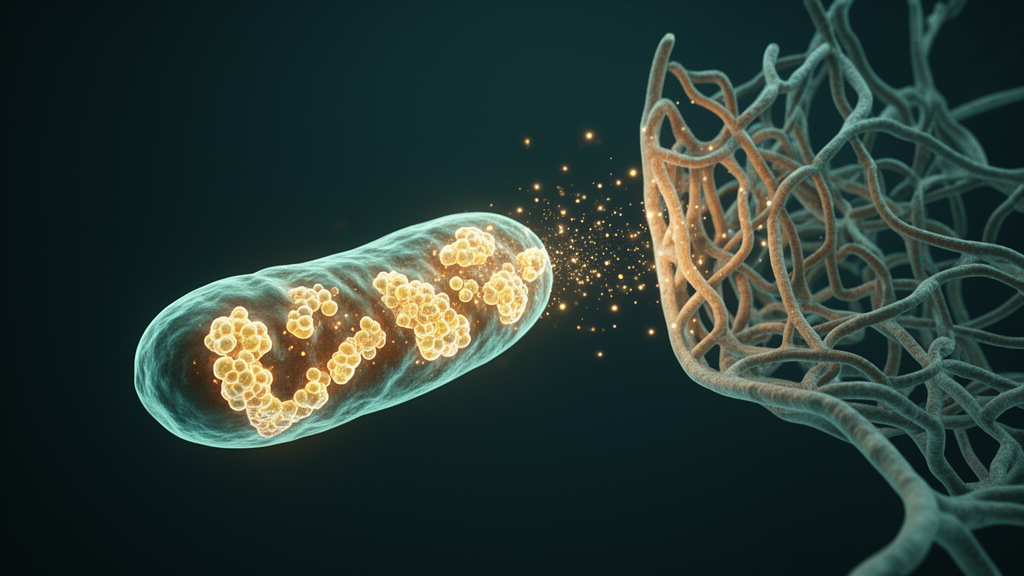
Under proteostatic stress, mitochondria can package damaged proteins into discrete aggregates that act as signalling hubs rather than passive debris. A study published in Nature on 21 October 2026 describes these structures, named stress-induced mitochondrial protein aggregates (SIMPAs), and reports that they coordinate a quality-control response that spans two organelles. According to the authors, SIMPAs form in a spatially confined manner, activating specific quality-control mechanisms locally without perturbing the mitochondrial network as a whole.
Mitochondria are bound by a double membrane and are semiautonomous organelles, features that the researchers note make them highly vulnerable to both global and internal proteostatic stress. Multiple surveillance mechanisms operating at proteostatic and inter-organellar levels are known to help maintain mitochondrial integrity and cellular health, but the precise ways in which proteostatic damage relays stress signals across organelles — and how the quality surveillance machinery coordinates these functions — had remained unknown, the team writes.
To characterize SIMPAs, the researchers combined quantitative proteomics with correlative light–electron microscopy. This analysis indicated that SIMPAs mediate inter-organellar communication through mitochondria–endoplasmic reticulum contact sites, also known as mitochondrial-associated membranes. In other words, the aggregates appear to concentrate at the junctions where the two organelles meet, providing a physical platform for cross-compartment signalling.
Mechanistically, the study identifies the protein GRP75 as a central coordinator. The authors report that GRP75 coordinates SIMPA biogenesis and focally activates endoplasmic reticulum unfolded protein response pathways via the mitochondria–ER contact sites, directing the targeted clearance of SIMPAs. This links a mitochondrial protein-aggregation event to a recognized ER stress-response programme at a defined subcellular location.
Functionally, the team examined the pathway in both cellular models and liver disease models. They report that the GRP75-dependent SIMPA signalling cascade attenuates mitochondrial stress and preserves mitochondrial integrity under proteotoxic stress. In the disease models, the authors further report that enhanced expression of GRP75 alleviates disease pathology by promoting SIMPA clearance, as summarized in the figure describing that experiment.
Taken together, the authors propose that SIMPAs, functioning as protein condensates, serve as a central cross-compartment communication hub for mitochondrial quality control, supporting cellular and organismal fitness. The work was carried out by a large team including Fan Yu, Lingyu Jiang, Jia Xiao and Quan Chen, among many co-authors listed on the paper.
The findings add a spatial dimension to how cells handle damaged mitochondrial proteins: rather than dispersing stress signals throughout the organelle, the cell appears to sequester damage into aggregates that recruit quality-control machinery at specific contact points with the endoplasmic reticulum. As with any study of this scope, the reported mechanisms were characterized in the cellular and liver disease models described, and the authors frame the pathway as one that attenuates mitochondrial stress under proteotoxic conditions rather than as a validated therapeutic intervention.
Subject of Research: Mitochondrial protein aggregates and GRP75-dependent inter-organellar quality control under proteostatic stress
Article Title: GRP75-dependent SIMPA mediates inter-organellar quality control
Article References: Yu, F., Jiang, L., Liu, H., Yang, S., Yuan, Y., Jin, H., Liu, J., Liu, X., Dong, Y., Ren, D., Kang, J., Huang, Y., Meng, Q., Bai, F., Li, Y., Li, S., Liu, H., Zhao, W., Xiao, J., & Chen, Q. (2026). GRP75-dependent SIMPA mediates inter-organellar quality control. Nature. https://doi.org/10.1038/s41586-026-10733-y
Image Credits: AI Generated
DOI: 10.1038/s41586-026-10733-y
Keywords: mitochondria, proteostasis, SIMPAs, GRP75, endoplasmic reticulum, mitochondria-associated membranes, unfolded protein response, quality control, protein aggregates, liver disease models, GRP75-dependent, SIMPA
News Source: Denise Maddox. (October 27, 2026). Stress-triggered mitochondrial protein aggregates relay quality-control signals to the ER. Scienmag.