• HOME
  • NEWS
  • EXPLORE
    • CAREER
      • Companies
      • Jobs
    • EVENTS
    • iGEM
      • News
      • Team
    • PHOTOS
    • VIDEO
    • WIKI
  • BLOG
  • COMMUNITY
    • FACEBOOK
    • INSTAGRAM
    • TWITTER
Tuesday, October 27, 2026
BIOENGINEER.ORG
No Result
View All Result
  • Login
  • HOME
  • NEWS
  • EXPLORE
    • CAREER
      • Companies
      • Jobs
        • Lecturer
        • PhD Studentship
        • Postdoc
        • Research Assistant
    • EVENTS
    • iGEM
      • News
      • Team
    • PHOTOS
    • VIDEO
    • WIKI
  • BLOG
  • COMMUNITY
    • FACEBOOK
    • INSTAGRAM
    • TWITTER
No Result
View All Result
Bioengineer.org
No Result
View All Result
Home NEWS Science News Agriculture

Superior haplotypes offer a new framework for climate-resilient crop breeding

by
October 27, 2026
in Agriculture
Reading Time: 2 mins read
0
Superior haplotypes offer a new framework for climate-resilient crop breeding

Superior haplotypes offer a new framework for climate-resilient crop breeding

Share on FacebookShare on TwitterShare on LinkedinShare on RedditShare on Telegram

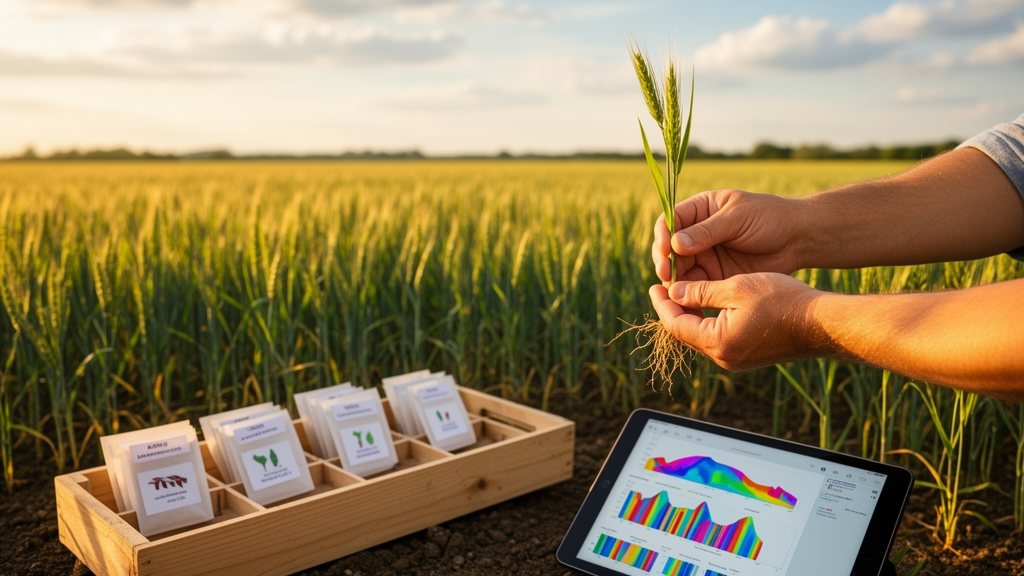
Crop breeders may be overlooking a layer of genetic information that single-letter DNA comparisons cannot capture, according to a review published in Theoretical and Applied Genetics. The authors, led by Nandigam Vinay Kumar and Vikas Kumar Singh, argue that a standardized framework built around superior haplotypes—specific combinations of gene variants inherited together—could resolve genetic architecture that the widely used SNP-based approach misses and guide targeted breeding for climate-resilient crops.

The review responds to mounting pressure on agriculture from two directions at once: climate change and a rapidly rising global population. Both forces, the authors write, are straining limited natural and genetic resources, and meeting future food demand will require accelerating the rate of genetic gain under environmental conditions that are themselves shifting quickly. Large-scale sequencing of diverse crop germplasm has already enabled researchers to map key genes and develop climate-resilient varieties, but the authors identify a persistent bottleneck in how those discoveries are used.

That bottleneck, they argue, lies in the narrow utility of many individually identified genes and their associated haplotypes. Versions of a gene that perform well in one ecology or population often fail to deliver the same benefit elsewhere, which restricts their broader introgression into breeding programmes operating in different environments. Rather than treating each gene variant in isolation, the superior haplotype concept focuses on identifying the allelic combination that confers a desirable trait with stable, consistent and significant performance across diverse genetic panels and environments.

The abstract grounds the concept in concrete examples from two major crops. In rice, the GS3-H1 haplotype is associated with improved grain size and yield potential, while the Sub1A-1 version of the submergence-tolerance gene confers superior flood survival compared with Sub1A-2. In rapeseed, haplotype 1 at two quantitative trait loci, qOCA3 and qOCC6, is associated with higher oil content. These cases illustrate the review’s central premise: that the value of a gene variant depends on the company it keeps, and that screening for whole haplotypes can capture effects that single-marker analyses obscure.

Building on such examples, the review systematically catalogues superior haplotypes identified across major crops, spanning cereals, oilseeds and legumes. It also highlights key research gaps in the field and outlines a roadmap for deploying validated haplotypes in genomic-assisted breeding, with the stated aim of enhancing crop productivity, adaptability and resilience. As a review article, the work synthesizes existing findings rather than reporting new experimental data, and its framework will need to be tested through deployment in actual breeding programmes.

Subject of Research: A review of superior haplotypes as a framework for genomic-assisted breeding of climate-resilient crops

Article Title: Superior haplotypes for transforming crop breeding

Article References: Kumar, N. V., Bogati, A., Singh, U. M., Rajesh, A. P., Srinivas, T., Kohli, A., Kalia, S., Kumar, A., Sinha, P., & Singh, V. K. (2026). Superior haplotypes for transforming crop breeding. Theoretical and Applied Genetics, 139(11), Article 310. https://doi.org/10.1007/s00122-026-05337-z

Image Credits: AI Generated

DOI: 10.1007/s00122-026-05337-z

Keywords: haplotypes, crop breeding, genomic-assisted breeding, climate resilience, rice, rapeseed, grain yield, submergence tolerance, oil content, genetic architecture, SNP, food security

News Source: Alan Morgan. (October 27, 2026). Superior haplotypes offer a new framework for climate-resilient crop breeding. Scienmag.

Tags: climate resiliencecrop breedingfood securitygenetic architecturegenomic-assisted breedinggrain yieldhaplotypesoil contentrapeseedriceSNPsubmergence tolerance
Share12Tweet7Share2ShareShareShare1

Related Posts

North American spring wheat shows weak seedling defense against Ug99 stem rust

North American spring wheat shows weak seedling defense against Ug99 stem rust

October 27, 2026
LoRaWAN Collars Track Grazing Cattle Across Colombian Savannah in Field Trial

LoRaWAN Collars Track Grazing Cattle Across Colombian Savannah in Field Trial

October 27, 2026

Slaughterhouse By-Products Could Feed the Cells Behind Cultivated Meat

October 27, 2026

Research report: Forecast-based virtual sensing and early-warning decision support for canopy-level thermal risk monitoring in tomato greenhouses

October 27, 2026

POPULAR NEWS

  • High-Risk NIPT Results Confirmed in Only Half of 1,326 Pregnancies, Study Finds

    High-Risk NIPT Results Confirmed in Only Half of 1,326 Pregnancies, Study Finds

    29 shares
    Share 12 Tweet 7
  • Stress-triggered mitochondrial protein aggregates relay quality-control signals to the ER

    29 shares
    Share 12 Tweet 7
  • Male and female breast cancer patients in India show distinct clinical and psychosocial profiles

    29 shares
    Share 12 Tweet 7
  • Superior haplotypes offer a new framework for climate-resilient crop breeding

    29 shares
    Share 12 Tweet 7

About

We bring you the latest biotechnology news from best research centers and universities around the world. Check our website.

Follow us

Recent News

High-Risk NIPT Results Confirmed in Only Half of 1,326 Pregnancies, Study Finds

Stress-triggered mitochondrial protein aggregates relay quality-control signals to the ER

Male and female breast cancer patients in India show distinct clinical and psychosocial profiles

Subscribe to Blog via Email

Enter your email address to subscribe to this blog and receive notifications of new posts by email.

Join 85 other subscribers
  • Contact Us

Bioengineer.org © Copyright 2023 All Rights Reserved.

Welcome Back!

Login to your account below

Forgotten Password?

Retrieve your password

Please enter your username or email address to reset your password.

Log In
No Result
View All Result
  • Homepages
    • Home Page 1
    • Home Page 2
  • News
  • National
  • Business
  • Health
  • Lifestyle
  • Science

Bioengineer.org © Copyright 2023 All Rights Reserved.