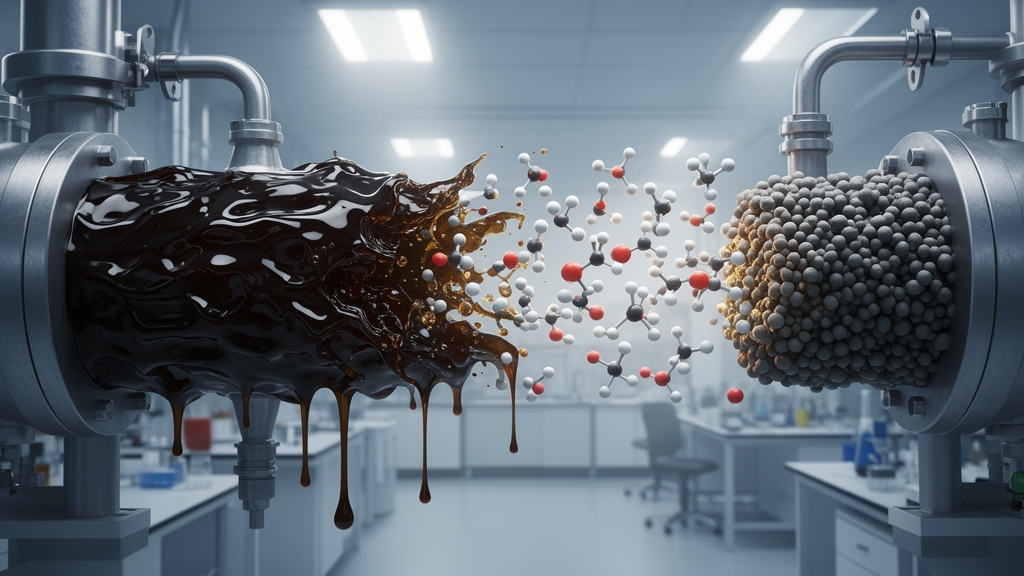
The study, published in Results in Engineering, tackles a persistent gap in renewable liquid fuels: while diesel-range biofuels such as fatty acid methyl ester biodiesel and hydrotreated vegetable oil are mature commercial technologies, the gasoline pool remains dominated by oxygenated bioethanol, whose limited blending ratios, lower volumetric energy density and water-tolerance constraints have left drop-in hydrocarbon gasoline routes comparatively underdeveloped.
The feedstock, called tri-pyrolysis oil, was produced by co-pyrolysis of oil palm fresh fruit bunches, medical-waste polypropylene bottles and used cooking oil sludge in equal proportions in a 120-liter batch reactor under oxygen-limited conditions at about 550 degrees Celsius. This blending strategy matters because conventional bio-oil from lignocellulosic biomass alone typically contains 16 to 40 weight percent oxygen, which lowers heating value, promotes polymerization during storage and gives the liquid a corrosive acidity. The lipid- and plastic-derived components act as hydrogen donors during co-pyrolysis, so the resulting oil is predominantly aliphatic with only 6.17 weight percent oxygen and a calculated lower heating value of about 42 to 43 megajoules per kilogram, comparable to conventional liquid fuels. Yet even this oil retains enough residual oxygen and acidity, with a total acid number of 33.52 milligrams of potassium hydroxide per gram, to require upgrading before use.
The team chose catalytic cracking over high-pressure hydrodeoxygenation, which demands an expensive external hydrogen supply. Their catalyst pellets contained 50 percent calcium oxide, 10 percent magnesium oxide and 40 percent bentonite, a low-cost binder that provides structural integrity and a porous network for heavy-hydrocarbon diffusion. The components were ball-milled, pressed into cylindrical pellets roughly 8 millimeters in diameter and 20 millimeters long, and calcined at 850 degrees Celsius for three hours. X-ray diffraction confirmed that calcination converted hydrated and carbonated precursors into the intended active phases: portlandite reflections disappeared, a lime reflection emerged, and periclase was retained. The calcined catalyst, however, readily re-formed a minor calcite fraction on exposure to atmospheric carbon dioxide even before use, a sign of its high basic reactivity.
The reactor itself was an atmospheric-pressure packed-bed system heated by liquefied petroleum gas infrared burners. Oil was vaporized in a lower chamber and the vapor rose through the catalyst bed in the upper cracking chamber, held at 450 degrees Celsius, before passing to a three-stage condenser. The oil feed rate was fixed at 1.76 kilograms per hour, with 1 kilogram of oil fed per run, and every condition was run in triplicate. Catalyst charges of 1.00, 1.25 and 1.50 kilograms corresponded to weight hourly space velocities of 1.76, 1.41 and 1.18 per hour. Thermocouple measurements showed the cracking bed averaged 456.0 degrees Celsius across all conditions, within 1.3 percent of the set point, so yield differences could be attributed to catalyst loading and feedstock rather than temperature.
The first experimental finding was unambiguous: more catalyst brought no benefit. As the loading increased from 1.0 to 1.5 kilograms, the condensate yield fell from 54.5 to 35.5 and then to 16.5 weight percent, while non-condensable gas rose from 39.5 to 51.5 and then to 68.5 weight percent, and the residual fraction climbed from 6.0 to 15.0 weight percent. A larger catalyst mass provides more active sites and longer vapor-solid contact, promoting secondary cracking of heavier hydrocarbons into light C1 to C4 gas molecules. The gasoline yield on a feed-mass basis collapsed accordingly, from 32.53 weight percent at 1.0 kilograms to 19.95 and then 6.63 weight percent. The authors caution that this experiment varied catalyst mass at constant feed rate, so the effect is confounded with the accompanying decrease in space velocity and increase in bed height, and no catalyst-free inert-bed run was performed to separate purely thermal cracking at 450 degrees Celsius from the catalytic contribution.
The second, more novel experiment addressed a subtlety that most bio-oil upgrading studies ignore: a pyrolysis oil already contains gasoline-range molecules that pass through a cracking bed unchanged, so yield data from whole oil cannot distinguish gasoline produced by cracking from gasoline that was there to begin with. The researchers therefore distilled off the gasoline fraction of the oil, which accounted for 29.67 weight percent of the original, and cracked only the heavier residue, denoted TPO-D, over 1 kilogram of catalyst. Expressed on the basis of the original oil, this cracking step contributed an additional 15.24 weight percent of gasoline-range material. Adding back the undistilled gasoline cut gave an overall gasoline-range yield of 44.91 weight percent of the original oil, up from 29.67 weight percent, at the cost of a lower liquid recovery and the highest residual yield of the program, 21.3 weight percent, with 34.04 weight percent of the original oil converted to gas, coke and pyroligneous acid during cracking.
The quality comparison between the two gasoline streams proved equally revealing. The gasoline cut distilled directly from the oil carried 16.17 weight percent oxygen and only 71.63 weight percent carbon, holding roughly 78 percent of the total oxygen in the oil while representing under 30 percent of its mass, with a calculated higher heating value of just 38.09 megajoules per kilogram. The gasoline produced by cracking the heavy residue contained only 4.95 weight percent oxygen, with carbon and hydrogen at 80.49 and 14.22 weight percent, an atomic hydrogen-to-carbon ratio of 2.11 close to conventional transport fuels, and a calculated higher heating value of 46.63 megajoules per kilogram, 22.4 percent higher. However, because the combined gasoline pool is 66 percent untreated native gasoline by mass, blending the two gives a pool with 12.36 weight percent oxygen and a calculated heating value of 40.99 megajoules per kilogram, so the gain in gasoline quantity does not translate into a matching gain in the quality of the whole pool. The authors also note that the oxygen content of the cracked gasoline actually exceeded that of its reactor feed, 2.72 weight percent, meaning any catalytic deoxygenation could not be isolated because the oxygen balance across the reactor could not be closed.
Gas chromatography confirmed that both cuts were clean gasoline-range distillates, with 99.4 and 98.8 area percent falling in the C5 to C12 range respectively. The directly distilled cut was dominated by a single C9 fraction at 54.9 area percent, whereas the cracked cut showed a markedly broader distribution spread across C11, C9, C12 and C10, the signature of fragmenting heavier chains into a range of shorter molecules. On acidity, the results were striking: simple distillation alone reduced the acid number of the gasoline fraction from 33.52 to 12.04 milligrams of potassium hydroxide per gram, while cracking brought the cut to 1.76 milligrams per gram, an 85 percent reduction, with viscosity falling to 0.83 centistokes, within the range typical of commercial gasoline. The authors attribute the acidity loss to acid removal over the basic solid rather than catalytic deoxygenation: the catalyst charge gained 63 grams, an amount of the same order as the 67 to 102 grams expected from stoichiometric capture of the feed’s 624 millimoles of titratable acid as calcium carboxylate, and the catalyst’s neutralizing capacity of about 17.8 moles far exceeded the acid inventory.
The researchers are careful about the limits of their work. The spent catalyst was not characterized, leaving unresolved whether carboxylate formation, carbonate formation or coke deposition dominates, and therefore whether the solid acts catalytically or is progressively consumed, a question that determines catalyst life at scale. The heating values were calculated from elemental analysis rather than measured calorimetrically, and each sample was analyzed once for those measurements. The vaporization chamber reached a maximum of only 357.6 degrees Celsius against a feed that was 18 weight percent material boiling above the diesel range, so the heaviest components could not fully vaporize, explaining the elevated residual yield and pointing to higher vaporization duty, rather than more catalyst, as the most direct route to improving conversion. Future work should include spent-catalyst X-ray diffraction, surface-area and basicity measurements, and an inert-bed control, alongside upgrading the oxygen-rich native gasoline cut that concentrates most of the feedstock’s oxygen and currently limits the quality of the combined gasoline pool.
Subject of Research: Catalytic cracking of tri-pyrolysis oil over a CaO–MgO/bentonite catalyst to increase gasoline-range yield and reduce acidity
Article Title: Atmospheric-pressure catalytic cracking of tri-pyrolysis oil over a low-cost CaO–MgO/bentonite catalyst: Effects of catalyst loading and feedstock composition on gasoline-range yield and acidity
Article References: Manchit, P., Yongying, N., Sriromreun, P., Tawkaew, S., Wiriyasart, S., & Kaewluan, S. (2026). Atmospheric-pressure catalytic cracking of tri-pyrolysis oil over a low-cost CaO–MgO/bentonite catalyst: Effects of catalyst loading and feedstock composition on gasoline-range yield and acidity. Results in Engineering, 32, Article 113749. https://doi.org/10.1016/j.rineng.2026.113749
Image Credits: AI Generated
DOI: 10.1016/j.rineng.2026.113749
Keywords: catalytic cracking, pyrolysis oil, CaO–MgO/bentonite catalyst, gasoline-range yield, total acid number, co-pyrolysis, atmospheric pressure, packed-bed reactor, bentonite, bio-oil upgrading, renewable fuels, calcium oxide
News Source: Bethany Barker. (October 27, 2026). Cracking Waste-Derived Pyrolysis Oil Into Gasoline With a Low-Cost Catalyst. Scienmag.