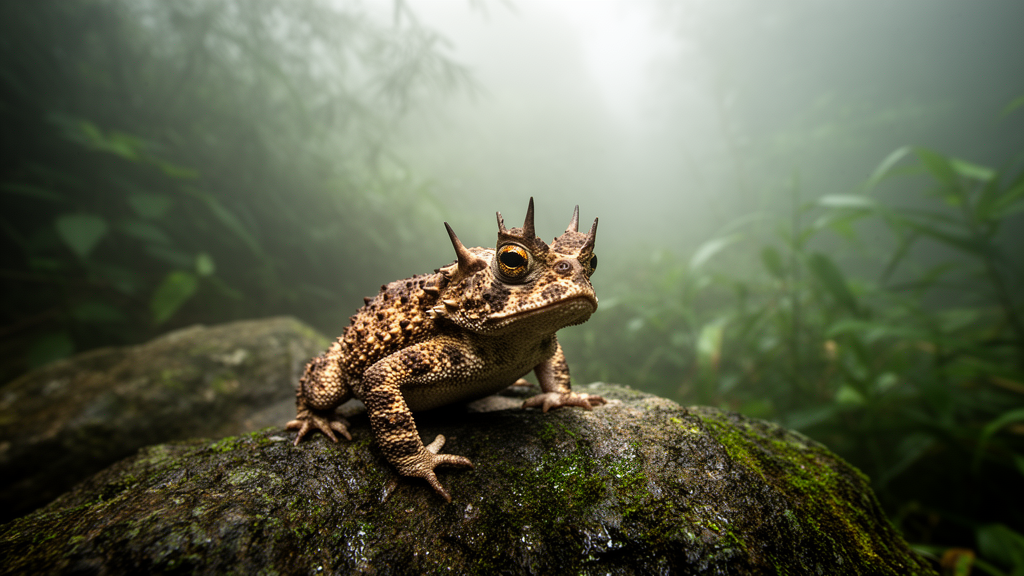
High on the mist-shrouded slopes of Mt. Lushan in northern Jiangxi Province, China, herpetologists have identified a horned toad that is new to science. The species, formally named Boulenophrys nebulosa and given the English vernacular name Yunwu Horned Toad, was described from specimens collected during field surveys conducted on the mountain since 2021. The name nebulosa, the feminine form of the Latin nebulosus, refers to the frequently fog-covered montane forests above 600 meters where the animal lives, and it also nods to the region’s famous Cloud and Fog Tea speciality. The corresponding Chinese name is Yunwu Jiaochan, literally the Cloud and Fog Horned Toad.
The genus Boulenophrys, placed in the subfamily Megophryinae of the family Megophryidae, currently comprises 78 recognized species. Its members are distributed across the Himalayas, northeastern India, southern China, and Southeast Asia. Recent integrative studies have revealed extensive cryptic diversity within the genus, much of which cannot be discerned by morphology alone, and a proposed ten-genus classification of the subfamily affirmed Boulenophrys as its most species-rich lineage. In Jiangxi, known Boulenophrys species had been described primarily from the Luoxiao Mountains along the Hunan border and the Wuyi Mountains along the Fujian border, leaving the northern part of the province, including the topographically isolated granitic massif of Mt. Lushan in the Yangtze River Basin, comparatively little studied.
Two Boulenophrys populations had historically been recorded at Mt. Lushan: B. lushanensis, described in 2025, and another first reported in 2007 and initially identified as Megophrys minor brachykolos, currently B. brachykolos. That species was once thought to be widely distributed across southern China and northern Vietnam, but voucher specimens and molecular data have since restricted B. brachykolos to Hong Kong and Shenzhen. Similar records elsewhere have been re-examined and split into new species, such as B. yaoshanensis from Mt. Dayaoshan in Guangxi and B. hengshanensis from Mt. Hengshan in Hunan. The Mt. Lushan population assigned to B. brachykolos had never been evaluated with genetic or detailed morphological analyses, leaving its identity unresolved until now.
During the surveys, seven adult specimens and one tadpole were collected in April, June, and November 2021. The animals were euthanized with tricaine methanesulfonate, tissue samples were preserved in 95% ethanol and stored at minus 70 degrees Celsius, and whole specimens were fixed in 75% ethanol. All material was deposited in the Animal Museum of the Life Sciences College at Jiangxi Normal University in Nanchang, and the animal protocols were reviewed and approved by the institution’s Animal Ethical and Welfare Committee. Morphological examination showed that the specimens could not be assigned to any known species of the genus. Although they superficially resemble B. mufumontana, they differ in a combination of characters, most notably in the relative lengths of their fingers.
To resolve the taxonomic status, the researchers sequenced two mitochondrial gene fragments, partial 16S ribosomal RNA and partial cytochrome c oxidase subunit I, and performed phylogenetic analyses on a concatenated dataset totaling 1,236 base pairs. Sequences of 78 Boulenophrys species were obtained from GenBank, with three species excluded because data were unavailable, and two Xenophrys species served as outgroups. Maximum likelihood and Bayesian inference produced highly consistent topologies. Samples of the undescribed species formed a strongly supported monophyletic clade in both analyses, with bootstrap support of 100 and a Bayesian posterior probability of 1.0, and this clade was consistently recovered as sister to B. mufumontana, with support values of 97 and 1.0 respectively.
Genetic distances based on uncorrected p-distances reinforced the distinctness of the new lineage. Within the undescribed species, divergence was below 0.6% for COI and below 0.4% for 16S. Between the new species and its closest relative, B. mufumontana, the COI distance was 8.2%, rising to 10.8% with B. caudoprocta, 11.4% with B. boettgeri, and 12.1% with B. liboensis. For the 16S gene, the closest distance was 1.5% with B. boettgeri, followed by 1.7% with B. mufumontana, 2.7% with B. caudoprocta, and 3.2% with B. liboensis.
Morphometric evidence pointed in the same direction. External measurements were taken with a digital caliper to the nearest 0.1 millimeter, log-transformed, and size-adjusted to remove allometric effects of body size before being standardized. Principal component analysis, run on male specimens from the type series of B. mufumontana and the undescribed species, extracted two components explaining 62.30% and 25.92% of the variance, a cumulative 88.23%. In the scatter plot of these components, the undescribed species and B. mufumontana separated without overlapping. Taken together with the phylogenetic results, this evidence supported formal description of the Mt. Lushan population as a distinct species.
Adult males measure 31.8 to 32.3 millimeters in snout-vent length and adult females 35.0 to 37.3 millimeters. The species is diagnosed by a distinctive combination of traits: a well-developed canthus rostralis with a tongue that is not notched posteriorly; a distinct tympanum; weak vomerine ridges with vomerine teeth present; a small, prominent horn-like tubercle on the outer margin of the upper eyelid; relative finger lengths I less than II less than IV less than III with indistinct subarticular tubercles at the base of each finger; heels that just meet when the hindlimbs are folded, with the tibiotarsal articulation reaching the center of the eye when the leg is stretched forward; toes bearing narrow fringes and only rudimentary webbing; rough dorsal skin with V-shaped, X-shaped, or Y-shaped ridges on the central back; and dense nuptial spines on the dorsal bases of the first and second fingers in breeding males, which also possess a subgular vocal sac.
Against its closest relative, B. mufumontana, the new species is distinguished by six characters: the relative finger lengths I less than II less than IV less than III, versus II equal to IV less than I less than III; indistinct rather than distinct subarticular tubercles at the base of each finger; larger male body size, 31.8 to 32.3 millimeters versus 30.1 to 30.8 millimeters; heels that just meet when the hindlimbs are folded, versus heels that overlap; a tibiotarsal articulation reaching the center of the eye when the leg is stretched forward, versus reaching the region between the posterior margin of the tympanum and the center of the eye; and the presence rather than absence of vomerine teeth. Comparisons with the other 77 congeners are tabulated in the study, which also describes a single tadpole, confirmed as B. nebulosa by molecular phylogenetics, at Gosner Stage 29 with a total length of 28.0 millimeters.
The species’ advertisement call was recorded from the holotype on 15 June 2021 at an ambient temperature of 22.3 degrees Celsius and 85% relative humidity. Thirteen call groups were analyzed. Each call averaged 120.3 plus or minus 7.4 milliseconds in duration, with an average inter-call interval of 487.6 plus or minus 48.8 milliseconds, repeated at a mean rate of 2.05 calls per second. Each call consisted of 31.7 plus or minus 2.1 pulses, and the dominant frequency averaged 3.70 plus or minus 0.08 kilohertz. The authors note that the acoustic analysis is based on a limited sample size of a single individual and that broader sampling across individuals and environments would better characterize call variation. B. nebulosa is currently known only from its type locality, where it occurs at elevations of 600 to 1,200 meters in mixed coniferous and broadleaved forests, typically on the forest floor or under leaf litter near montane streams and along moist roadside drainage channels. Calling males were observed from May to July beneath accumulations of coniferous leaf litter, while females were occasionally seen in drainage ditches lacking flowing water, and tadpoles are observed throughout the year, coexisting with the tadpoles of Quasipaa spinosa and B. lushanensis in some aquatic habitats. The description brings the total number of Boulenophrys species recorded in Jiangxi to 15, and the authors suggest that the geographic isolation of Mt. Lushan, surrounded by the Yangtze River, Poyang Lake water systems, and broad plains, limits gene flow between the mountain’s amphibians and outside populations, potentially driving rapid lineage divergence within the genus.
Subject of Research: Description of a new horned toad species, Boulenophrys nebulosa, from Mt. Lushan, China, based on genetic and morphological evidence.
Article Title: A new species of Boulenophrys ( Anura , Megophryidae ) from northern Jiangxi, China
Article References: Shen, D., Zhou, H., Wang, C., Xu, J., Xu, S., Zhong, Y., Wang, Z., Cai, H., Wu, Y., Wei, M., & Li, Y. (2025). A new species of Boulenophrys (Anura, Megophryidae) from northern Jiangxi, China. Zoosystematics and Evolution, 101(4), 2251-2266. https://doi.org/10.3897/zse.101.166556
Image Credits: AI Generated
Keywords: Boulenophrys nebulosa, horned toad, Megophryidae, Mt. Lushan, Jiangxi, new species, mitochondrial DNA, phylogenetics, taxonomy, amphibian, China, herpetology
News Source: Drew Townsend. (October 27, 2026). Misty Mountain Yields New Horned Toad Species in Northern Jiangxi. Scienmag.