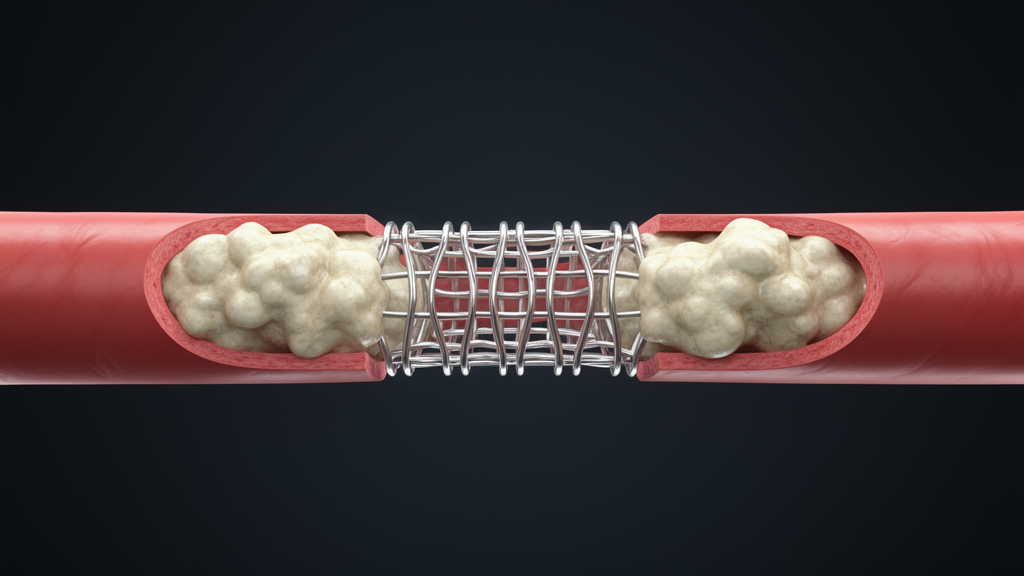
Cardiologists have long assumed that the harder they work to grind, fracture, or vaporise calcium inside coronary arteries, the better their patients will fare. A new review argues that this assumption is increasingly difficult to defend. Writing in Frontiers in Cardiovascular Medicine, a team of United Kingdom-based interventional cardiologists synthesises the randomised evidence on treating coronary artery calcification during percutaneous coronary intervention, and concludes that the field has moved decisively away from routine aggressive debulking toward an individualised, imaging-guided strategy in which the goal is sufficient modification rather than maximal removal.
Coronary artery calcification becomes more common as populations age and as chronic kidney disease, diabetes, smoking, dyslipidaemia, and hypertension accumulate. Severe calcification makes balloon and stent delivery difficult, prevents full stent expansion, and is an independent predictor of target lesion failure, stent thrombosis, and restenosis. Under-prepared calcified plaque predisposes to stent under-expansion and mal-apposition, yet over-aggressive debulking carries its own risks of dissection, perforation, and no-reflow. The review’s central theme is that more aggressive calcium modification does not automatically translate into better clinical outcomes, a point several contemporary randomised trials have now demonstrated.
The pivotal challenge to routine debulking comes from the ECLIPSE trial, which randomised 2,005 patients at 104 United States centres to orbital atherectomy versus conventional balloon angioplasty before drug-eluting stent implantation. The primary clinical endpoint, target vessel failure at one year, occurred in 11.5 percent of the orbital atherectomy group versus 10.0 percent of the balloon group, and the primary imaging endpoint, mean post-procedure minimal stent area at the site of maximum calcification, was 7.67 versus 7.42 square millimetres, with neither difference reaching significance. Coronary perforation occurred in 1.8 percent versus 1.0 percent, and cardiac deaths were significantly higher after orbital atherectomy at 30 days, 0.8 percent versus 0.0 percent, several being device related. The trial concluded that routine orbital atherectomy did not improve stent expansion or reduce target vessel failure and should be individualised rather than applied routinely. The authors note these neutral findings apply primarily to severely calcified lesions considered suitable for both strategies and should not be generalised to uncrossable or undilatable lesions.
Rotational atherectomy, the oldest dedicated calcium-modification technology, uses a diamond-coated elliptical burr rotating at 135,000 to 180,000 rpm to ablate inelastic calcified tissue by differential cutting. Its limitations include guidewire bias, slow flow or no-reflow from microparticulate embolisation, burr entrapment, dissection, perforation, and a demanding learning curve. The ROTAXUS trial of 2013 found that rotational atherectomy improved acute lumen gain and reduced strategy crossover but did not improve nine-month angiographic or clinical outcomes. The PREPARE-CALC trial of 2018 compared upfront rotational atherectomy with a cutting or scoring balloon strategy and found similar late-loss and major adverse cardiac event outcomes. A pooled analysis of 440 patients from both trials found more crossover from the balloon-only arm, 14.1 versus 2.3 percent, and higher procedural success with atherectomy, but no difference in late lumen loss or major adverse events at nine months.
Intravascular lithotripsy has emerged as a widely adopted alternative, delivering pulsatile acoustic pressure waves through emitters in a semi-compliant balloon to fracture calcium while sparing soft tissue. The pooled Disrupt CAD I-IV programme, spanning 628 patients at 72 sites in 12 countries, achieved its safety and effectiveness endpoints in 92.7 and 92.4 percent of patients respectively, with no lithotripsy-associated perforations, abrupt closures, or no-reflow events. Head-to-head data have been reassuring: the ROTA.shock trial randomised 70 patients and found optical coherence tomography-assessed minimal stent area numerically lower but statistically non-inferior after lithotripsy, 6.10 versus 6.60 square millimetres, and the ICARE OFDI trial of 169 patients found lithotripsy non-inferior to rotational atherectomy for minimal stent area, 6.0 versus 5.9 square millimetres, with identical rates of adequate stent expansion and significantly less major stent strut mal-apposition after lithotripsy.
Perhaps the most striking recent development concerns specialty balloons, long considered inferior to dedicated devices. The Short-CUT trial, presented at TCT 2025, randomised 413 patients with moderate-to-severely calcified de novo coronary lesions across 21 United States sites to cutting balloon versus intravascular lithotripsy, and found the cutting balloon non-inferior for post-procedural minimal stent area, 8.0 versus 8.6 square millimetres, with no significant differences in stent expansion, calcium fracture rates, procedural success, adverse events, or 30-day outcomes, while saving approximately 3,600 dollars per case. The parallel VICTORY trial found the OPN ultra-high-pressure balloon non-inferior to lithotripsy for final stent expansion. The review cautions, however, that these conference-presented results rest primarily on mechanistic imaging endpoints and should not be interpreted as proof of equivalent long-term clinical safety or efficacy.
Direct three-way comparisons are also reshaping the field. ROLLER COASTR-EPIC22, the first randomised trial to compare rotational atherectomy, intravascular lithotripsy, and excimer laser coronary atherectomy in the same population, enrolled 171 patients across eight Spanish centres and found similar procedural success and final minimal stent area across the three arms, 5.5, 5.4, and 5.1 square millimetres respectively, with no significant differences in one-year major adverse cardiac events. Lithotripsy was non-inferior to rotational atherectomy for stent expansion, while laser did not meet that threshold, and complications were numerically lower with lithotripsy. The authors conclude that these technologies are complementary rather than hierarchically ranked, and that no single technology is adequate for every lesion morphology.
Accurate assessment of calcium underpins this individualised approach. Two-dimensional angiography underestimates calcification, so intravascular ultrasound and optical coherence tomography are used at three stages: pre-procedural characterisation, intra-procedural device selection, and post-procedural confirmation of stent expansion. Optical coherence tomography offers far higher axial resolution, roughly 10 to 15 micrometres versus 100 to 150 for ultrasound, and directly measures calcium arc, thickness, and length, while ultrasound offers deeper penetration up to 10 millimetres. Computed tomography coronary angiography is emerging as a non-invasive planning tool, with lesion-specific calcium scores predicting the need for rotational atherectomy and stent under-expansion, and the planned OPTIMAL trial will test whether CT-based characterisation can guide modification strategy. Notably, in the ECLIPSE imaging sub-study, intravascular imaging-guided procedures were associated with lower one-year target vessel failure than angiographic guidance, 9.3 versus 13.2 percent, independent of lesion-preparation strategy, suggesting that imaging guidance may matter as much as the mode of modification.
The 2021 ACC/AHA/SCAI and 2024 ESC guidelines both recognise dedicated calcium-modification technologies as reasonable adjuncts for severely calcified lesions not adequately prepared by conventional balloons, while favouring a provisional, lesion-specific approach guided by intravascular imaging rather than routine debulking. The review’s authors propose a practical framework: crossable, adequately dilatable lesions may often be treated with conventional or specialty balloons; deep, circumferential, or long-segment calcium may require lithotripsy or atherectomy; and atherectomy or laser retain defined niches for uncrossable or undilatable lesions, with calcified nodules often needing sequential combination strategies. In high-risk patients, avoiding prolonged instrumentation, embolisation, slow flow, and perforation becomes especially important.
The authors are candid about the evidence base’s limitations. Randomised comparisons between atherectomy modalities and lithotripsy enrolled only 70 to 171 patients, most trials are industry-sponsored to varying extents, and most enrolled predominantly stable, elective patients in experienced centres, leaving patients with acute coronary syndromes, advanced kidney disease, calcified nodules, and uncrossable lesions underrepresented. Many studies are powered for imaging surrogates rather than hard clinical endpoints, and a larger minimal stent area does not automatically establish improved long-term outcomes. The field, they argue, has moved from an era in which more aggressive debulking was assumed to be better to one shaped by neutral or cautionary randomised data, in which non-inferiority for an imaging endpoint should never be mistaken for proof of equivalent long-term safety or efficacy, and larger trials with long-term clinical endpoints are urgently needed.
Subject of Research: Calcium modification strategies during percutaneous coronary intervention for calcified coronary lesions
Article Title: Balancing innovation and safety in percutaneous treatment of coronary artery calcification
Article References: Helal, A., Ladwiniec, A., Mozid, A., Malik, I., Ruparelia, N., Farooq, M., Cader, F. A., Ehtisham, J., Raju, P., Shaukat, N., Shah, B., Viswanathan, G., & Prendergast, B. (2026). Balancing innovation and safety in percutaneous treatment of coronary artery calcification. Frontiers in Cardiovascular Medicine, 13, 1964987. https://doi.org/10.3389/fcvm.2026.1964987
Image Credits: AI Generated
DOI: 10.3389/fcvm.2026.1964987
Keywords: coronary artery calcification, percutaneous coronary intervention, intravascular lithotripsy, rotational atherectomy, orbital atherectomy, excimer laser atherectomy, cutting balloon, intravascular ultrasound, optical coherence tomography, stent under-expansion, ECLIPSE trial, imaging-guided PCI
News Source: Ophelia Keating. (October 27, 2026). More Aggressive Calcium Clearing May Not Improve Heart Stent Outcomes. Scienmag.